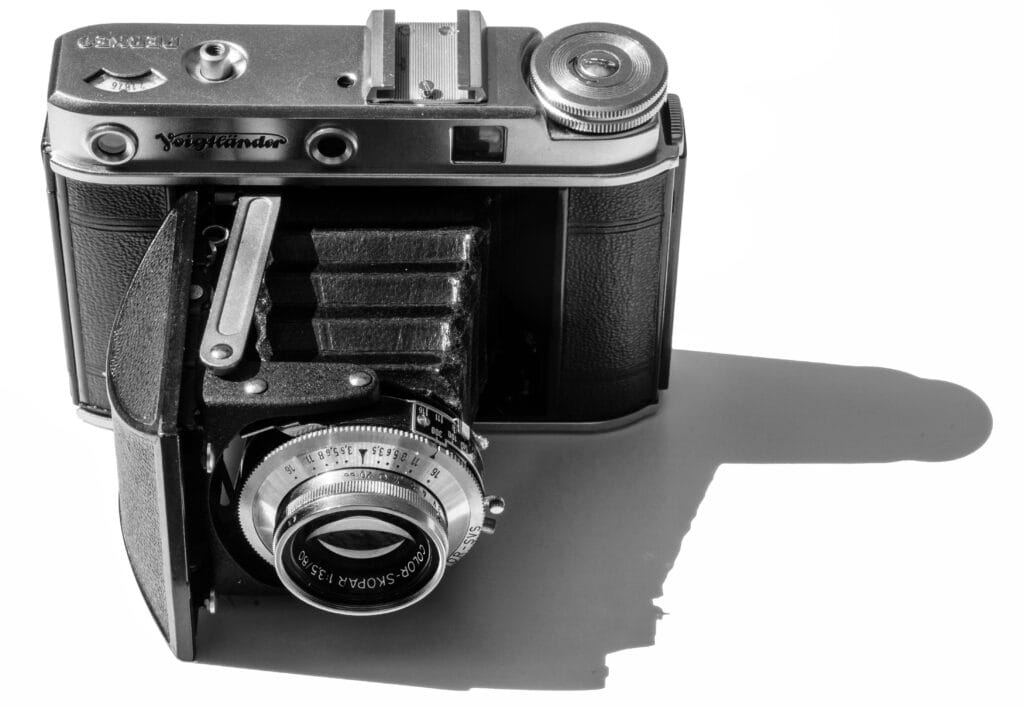
If you want to take a medium format camera somewhere where size and weight matter, in my case, the Goodwin Sands, the Voigtländer Perkeo is ideal. It is among the smallest, lightest 6×6 folders ever built. With this camera, Voigtländer managed to miniaturise roll-film photography without miniaturising the negative. As a result, compared to most other medium-format cameras, it is extremely light and compact. Equipped with its best lens option, the Color-Skopar 80mm f/3.5, and fitted with one of the faster leaf shutters, the Perkeo is a practical proposition and perfectly capable of taking excellent pictures with plenty of detail.
Origins
The name Perkeo first appeared on a compact magazine camera called the Perkeo N°140, produced by Rudolf Krügener, a chemist, in the late 19th century. He had experience in developing small cameras, as one of his models was Dr Krügener’s pocketbook camera, one of the smallest cameras of its time at 45×100×140mm.
Voigtländer’s first Perkeos were a range of small 3×4 cm self-erecting folders for 127 film in the early 1930s. The company resurrected the name for a series of 120-film 6×6 folders in 1950.
Perkeo = Small
The name Perkeo is associated with diminutive proportions. It is most often associated with the nickname of Clemens Pankert (AKA Giovanni Clementi), who lived from 1702 to 1735. He served as court jester and wine steward at Heidelberg Castle, and was a man of short stature. The nickname was apparently derived from his response perché no? (“why not?”) when offered more wine, which he seldom declined. He was celebrated for his prodigious wine consumption despite his small figure, and became a local legend. Ironically, he was in charge of the largest wine barrel in the world, the massive Heidelberg Tun. Perkeo is not German for dwarf, as is frequently suggested. I have also seen it attributed to the Pygmy Batis (Batis perkeo), which is not a bat, but a tiny bird from the savannahs of north-eastern Africa. Whatever the origin, we can be sure it is intended to convey smallness.
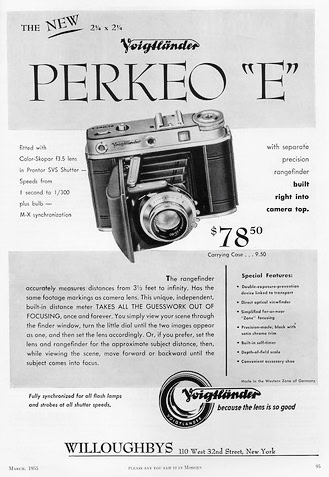
The post-war Perkeo cameras are the subject of this article. I own a Perkeo I, II and the uncoupled rangefinder model, known variously as the E, III or IIIE. I’ve also seen IIIe. The Perkeos are compact vertical folders made by Voigtländer of Braunschweig in the early to mid 1950s, taking 6×6 cm exposures on 120 film. All models use a small reverse-Galilean telescopic finder in a metal top housing with a cold shoe.
Dimensions and Weight
Measurements depend on whether controls are included, but the ranges in the table below are a fairly safe bet.
| Model | Width | Height | Depth, folded |
| Perkeo I | 125–127 mm | 85–89 mm | 40–43 mm |
| Perkeo II | 125–127 mm | 85–89 mm | 40–43 mm |
| Perkeo E | 125–128 mm | 91–96 mm | 42–48 mm |
Weights vary by lens and shutter, with the light end of the spectrum being a triplet Vaskar with a Pronto shutter. At the other end is a four-element Color-Skopar with a Prontor-SVS shutter with a rangefinder housing on top. The spread across the range is 480-560 grams.
Alternatives
Zeiss Ikon’s Super Ikonta and Balda’s Super Baldax are probably the closest lightweight alternatives, though both 6×6 folders offer a coupled rangefinder. The 6×6 Super Ikonta weighs around 660 grams and measures about 138 × 103 × 43 mm folded; the Super Baldax is a little heavier at 700 grams and 135 × 101 × 47 mm.
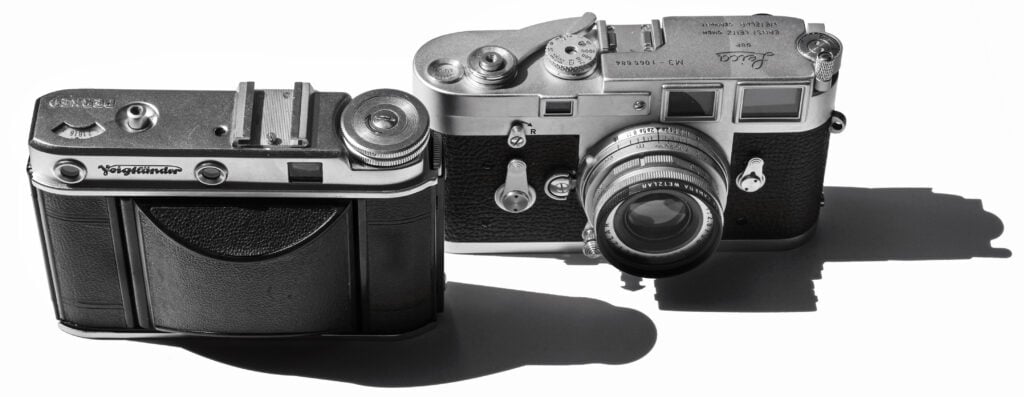
The Perkeo I, II and E (III) models
The design appears to descend from the Bessa 66 of 1938. Despite the light weight, the cameras feel very solid in the hand. The sources for the many lens and shutter options available for three models occasionally contradict each other, but I have done my best to get these as accurate as I can.
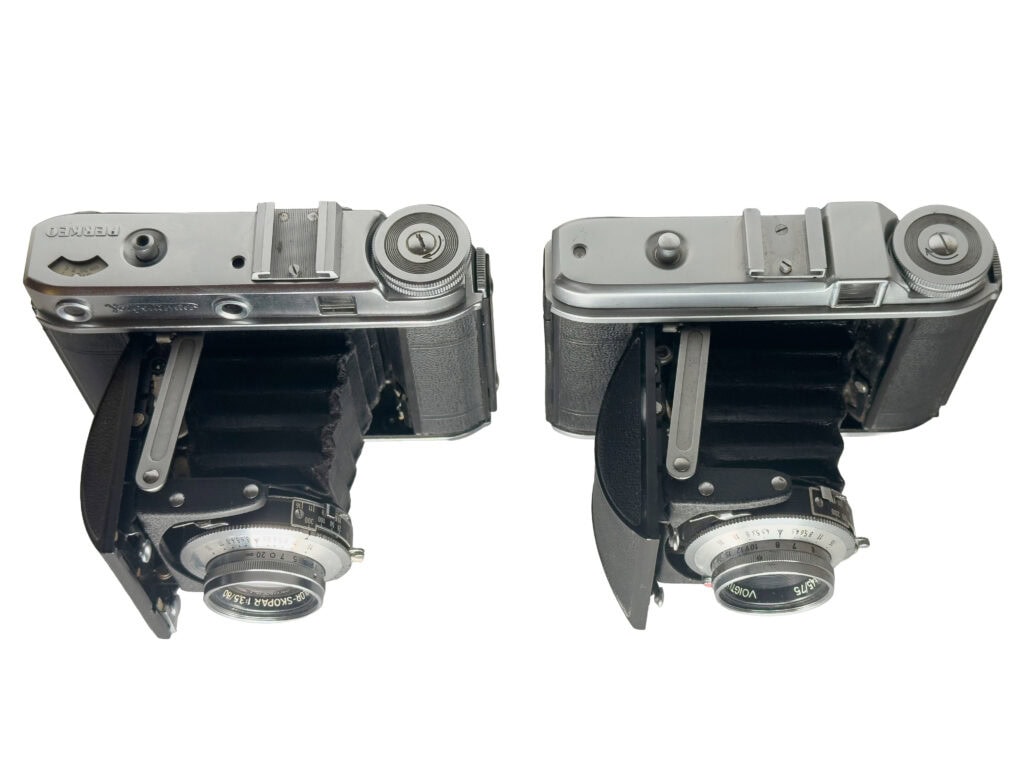
Perkeo I. This is the simplest model. It provides a finder, scale focusing, and double-exposure prevention interlock (except for the early models). The film is advanced manually with the winding knob and observing the numbers through the red window on the back of the camera. Lens options were the Vaskar 75mm f/4.5, the Vaskar 80mm f/4.5, or the faster Color-Skopar 80mm f/3.5.
The Perkeo I was offered with a wide range of shutter combinations, including the Vario, Pronto, Prontor-S, Prontor-SV, Prontor-SVS and Synchro-Compur. Compur-Rapid examples are also reported, particularly with the Color-Skopar, although whether this was a regular factory option is not clear.
Perkeo II. Adds an automatic frame counter and wind stop. The red window is needed only to set frame one; after that, the winding knob stops itself at each frame. The film passes over a measuring roller beside the film gate, whose rotation determines the film movement. Once frame 1 has been established through the red window and the automatic system is engaged, the counter and wind stop take over. Although this sounds simple, the camera is more complex than the other two models.
This arrangement produces tight, consistent spacing, which is why a Perkeo II may yield an additional thirteenth frame on a modern roll of film. The Perkeo II was normally fitted with the Color-Skopar 80mm f/3.5. Documented shutters include the Prontor-S, Prontor-SV, Prontor-SVS, Compur-Rapid and Synchro-Compur.
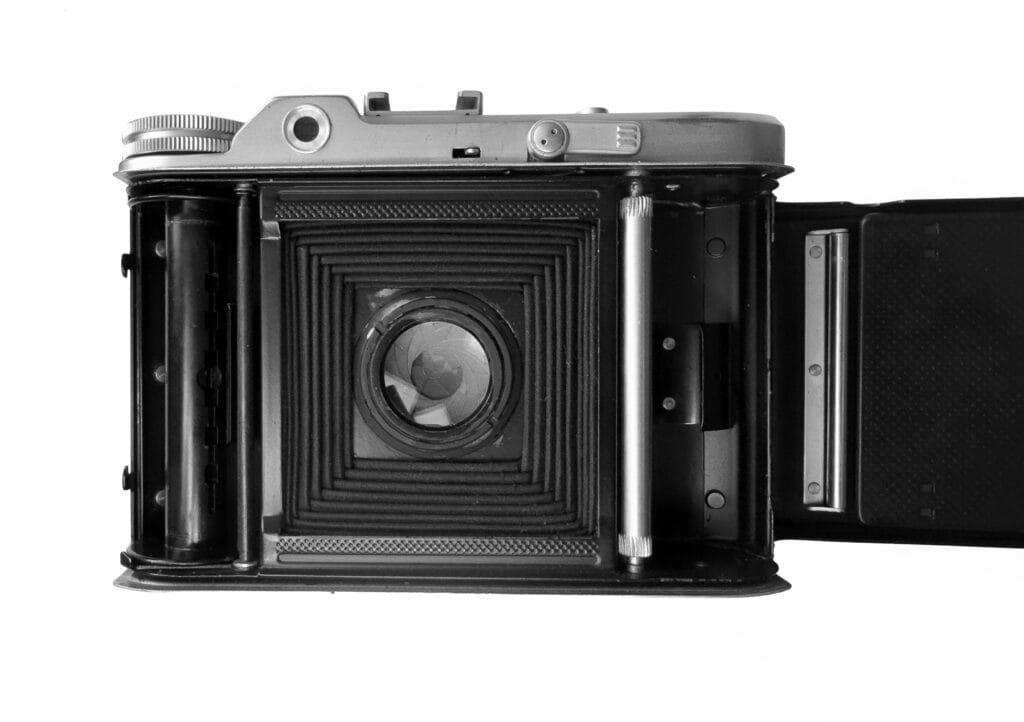
Perkeo E (AKA III and IIIE): This is the final, less common variant, which adds an uncoupled rangefinder in the top housing and moves the Voigtländer name to the front of the body. To my eyes, this is the best-looking design. Once the rangefinder patch is aligned, you read the range from the top scale and then transfer it to the focusing scale.
With the rangefinder fitted, there wasn’t enough space for the automatic counter in the E, so you need to wind on using the red window. However, although the Perkeo E returned to the Perkeo I’s red-window film advance, Voigtländer did not simply reuse its film chamber. Instead, the loading arrangement featured swing-out spool carriers on both sides and guide rollers at both ends of the film gate. This was an upgrade on the Perkeo I, which featured a single roller and swing-out spool carrier on the take-up side.
The Perkeo E was offered with either the three-element Vaskar 80mm f/4.5 or the superior four-element Color-Skopar 80mm f/3.5. Documented shutters include the Pronto, Prontor-S and Prontor-SVS; the latter, with a top speed of 1/300 second, is commonly found paired with the Color-Skopar.
Feature Comparison
| Feature | Early Perkeo I | Later Perkeo I | Perkeo II | Perkeo E |
| Double-exposure prevention | No | Yes | Yes | Yes |
| Red-window film advance | Yes | Yes | First frame only | Yes |
| Automatic frame counter | No | No | Yes | No |
| Automatic film advance stop | No | No | Yes | No |
| Film-loading assistance | Swing-out take-up spool carrier | Swing-out take-up spool carrier | Swing-out take-up spool carrier | Swing-out carriers for both spools |
| Film transport / guidance | Single roller | Single roller | Toothed measuring roller for automatic frame spacing | Guide rollers on both sides of film gate |
| Uncoupled rangefinder | No | No | No | Yes |
A comparison of the Perkeo models
The majority of the differences between the Perkeo I, II and E are on the top plate of the cameras and inside the body.
The Perkeo I has an uninscribed top plate with a single viewfinder window. The shutter release button does not have a screw fitting for a cable release and the small top plate window showing an arrow (the double exposure prevention indicator) is on the far right of the top plate. On the Perkeo I Voigtländer calls this a “Checkwindow for Exposure lock”. The Perkeo I has the make and model inscribed in the leatherette on the rear of the camera.
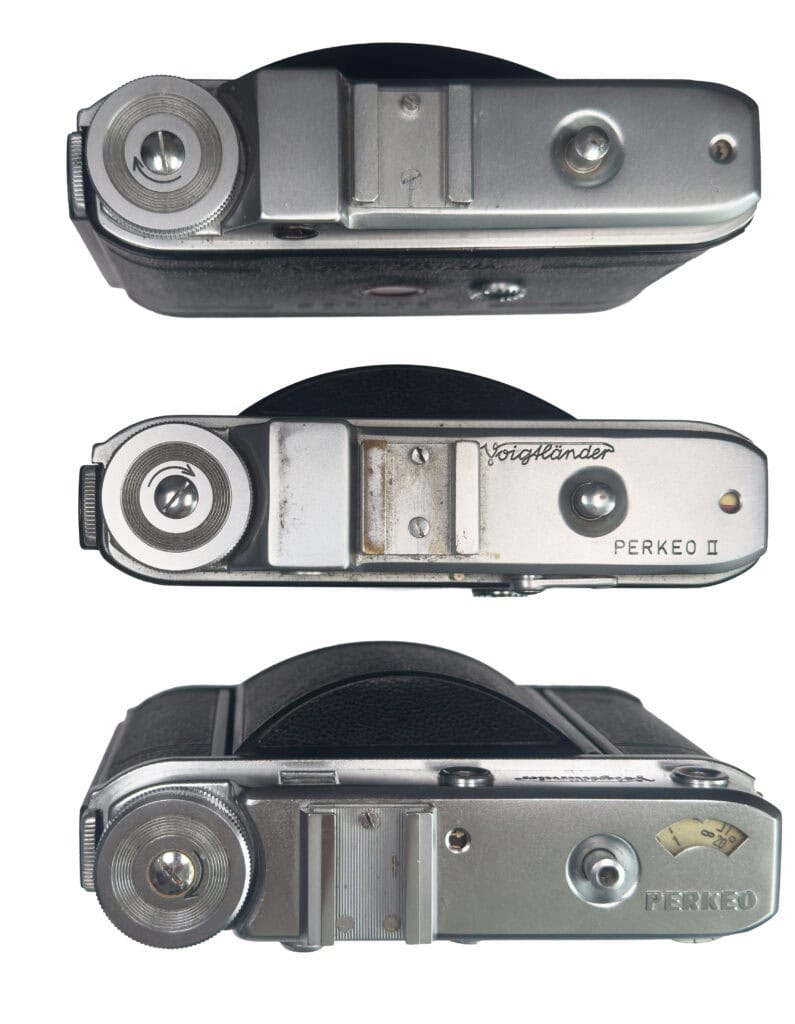
The Perkeo II has ‘Voigtländer’ and ‘Perkeo II’ inscribed on the top plate near the shutter release button. There is a lever on the rear of the Perkeo II’s top plate which is used to engage or disengage the Perkeo II’s automatic frame-counting and film-stop mechanism. Voigtländer calls it the “locking lever”. The frame counter is on the top plate, on the far right of the camera.
The E model has the additional rangefinder windows with ‘Voigtländer’ inscribed between them and ‘PERKEO’ in raised text near the shutter release button, which will take a cable release. On the E the small window that displays an arrow is a “Signal window for double exposure lock”. This indicates to the photographer whether exposure or winding is required.
All models have ‘GERMANY’ inscribed vertically on the right-hand side of the leatherette at the back. The bottom plate and camera opening button mechanisms appear identical.
There are some less obvious differences inside the cameras. The Perkeo I has a conventional fixed chamber for the fresh roll, while only the take-up spool is carried in a swing-out holder to make loading easier; it also uses a single guide roller on the take-up side of the film gate. The Perkeo II has a roller each side of the gate and another next to the film flatness plate. The roller on the supply side is fluted top and bottom. In the later Perkeo E, both spool holders swing out for loading, and there are two guide rollers, one on each side of the film gate.
The complexity of the Perkeo II interlock
The contrast between the mechanisms of the Perkeo I and E and the more complex Perkeo II is strongest when operating the shutters of all three without film. Testing the Perkeo I and E like this couldn’t be simpler. Open the camera front, set the shutter speed and aperture, cock the shutter and fire it. Turn the wind knob until it clicks and repeat.
The Perkeo II is less straightforward and, when I first bought mine, I struggled to get the sequence right. This is because its film transport incorporates the more elaborate frame-counting and double-exposure interlock, operated by the fluted roller inside the camera.
To test the camera, first move the rear locking lever to the left and turn the fluted metering roller until the mechanism stops and the frame counter reaches frame 1. Set the shutter to a moderate speed such as 1/50, cock it manually and press the top-plate release. After firing, turn the metering roller again to simulate advancing the film to the next frame; this resets the interlock and allows the shutter to be released again.
Loading and shooting with the camera is considerably simpler!
Dating the Perkeo models
The best dates I can find for the range are 1951 to 1955 for the Perkeo I, 1952 to 1955 for the Perkeo II, and 1955 to 1957 for the Perkeo E. No factory production records survive, so all dates come from catalogues and price lists. The bodies don’t carry a serial number, though the shutter and lenses do. The serial number on my Perkeo E is on the outer edge of the lens. As far as I can tell, the lens was made in 1954 for a camera introduced in 1955. My Perkeo I’s Vaskar was made in 1951.
The rise and fall of the 6×6 Folder
The square 6×6 became popular in the mid-1930s. It was simpler to use, since there was no distinction between landscape and portrait orientation, and it suited contact printing and small enlargers. However, by the late 1950s the 6×6 folder’s day was over. Coated lenses and improved emulsions had made 35mm negatives ‘good enough’ and folders were costly to build. Professionals and serious amateurs moved to twin lens reflexes and the Hasselblad 500C, and the rest of the market moved to 35mm. The Perkeo E was one of the last generation of folders and arrived just as the market had moved on.
The Lenses
My Perkeo E and Perkeo II both have the Color (spelled thus) Skopar lens. Skopar was Voigtländer’s name for their four-element Tessar-type lens. Color refers to the lens coating, which was considered better for colour photography. It is a quality, sharp lens, with just a bit of softness in the corners wide open.
My Perkeo I has the Vaskar f/4.5 75mm lens. This is a coated three-element Cooke-type triplet, which was the basic lens offering in the range and about 41mm equivalent on a 35mm camera. It is by no means a bad lens, but definitely benefits from stopping down to f/8.
Opening and Closing
Open the front door by pressing a small button on the base of the camera. Next, pull the door open until it gives a loud, positive click after it erects the lens. To close the door, depress the two buttons on the inside of the door at the front. If you need it, there is a small stand at the base of the door, marked with a red arrow.
Loading the Perkeo E and I
These are for the E, which has the most advanced loading functions, but the procedure is very similar for the I, except that their is only one hinged cradle.
Open the back by depressing the two buttons on the left (wind) side of the camera and pulling out the film advance knob, then swing the hinged cradle on the right-hand side (lens away from you) out.
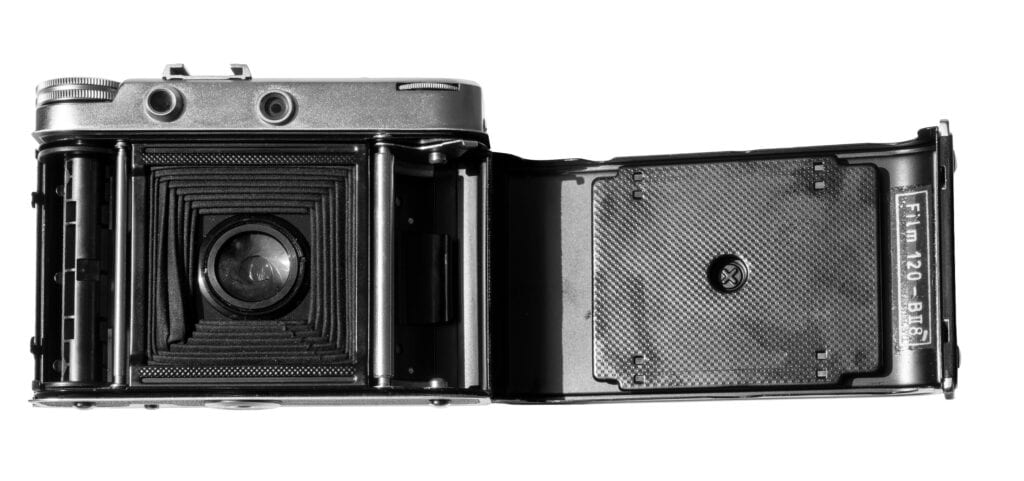
Move the empty take-up spool, usually in the camera, into the cradle on the wind side, and put the fresh roll into the opposite chamber. Pull the paper leader across the film gate and slot its tip into the take-up spool, then turn the knob a couple of times until the paper is straight and taut.
Swing the cradle back in and close the back until it latches. Lastly, open the red window cover and wind steadily, watching for the warning dots and then the figure 1. Stop the moment it sits centred in the window.
Unloading the I and E
After taking the 12th exposure, continue turning the film-wind knob to wind the remaining film and backing paper completely onto the take-up spool. Continue winding until the backing paper has passed completely through the red window and onto the take-up spool. Then open the camera back, remove the exposed roll, keep it tightly wound and secure it with the adhesive tab.
Loading the Perkeo II
Before opening the camera, move the rear locking lever to the right. In this position the automatic frame counter and film-stop mechanism are disengaged, so the film can wind freely during loading.
Open the camera back and load as for the E and I above. The Perkeo II uses a spring clip on the supply side: push the fresh 120 roll under it, draw the backing paper across the film gate and make sure it is correctly positioned against the film-metering roller before securing the leader in the take-up spool. Wind sufficiently to ensure that the paper is running straight and securely onto the take-up spool, then close the camera back.
Open the red-window cover and slowly turn the film-wind knob. Watch for the backing-paper markings; you will see warning circles before the number. Stop when the number 1 for the 6×6 track is centred in the window. Wind slowly as you approach it, as there is nothing to prevent you overshooting while the locking lever is to the right.
Close the red-window cover and move the rear locking lever to the left, towards the film-wind knob. This engages the automatic frame-counting and film-stop mechanism, and the top-plate frame counter should now indicate 1.
Once the camera is loaded, do not move the rear locking lever again during the roll, as doing so will reset the counting mechanism. After each exposure, turn the film-wind knob until it reaches its automatic stop; from this point onwards the metering mechanism, rather than the red window, determines the position of each frame.
Underloading the Perkeo II
After taking the 12th exposure, turn the film-wind knob again until the frame counter reaches the red indication. If the film will not advance from 12, make sure the shutter has been cocked and the top-plate release has been operated fully, as the body interlock must complete its cycle before the transport is released.
Once the counter shows red, move the rear locking lever to the right to disengage the automatic film stop, then continue winding until all the backing paper has passed onto the take-up spool. Then open the camera back, remove the exposed roll, keep it tightly wound and secure it with the adhesive tab.
Setting the exposure
With no built-in light meter, you’ll need to use a handheld meter, a phone app, or the Sunny 16 rule, after which you can set the exposure on the shutter housing at the front of the camera. The speed ring runs round the barrel, giving you one second to 1/300 plus B on my E’s Prontor-SVS, and one second to 1/500 on the Perkeo II’s Syncho-Compur. The aperture has its own small lever near the bellows, running f/3.5 to f/16 on those models and you read it against the scale on the lens barrel.
There is a third ring on the camera on the SVS, which is a synchro switch for flash:
- M for M-type flashbulbs, which you can use at speeds between 1/50 and 1/300.
- X for electronic flash at any speed, and for bulbs at 1/25 or slower.
- V for the self-timer, which also works with electronic flash up to 1/300 and bulbs up to 1/25. Its synchronisation matches X.
I’ve never used flash with the camera and leave the ring on X. If needed, a flash plugs into the PC socket on the shutter barrel.
Focusing
The Perkeo I and Perkeo II are both scale-focusing cameras. To focus, you estimate or measure the distance to the subject and rotate the front focusing ring until that distance is opposite the index mark on the lens. Both cameras also provide zone-focus markings, intended to make rapid shooting easier: at f/8, presetting the lens to the appropriate mark gives sufficient depth of field for groups or more distant subjects without having to judge the distance precisely. For more critical work, particularly at close distances or wide apertures, an uncoupled accessory rangefinder can be fitted to the accessory shoe; the measured distance is then transferred manually to the lens scale.
Focusing the Perkeo E involves using an uncoupled rangefinder, which was new to me, and I didn’t find it particularly easy. Being uncoupled, it requires two separate movements. First, you focus the rangefinder by aligning the images in the rangefinder patch from the rangefinder window. This has higher magnification than the viewfinder to help achieve focus.
Next, you read the distance from the indicator on the top of the camera, and then finally transfer that figure to the lens. Composition is done through the second window, which has lower magnification. I couldn’t find accurate figures for magnification online, but after a fairly quick-and-dirty home test, I estimate 0.7 for the viewfinder and 1.1 for the rangefinder.
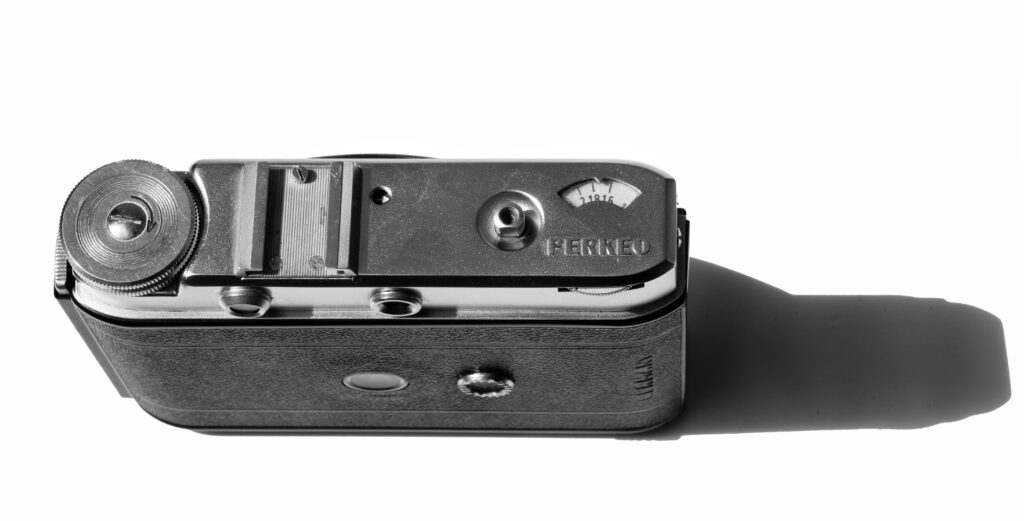
The rangefinder patch isn’t particularly bright, so I’ve moved to zone focusing witht the aid of a LiDAR rangefinder app on the iPhone.
As with the Perkeo I and II, there are focusing aids that assist with focusing. On the E set the aperture to f/8, then rotate the lens barrel to the triangle symbol on the lens, which is set just past the 3 metre mark (3.35m). Everything from 2.5m to 5m should be sharp. Set the focus to the circle symbol at 10.06m, and everything will be sharp from 5.05m to infinity. The circle is particularly useful for landscapes.
My Perkeo I’s Vaskar is calibrated in feet, rather than metres. The recommended aperture for the focusing aids is f/8. The distances are 11 feet (sharp 8½–18 ft) for the triangle and about 33 feet (sharp 18 ft–∞) for the circle.
Setting and Firing the Shutter
The shutter is cocked using the cocking lever on the shutter housing beside the lens and fired with the button on the top plate. For the I and E, open the red window cover to wind on to 2, and repeat for the rest of the roll. At the end (12 or 13 frames), wind on until the paper trailer clears, then open the back in the shade and seal the roll.
The Red Window
The Perkeo I and E both count frames through a small red window in the back door, and all but the earliest Perkeo I models are fitted with a rotating cover, marked with an X when closed. The II alone has a top plate frame counter.
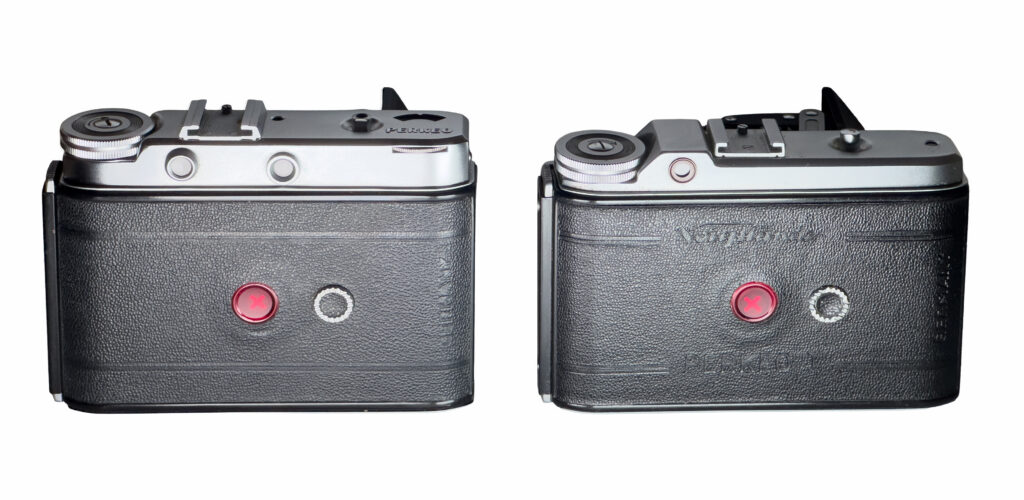
The purpose of the red window is to keep light from fogging the film. The ruby-coloured glass passes only red light, which the orthochromatic and slow panchromatic stocks were less sensitive to. Our faster modern emulsions and thinner backing papers are less forgiving, and a window left open throughout the roll may well fog the roll through the paper. On the Perkeo II, the cover is needed only briefly because the window is used only to position the first frame before the auto-stop advance takes over. The Perkeo I and the rangefinder-equipped Perkeo E have no frame counter, and the cover needs to be opened each time you wind on. This is common on early cameras and I find it mildly tedious. However, whether the complexity of the Perkeo II is a good trade off in alleviating this is another question.
Double-Exposure Prevention
Every Perkeo has double-exposure prevention apart from the earliest Perkeo I bodies. The Perkeo I and E use a relatively simple double-exposure interlock: after an exposure the body release is locked until the film wind has been operated, while an indicator shows whether the camera is ready to expose or needs to be wound on. The Perkeo II goes considerably further, combining double-exposure prevention with a film-driven metering roller, automatic frame counter and film-advance stop.
| Model | Double-exposure prevention mechanism | Indicator | Film advance/spacing |
|---|---|---|---|
| Perkeo I (later versions) | Exposure locks the body release; winding on resets it | Arrow forward/towards the subject = ready to expose; arrow towards camera back = wind/locked | Manual. Continue to next number in red window |
| Perkeo II | Body release and film transport are interlocked. Exposure releases transport and reaching the next measured frame restores the exposure state. | Frame counter, no window with arrow | Automatic. Measuring roller, counter and wind stop |
| Perkeo E | Exposure locks the body release; winding on resets it | Arrow towards the subject/away from the photographer = ready/unlocked; arrow towards camera back = wind/locked. Viewed normally on your camera, the ready position appears to point right | Manual. Continue to next number in red window |
An Excursion to the Goodwin Sands
I took the Perkeo E on a trip to the Goodwin Sands. We were taken to the sands (and back!) by Dover Sea Safari, who were excellent. The crew were both extremely professional and personable, and the boat was well equipped. The journey from Dover takes about 30 minutes in clear weather, which is what we enjoyed. All my gear had to fit into a small Peli-type watertight case, and I had a Nikon Zf, a 24-120 mm zoom, and a 100-400 mm zoom to take. The Perkeo was the only option for medium format.
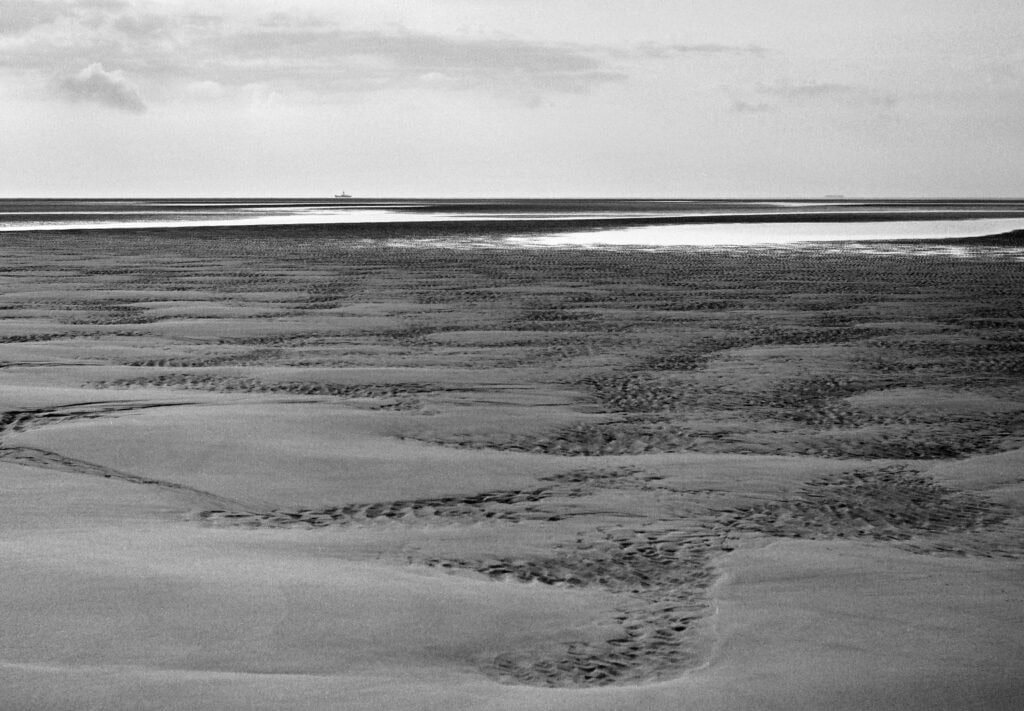
Shooting the Voigtländer Perkeo E out on the Goodwin Sands was easy enough. I didn’t have to worry about focus as I was always set to infinity, as I needed the horizon as sharp as possible for the East Goodwin Lightvessel, which you can see as a distant speck. We visited on the 1st of August 2026, just before she was permanently withdrawn by Trinity House on August 14th – the last of the historic lightship station markers on the Goodwins. It was an event we wanted to mark, and the reason I took Nikon’s excellent 100-400mm zoom on my Nikon Zf.
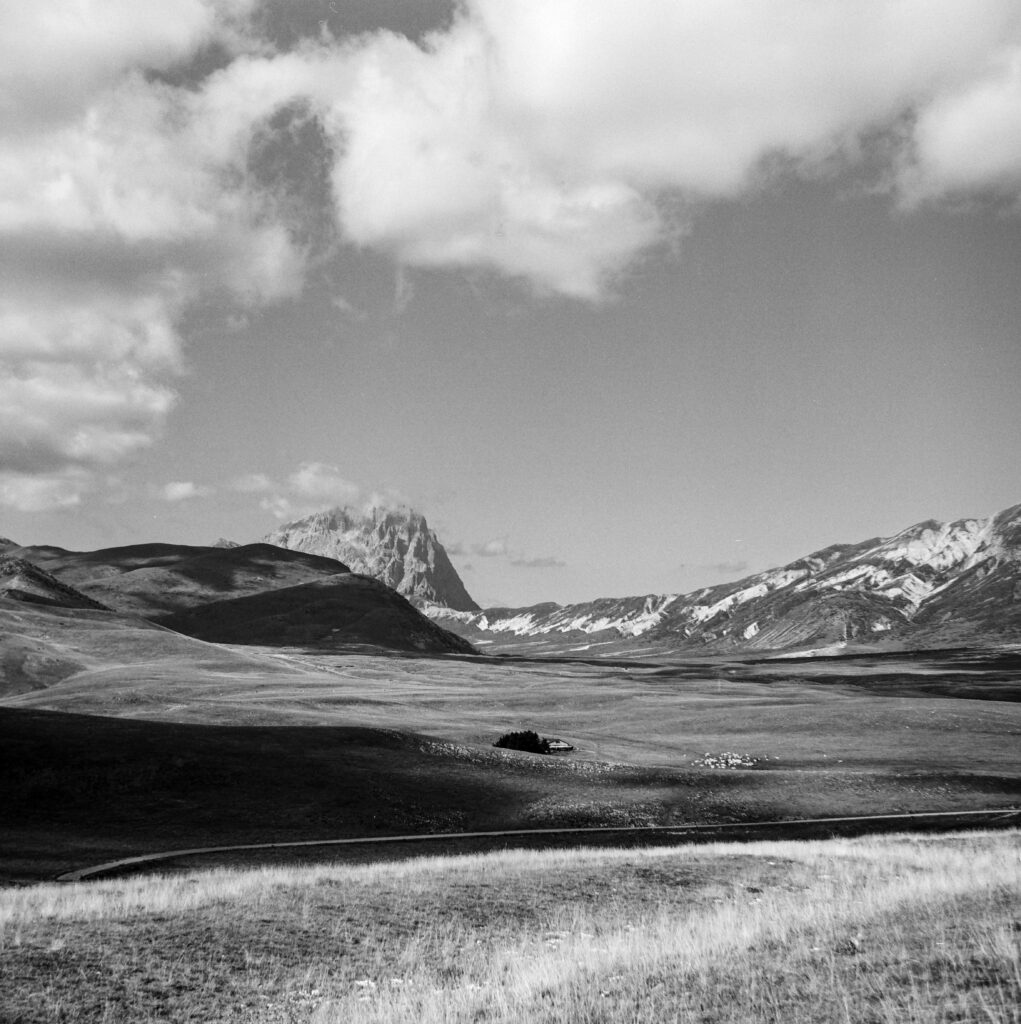
Shooting with the Perkeo E at f/8, the light meter on my phone told me I needed about 1/500 most of the time, and 1/300 was the fastest shutter speed I had available. However, with black and white film, this proved to be fine for the shots I took. The only drawbacks of shooting with the Perkeo were the slow wind-on and the need to remember to cover the red window between frames. I was glad I took it.
