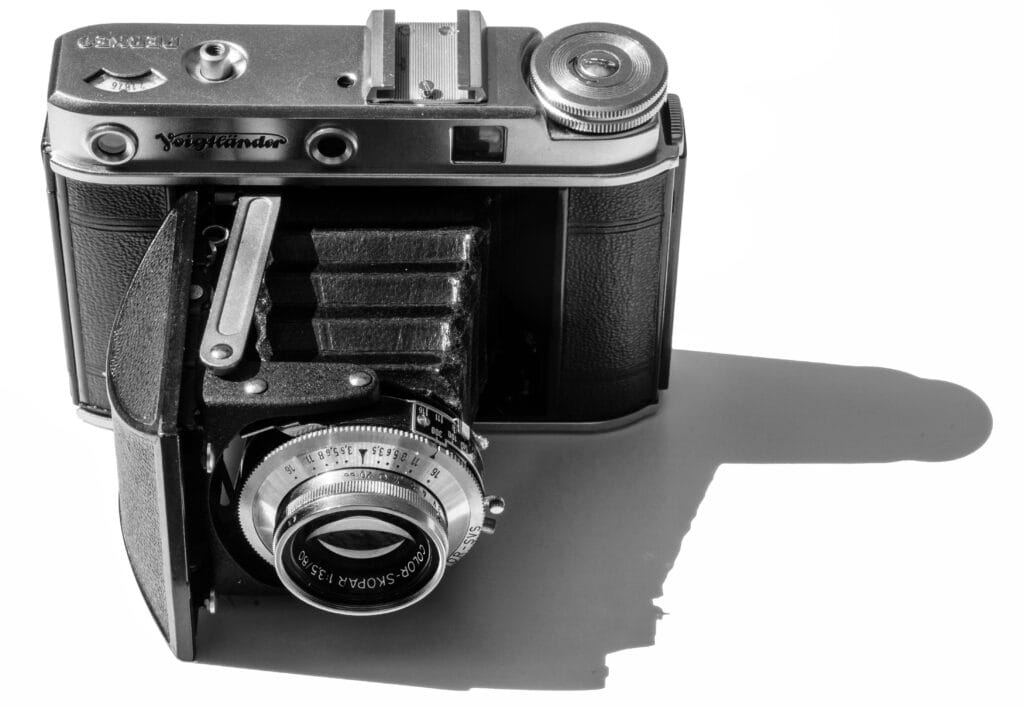
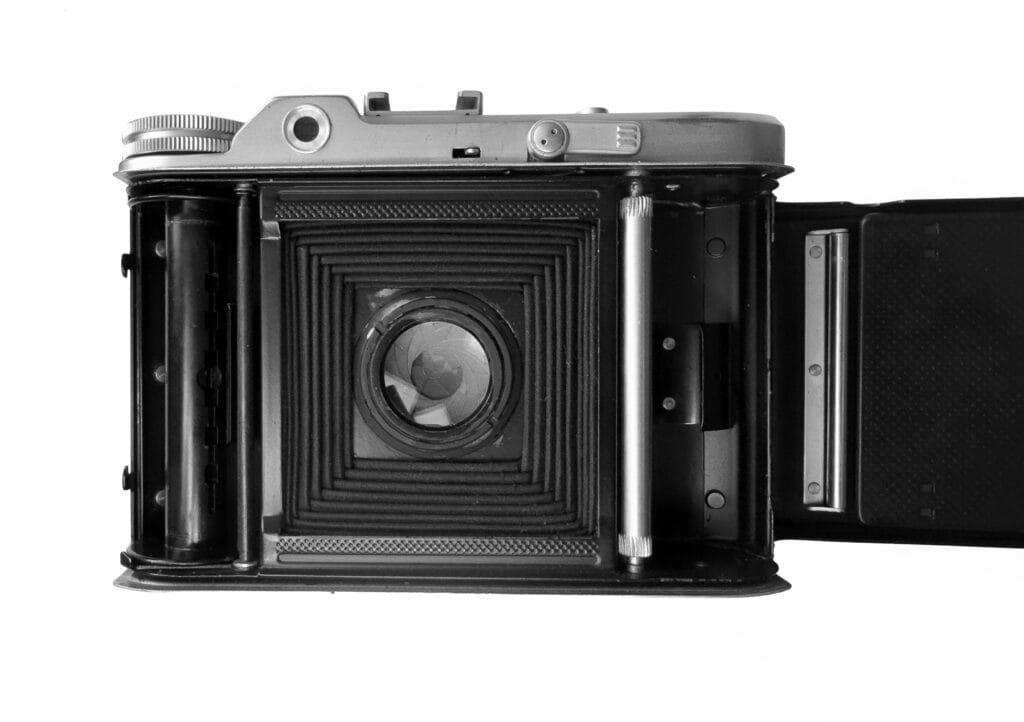
If you want to take a medium format camera somewhere where size and weight matter, in my case, the Goodwin Sands, the Voigtländer Perkeo is ideal. It is among the smallest, lightest 6×6 folders ever built. With this camera, Voigtländer managed to miniaturise roll-film photography without miniaturising the negative. As a result, compared to most other medium-format cameras, it is extremely light and compact. Equipped with its best lens option, the Color-Skopar 80mm f/3.5, and fitted with one of the faster leaf shutters, the Perkeo is a practical proposition and perfectly capable of taking excellent pictures with plenty of detail.
Voigtländer Perkeo E (III) (1955)
Origins
The name Perkeo first appeared on a compact magazine camera called the Perkeo N°140, produced by Rudolf Krügener, a chemist, in the late 19th century. He had experience in developing small cameras, as one of his models was Dr Krügener’s pocketbook camera, one of the smallest cameras of its time at 45×100×140mm.
Voigtländer’s first Perkeos were a range of small 3×4 cm self-erecting folders for 127 film in the early 1930s. The company resurrected the name for a series of 120-film 6×6 folders in 1950.
Perkeo = Small
The name Perkeo is associated with diminutive proportions. It is most often associated with the nickname of Clemens Pankert (AKA Giovanni Clementi), who lived from 1702 to 1735. He served as court jester and wine steward at Heidelberg Castle, and was a man of short stature. The nickname was apparently derived from his response perché no? (“why not?”) when offered more wine, which he seldom declined. He was celebrated for his prodigious wine consumption despite his small figure, and became a local legend. Ironically, he was in charge of the largest wine barrel in the world, the massive Heidelberg Tun. Perkeo is not German for dwarf, as is frequently suggested. I have also seen it attributed to the Pygmy Batis (Batis perkeo), which is not a bat, but a tiny bird from the savannahs of north-eastern Africa. Whatever the origin, we can be sure it is intended to convey smallness.
The post-war Perkeo cameras are the subject of this article. I own a Perkeo I, II and the uncoupled rangefinder model, known variously as the E, III or IIIE. I’ve also seen IIIe. The Perkeos are compact vertical folders made by Voigtländer of Braunschweig in the early to mid 1950s, taking 6×6 cm exposures on 120 film. All models use a small reverse-Galilean telescopic finder in a metal top housing with a cold shoe.
Dimensions and Weight
Measurements depend on whether controls are included, but the ranges in the table below are a fairly safe bet.
Model
Width
Height
Depth, folded
Perkeo I
125–127 mm
85–89 mm
40–43 mm
Perkeo II
125–127 mm
85–89 mm
40–43 mm
Perkeo E
125–128 mm
91–96 mm
42–48 mm
Weights vary by lens and shutter, with the light end of the spectrum being a triplet Vaskar with a Pronto shutter. At the other end is a four-element Color-Skopar with a Prontor-SVS shutter with a rangefinder housing on top. The spread across the range is 480-560 grams.
Alternatives
Zeiss Ikon’s Super Ikonta and Balda’s Super Baldax are probably the closest lightweight alternatives, though both 6×6 folders offer a coupled rangefinder. The 6×6 Super Ikonta weighs around 660 grams and measures about 138 × 103 × 43 mm folded; the Super Baldax is a little heavier at 700 grams and 135 × 101 × 47 mm.
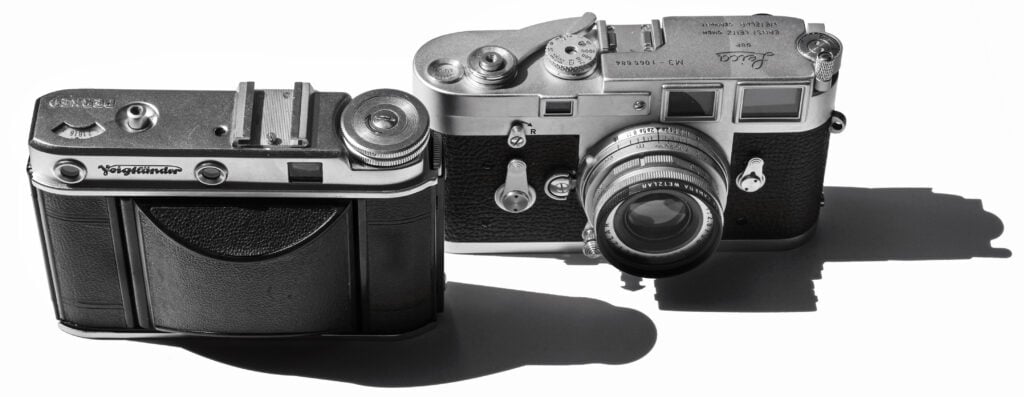
Voigtländer Perkeo E closed with the Leica M3 for size comparison.
The Perkeo I, II and E (III) models
The design appears to descend from the Bessa 66 of 1938. Despite the light weight, the cameras feel very solid in the hand. The sources for the many lens and shutter options available for three models occasionally contradict each other, but I have done my best to get these as accurate as I can.
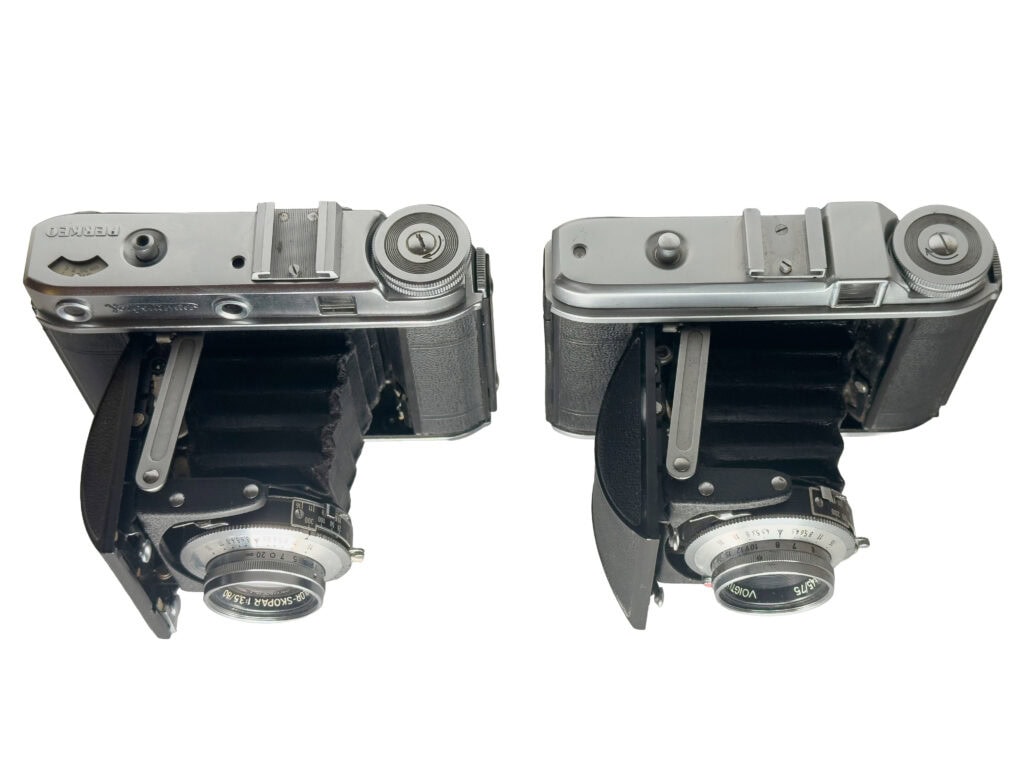
Top view of the Voigtländer Perkeo E (left) and I open.
Perkeo I. This is the simplest model. It provides a finder, scale focusing, and double-exposure prevention interlock (except for the early models). The film is advanced manually with the winding knob and observing the numbers through the red window on the back of the camera. Lens options were the Vaskar 75mm f/4.5, the Vaskar 80mm f/4.5, or the faster Color-Skopar 80mm f/3.5.
The Perkeo I was offered with a wide range of shutter combinations, including the Vario, Pronto, Prontor-S, Prontor-SV, Prontor-SVS and Synchro-Compur. Compur-Rapid examples are also reported, particularly with the Color-Skopar, although whether this was a regular factory option is not clear.
Perkeo II. Adds an automatic frame counter and wind stop. The red window is needed only to set frame one; after that, the winding knob stops itself at each frame. The film passes over a measuring roller beside the film gate, whose rotation determines the film movement. Once frame 1 has been established through the red window and the automatic system is engaged, the counter and wind stop take over. Although this sounds simple, the camera is more complex than the other two models.
This arrangement produces tight, consistent spacing, which is why a Perkeo II may yield an additional thirteenth frame on a modern roll of film. The Perkeo II was normally fitted with the Color-Skopar 80mm f/3.5. Documented shutters include the Prontor-S, Prontor-SV, Prontor-SVS, Compur-Rapid and Synchro-Compur.
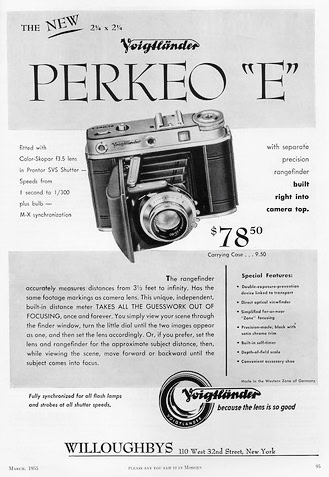
Perkeo E (AKA III and IIIE): This is the final, less common variant, which adds an uncoupled rangefinder in the top housing and moves the Voigtländer name to the front of the body. To my eyes, this is the best-looking design. Once the rangefinder patch is aligned, you read the range from the top scale and then transfer it to the focusing scale.
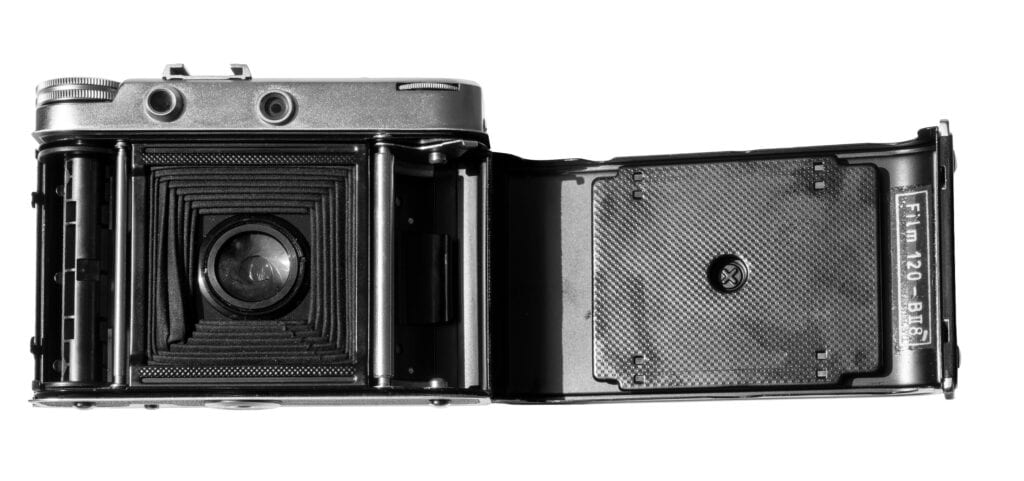
With the rangefinder fitted, there wasn’t enough space for the automatic counter in the E, so you need to wind on using the red window. However, although the Perkeo E returned to the Perkeo I’s red-window film advance, Voigtländer did not simply reuse its film chamber. Instead, the loading arrangement featured swing-out spool carriers on both sides and guide rollers at both ends of the film gate. This was an upgrade on the Perkeo I, which featured a single roller and swing-out spool carrier on the take-up side.
The Perkeo E was offered with either the three-element Vaskar 80mm f/4.5 or the superior four-element Color-Skopar 80mm f/3.5. Documented shutters include the Pronto, Prontor-S and Prontor-SVS; the latter, with a top speed of 1/300 second, is commonly found paired with the Color-Skopar.
Feature Comparison
Feature
Early Perkeo I
Later Perkeo I
Perkeo II
Perkeo E
Double-exposure prevention
No
Yes
Yes
Yes
Red-window film advance
Yes
Yes
First frame only
Yes
Automatic frame counter
No
No
Yes
No
Automatic film advance stop
No
No
Yes
No
Film-loading assistance
Swing-out take-up spool carrier
Swing-out take-up spool carrier
Swing-out take-up spool carrier
Swing-out carriers for both spools
Film transport / guidance
Single roller
Single roller
Toothed measuring roller for automatic frame spacing
Guide rollers on both sides of film gate
Uncoupled rangefinder
No
No
No
Yes
Perkeo feature comparison
A comparison of the Perkeo models
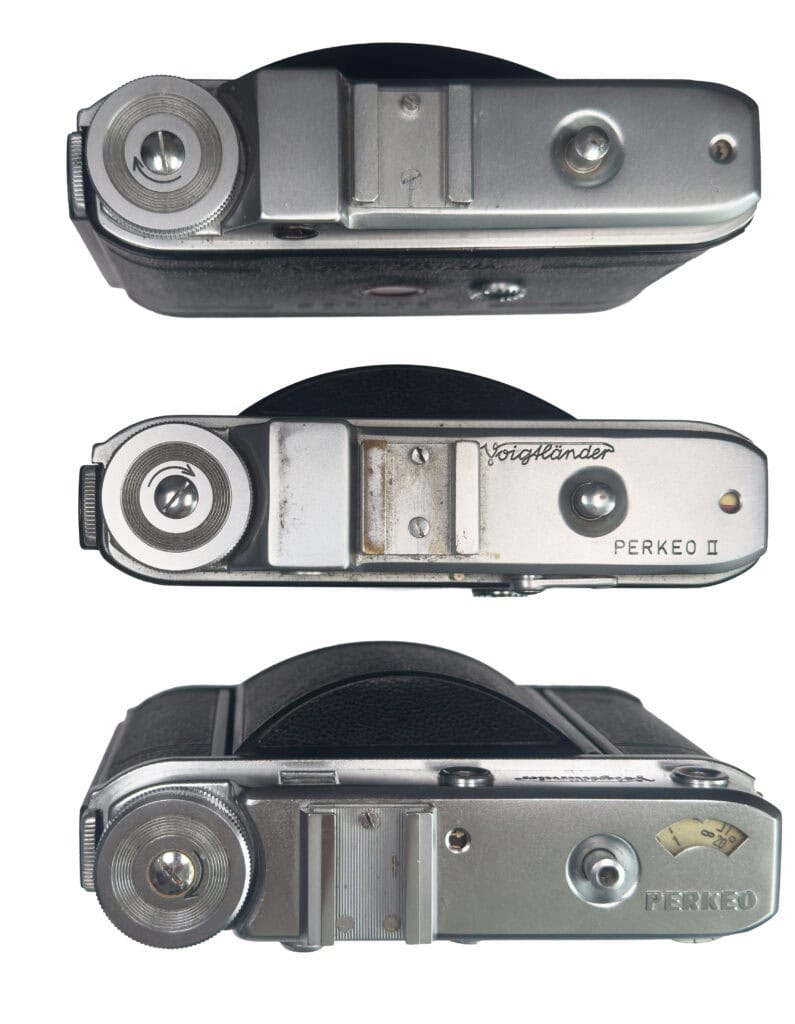
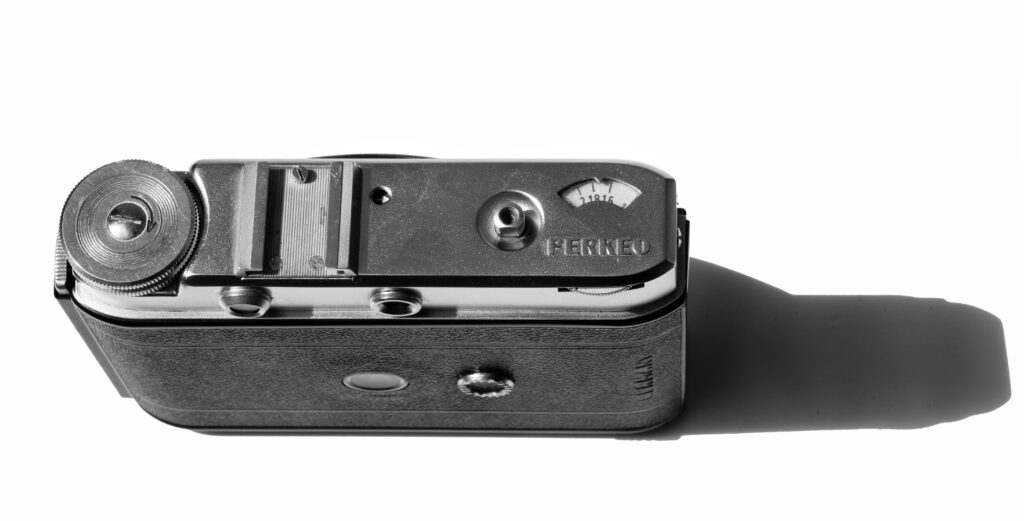
The majority of the differences between the Perkeo I, II and E are on the top plate of the cameras and inside the body.
The Perkeo I has an uninscribed top plate with a single viewfinder window. The shutter release button does not have a screw fitting for a cable release and the small top plate window showing an arrow (the double exposure prevention indicator) is on the far right of the top plate. On the Perkeo I Voigtländer calls this a “Checkwindow for Exposure lock”. The Perkeo I has the make and model inscribed in the leatherette on the rear of the camera.
Top view of the three Perkeo models
The Perkeo II has ‘Voigtländer’ and ‘Perkeo II’ inscribed on the top plate near the shutter release button. There is a lever on the rear of the Perkeo II’s top plate which is used to engage or disengage the Perkeo II’s automatic frame-counting and film-stop mechanism. Voigtländer calls it the “locking lever”. The frame counter is on the top plate, on the far right of the camera.
The E model has the additional rangefinder windows with ‘Voigtländer’ inscribed between them and ‘PERKEO’ in raised text near the shutter release button, which will take a cable release. On the E the small window that displays an arrow is a “Signal window for double exposure lock”. This indicates to the photographer whether exposure or winding is required.
All models have ‘GERMANY’ inscribed vertically on the right-hand side of the leatherette at the back. The bottom plate and camera opening button mechanisms appear identical.
There are some less obvious differences inside the cameras. The Perkeo I has a conventional fixed chamber for the fresh roll, while only the take-up spool is carried in a swing-out holder to make loading easier; it also uses a single guide roller on the take-up side of the film gate. The Perkeo II has a roller each side of the gate and another next to the film flatness plate. The roller on the supply side is fluted top and bottom. In the later Perkeo E, both spool holders swing out for loading, and there are two guide rollers, one on each side of the film gate.
The complexity of the Perkeo II interlock
The contrast between the mechanisms of the Perkeo I and E and the more complex Perkeo II is strongest when operating the shutters of all three without film. Testing the Perkeo I and E like this couldn’t be simpler. Open the camera front, set the shutter speed and aperture, cock the shutter and fire it. Turn the wind knob until it clicks and repeat.
Interior of the Perkeo II, showing the fluted roller to the right of the film gate and the locking lever on the rear of the top plate.
The Perkeo II is less straightforward and, when I first bought mine, I struggled to get the sequence right. This is because its film transport incorporates the more elaborate frame-counting and double-exposure interlock, operated by the fluted roller inside the camera.
To test the camera, first move the rear locking lever to the left and turn the fluted metering roller until the mechanism stops and the frame counter reaches frame 1. Set the shutter to a moderate speed such as1/50, cock it manually and press the top-plate release. After firing, turn the metering roller again to simulate advancing the film to the next frame; this resets the interlock and allows the shutter to be released again.
Loading and shooting with the camera is considerably simpler!
Dating the Perkeo models
The best dates I can find for the range are 1951 to 1955 for the Perkeo I, 1952 to 1955 for the Perkeo II, and 1955 to 1957 for the Perkeo E. No factory production records survive, so all dates come from catalogues and price lists. The bodies don’t carry a serial number, though the shutter and lenses do. The serial number on my Perkeo E is on the outer edge of the lens. As far as I can tell, the lens was made in 1954 for a camera introduced in 1955. My Perkeo I’s Vaskar was made in 1951.
An American Ad for the Perkeo E from 1955
The rise and fall of the 6×6 Folder
The square 6×6 became popular in the mid-1930s. It was simpler to use, since there was no distinction between landscape and portrait orientation, and it suited contact printing and small enlargers. However, by the late 1950s the 6×6 folder’s day was over. Coated lenses and improved emulsions had made 35mm negatives ‘good enough’ and folders were costly to build. Professionals and serious amateurs moved to twin lens reflexes and the Hasselblad 500C, and the rest of the market moved to 35mm. The Perkeo E was one of the last generation of folders and arrived just as the market had moved on.
The Lenses
My Perkeo E and Perkeo II both have the Color (spelled thus) Skopar lens. Skopar was Voigtländer’s name for their four-element Tessar-type lens. Color refers to the lens coating, which was considered better for colour photography. It is a quality, sharp lens, with just a bit of softness in the corners wide open.
My Perkeo I has the Vaskar f/4.5 75mm lens. This is a coated three-element Cooke-type triplet, which was the basic lens offering in the range and about 41mm equivalent on a 35mm camera. It is by no means a bad lens, but definitely benefits from stopping down to f/8.
Opening and Closing
Open the front door by pressing a small button on the base of the camera. Next, pull the door open until it gives a loud, positive click after it erects the lens. To close the door, depress the two buttons on the inside of the door at the front. If you need it, there is a small stand at the base of the door, marked with a red arrow.
Loading the Perkeo E and I
These are for the E, which has the most advanced loading functions, but the procedure is very similar for the I, except that their is only one hinged cradle.
Open the back by depressing the two buttons on the left (wind) side of the camera and pulling out the film advance knob, then swing the hinged cradle on the right-hand side (lens away from you) out.
Interior of the Perkeo E (III) Medium Format Uncoupled Rangefinder.
Move the empty take-up spool, usually in the camera, into the cradle on the wind side, and put the fresh roll into the opposite chamber. Pull the paper leader across the film gate and slot its tip into the take-up spool, then turn the knob a couple of times until the paper is straight and taut.
Swing the cradle back in and close the back until it latches. Lastly, open the red window cover and wind steadily, watching for the warning dots and then the figure 1. Stop the moment it sits centred in the window.
Unloading the I and E
After taking the 12th exposure, continue turning the film-wind knob to wind the remaining film and backing paper completely onto the take-up spool. Continue winding until the backing paper has passed completely through the red window and onto the take-up spool. Then open the camera back, remove the exposed roll, keep it tightly wound and secure it with the adhesive tab.
Loading the Perkeo II
Before opening the camera, move the rear locking lever to the right. In this position the automatic frame counter and film-stop mechanism are disengaged, so the film can wind freely during loading.
Open the camera back and load as for the E and I above. The Perkeo II uses a spring clip on the supply side: push the fresh 120 roll under it, draw the backing paper across the film gate and make sure it is correctly positioned against the film-metering roller before securing the leader in the take-up spool. Wind sufficiently to ensure that the paper is running straight and securely onto the take-up spool, then close the camera back.
Open the red-window cover and slowly turn the film-wind knob. Watch for the backing-paper markings; you will see warning circles before the number. Stop when the number 1 for the 6×6 track is centred in the window. Wind slowly as you approach it, as there is nothing to prevent you overshooting while the locking lever is to the right.
Close the red-window cover and move the rear locking lever to the left, towards the film-wind knob. This engages the automatic frame-counting and film-stop mechanism, and the top-plate frame counter should now indicate 1.
Once the camera is loaded, do not move the rear locking lever again during the roll, as doing so will reset the counting mechanism. After each exposure, turn the film-wind knob until it reaches its automatic stop; from this point onwards the metering mechanism, rather than the red window, determines the position of each frame.
Underloading the Perkeo II
After taking the 12th exposure, turn the film-wind knob again until the frame counter reaches the red indication. If the film will not advance from 12, make sure the shutter has been cocked and the top-plate release has been operated fully, as the body interlock must complete its cycle before the transport is released.
Once the counter shows red, move the rear locking lever to the right to disengage the automatic film stop, then continue winding until all the backing paper has passed onto the take-up spool. Then open the camera back, remove the exposed roll, keep it tightly wound and secure it with the adhesive tab.
Setting the exposure
With no built-in light meter, you’ll need to use a handheld meter, a phone app, or the Sunny 16 rule, after which you can set the exposure on the shutter housing at the front of the camera. The speed ring runs round the barrel, giving you one second to 1/300 plus B on my E’s Prontor-SVS, and one second to 1/500 on the Perkeo II’s Syncho-Compur. The aperture has its own small lever near the bellows, running f/3.5 to f/16 on those models and you read it against the scale on the lens barrel.
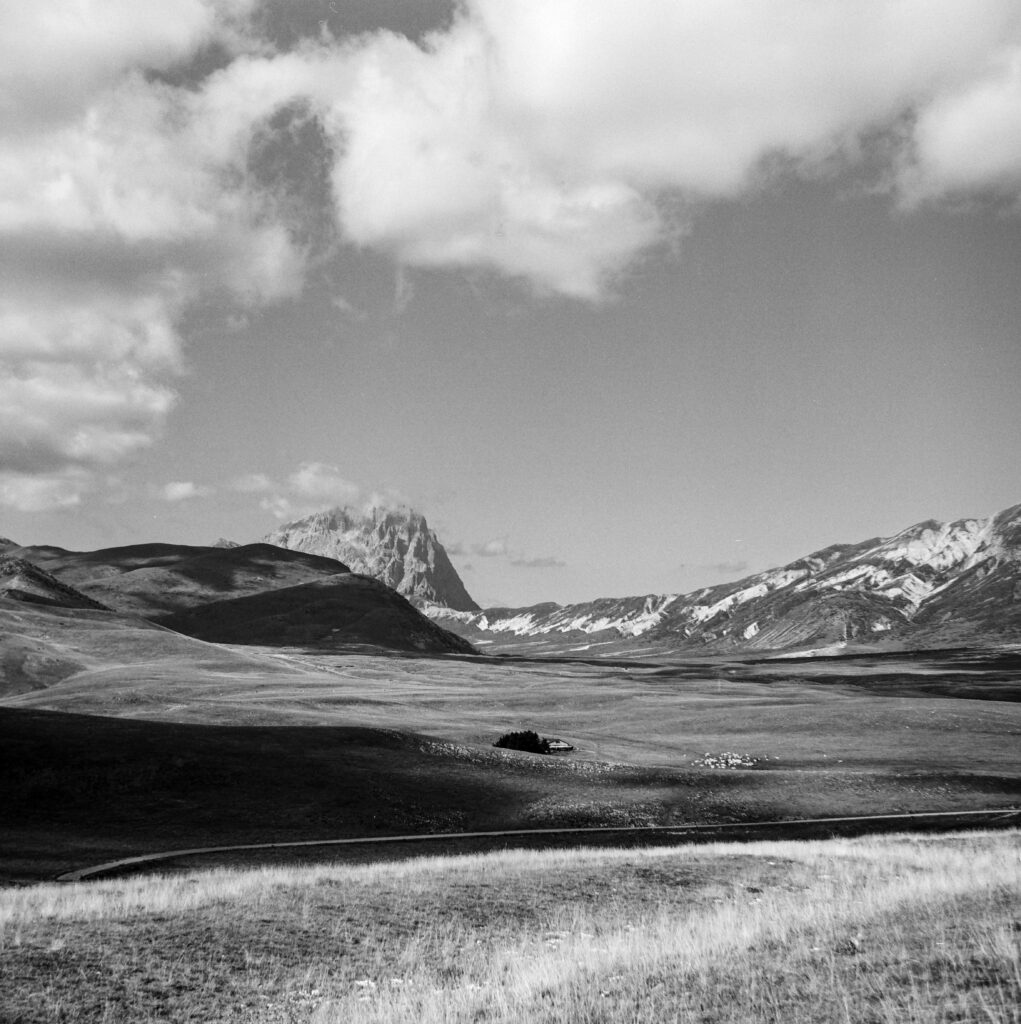
Corno Grande, Abruzzo, Italy. Shot with the Voigtländer Perkeo I
There is a third ring on the camera on the SVS, which is a synchro switch for flash:
M for M-type flashbulbs, which you can use at speeds between 1/50 and 1/300.
X for electronic flash at any speed, and for bulbs at 1/25 or slower.
V for the self-timer, which also works with electronic flash up to 1/300 and bulbs up to 1/25. Its synchronisation matches X.
I’ve never used flash with the camera and leave the ring on X. If needed, a flash plugs into the PC socket on the shutter barrel.
Focusing
The Perkeo I and Perkeo II are both scale-focusing cameras. To focus, you estimate or measure the distance to the subject and rotate the front focusing ring until that distance is opposite the index mark on the lens. Both cameras also provide zone-focus markings, intended to make rapid shooting easier: at f/8, presetting the lens to the appropriate mark gives sufficient depth of field for groups or more distant subjects without having to judge the distance precisely. For more critical work, particularly at close distances or wide apertures, an uncoupled accessory rangefinder can be fitted to the accessory shoe; the measured distance is then transferred manually to the lens scale.
Focusing the Perkeo E involves using an uncoupled rangefinder, which was new to me, and I didn’t find it particularly easy. Being uncoupled, it requires two separate movements. First, you focus the rangefinder by aligning the images in the rangefinder patch from the rangefinder window. This has higher magnification than the viewfinder to help achieve focus.
Next, you read the distance from the indicator on the top of the camera, and then finally transfer that figure to the lens. Composition is done through the second window, which has lower magnification. I couldn’t find accurate figures for magnification online, but after a fairly quick-and-dirty home test, I estimate 0.7 for the viewfinder and 1.1 for the rangefinder.
Top rear view of the Perkeo E (III)
The rangefinder patch isn’t particularly bright, so I’ve moved to zone focusing witht the aid of a LiDAR rangefinder app on the iPhone.
As with the Perkeo I and II, there are focusing aids that assist with focusing. On the E set the aperture to f/8, then rotate the lens barrel to the triangle symbol on the lens, which is set just past the 3 metre mark (3.35m). Everything from 2.5m to 5m should be sharp. Set the focus to the circle symbol at 10.06m, and everything will be sharp from 5.05m to infinity. The circle is particularly useful for landscapes.
My Perkeo I’s Vaskar is calibrated in feet, rather than metres. The recommended aperture for the focusing aids is f/8. The distances are 11 feet (sharp 8½–18 ft) for the triangle and about 33 feet (sharp 18 ft–∞) for the circle.
Setting and Firing the Shutter
The shutter is cocked using the cocking lever on the shutter housing beside the lens and fired with the button on the top plate. For the I and E, open the red window cover to wind on to 2, and repeat for the rest of the roll. At the end (12 or 13 frames), wind on until the paper trailer clears, then open the back in the shade and seal the roll.
The Red Window
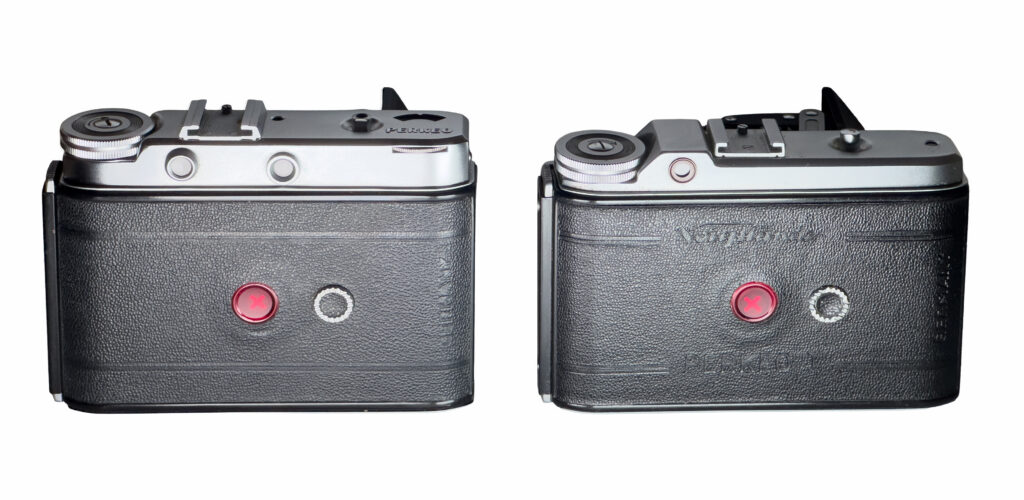
The Perkeo I and E both count frames through a small red window in the back door, and all but the earliest Perkeo I models are fitted with a rotating cover, marked with an X when closed. The II alone has a top plate frame counter.
Rear views of the Perkeo E (left) and Perkeo I showing their red rear windows.
The purpose of the red window is to keep light from fogging the film. The ruby-coloured glass passes only red light, which the orthochromatic and slow panchromatic stocks were less sensitive to. Our faster modern emulsions and thinner backing papers are less forgiving, and a window left open throughout the roll may well fog the roll through the paper. On the Perkeo II, the cover is needed only briefly because the window is used only to position the first frame before the auto-stop advance takes over. The Perkeo I and the rangefinder-equipped Perkeo E have no frame counter, and the cover needs to be opened each time you wind on. This is common on early cameras and I find it mildly tedious. However, whether the complexity of the Perkeo II is a good trade off in alleviating this is another question.
Double-Exposure Prevention
Every Perkeo has double-exposure prevention apart from the earliest Perkeo I bodies. The Perkeo I and E use a relatively simple double-exposure interlock: after an exposure the body release is locked until the film wind has been operated, while an indicator shows whether the camera is ready to expose or needs to be wound on. The Perkeo II goes considerably further, combining double-exposure prevention with a film-driven metering roller, automatic frame counter and film-advance stop.
Model
Double-exposure prevention mechanism
Indicator
Film advance/spacing
Perkeo I (later versions)
Exposure locks the body release; winding on resets it
Arrow forward/towards the subject = ready to expose; arrow towards camera back = wind/locked
Manual. Continue to next number in red window
Perkeo II
Body release and film transport are interlocked. Exposure releases transport and reaching the next measured frame restores the exposure state.
Frame counter, no window with arrow
Automatic. Measuring roller, counter and wind stop
Perkeo E
Exposure locks the body release; winding on resets it
Arrow towards the subject/away from the photographer = ready/unlocked; arrow towards camera back = wind/locked. Viewed normally on your camera, the ready position appears to point right
Manual. Continue to next number in red window
Double Exposure Prevention Mechanisms
An Excursion to the Goodwin Sands
I took the Perkeo E on a trip to the Goodwin Sands. We were taken to the sands (and back!) by Dover Sea Safari, who were excellent. The crew were both extremely professional and personable, and the boat was well equipped. The journey from Dover takes about 30 minutes in clear weather, which is what we enjoyed. All my gear had to fit into a small Peli-type watertight case, and I had a Nikon Zf, a 24-120 mm zoom, and a 100-400 mm zoom to take. The Perkeo was the only option for medium format.
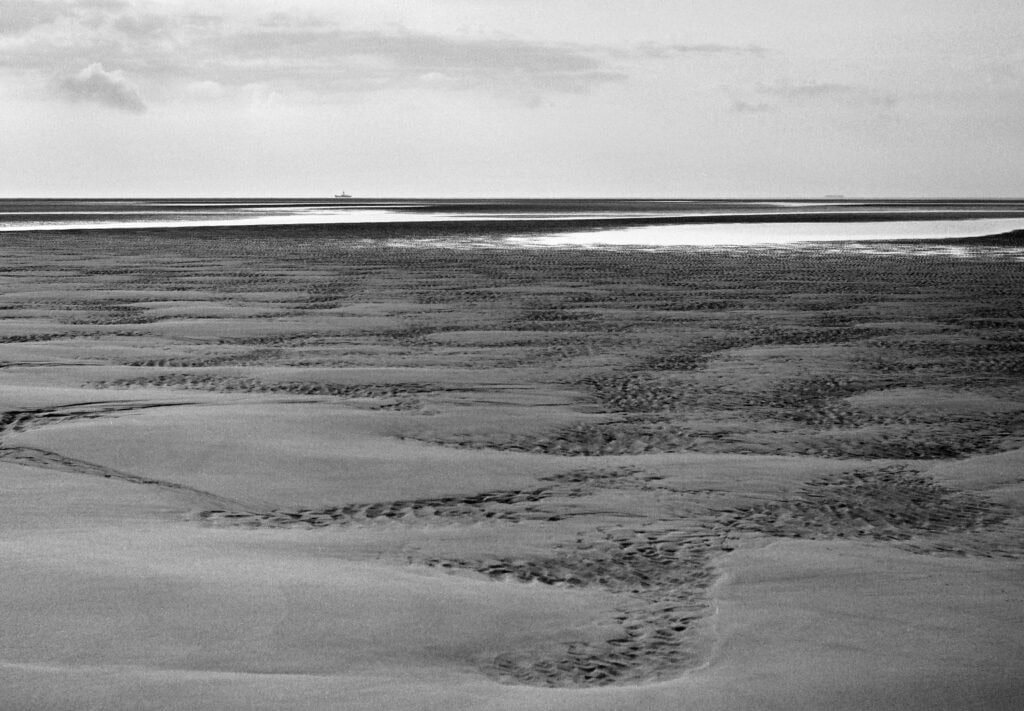
The Goodwin Sands, with the East Goodwin Lightvessel on the horizon. Shot with a Voigtländer Perkeo E (cropped)
Shooting the Voigtländer Perkeo E out on the Goodwin Sands was easy enough. I didn’t have to worry about focus as I was always set to infinity, as I needed the horizon as sharp as possible for the East Goodwin Lightvessel, which you can see as a distant speck. We visited on the 1st of August 2026, just before she was permanently withdrawn by Trinity House on August 14th – the last of the historic lightship station markers on the Goodwins. It was an event we wanted to mark, and the reason I took Nikon’s excellent 100-400mm zoom on my Nikon Zf.
Shooting with the Perkeo E at f/8, the light meter on my phone told me I needed about 1/500 most of the time, and 1/300 was the fastest shutter speed I had available. However, with black and white film, this proved to be fine for the shots I took. The only drawbacks of shooting with the Perkeo were the slow wind-on and the need to remember to cover the red window between frames. I was glad I took it.
This timeline of early cameras describes significant photographic milestones and early cameras representative of their year of introduction between the inception of photography and 1900. I’ve also provided an overview of the most important developments decade by decade from 1840-1900 as an introduction to the timeline.
If you are interested in the development of 20th century cameras there is also a timeline from 1900 to the present day on the site, whilst the article From Chemistry to Computation provides an overview and timeline of the development of cameras, lenses, and photographic processes from the 1840s to the present day.
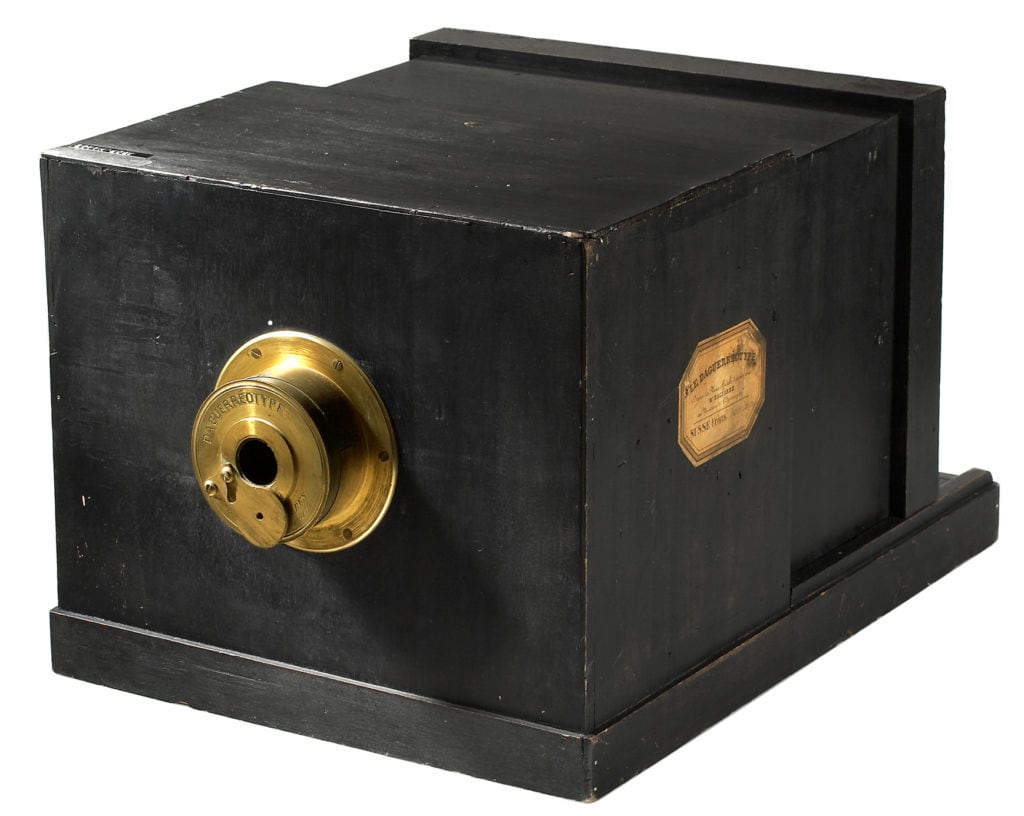
The first cameras were smaller versions of the camera obscura, a simple viewing device based on a sliding-box design that had been in use for several hundred years. By the 19th century this was commonly employed by landscape painters to achieve proper perspective. French artist Louis Daguerre built upon the work of Nicéphore Niépce, who had produced what is widely regarded as the first photograph in 1826, by designing the first camera to be commercially produced. This was the Daguerreotype, which was announced to the world in 1839.
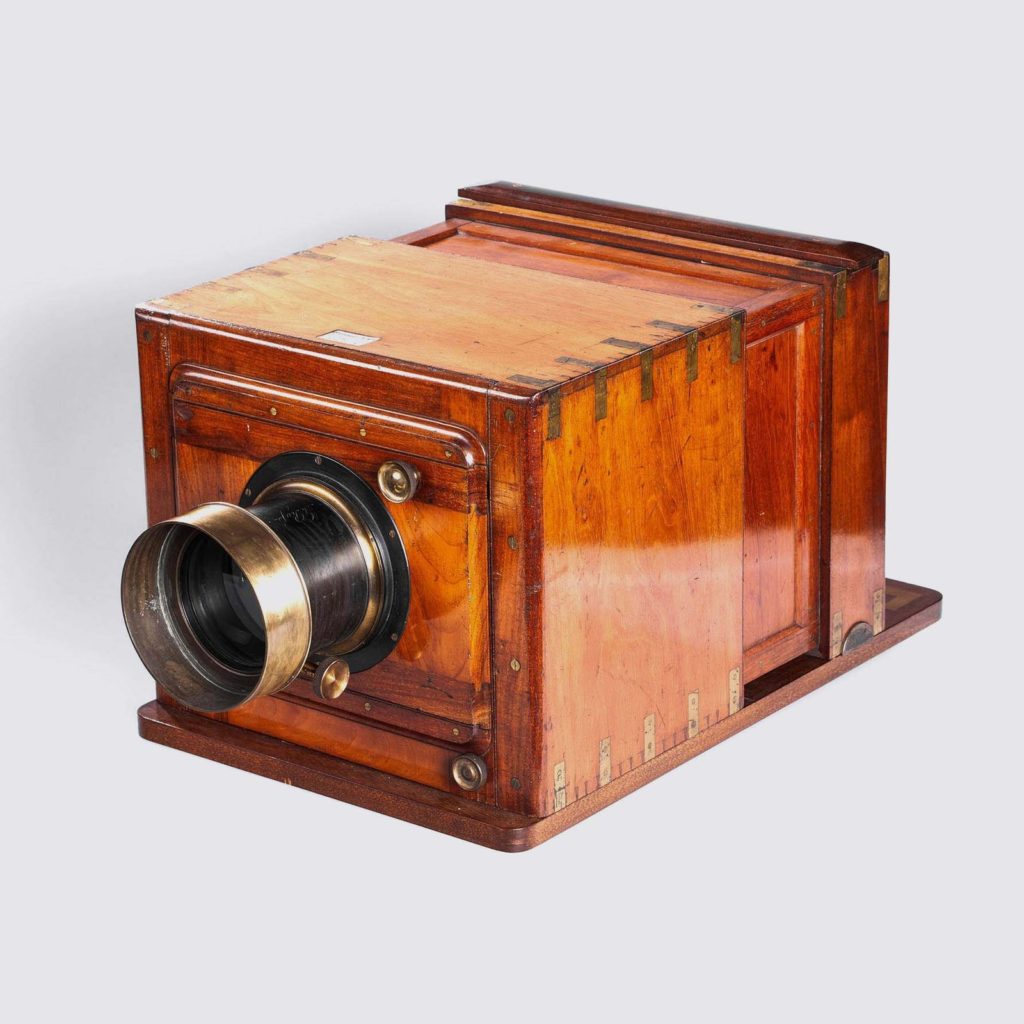
Daguerreotypes followed the sliding-box design of the camera obscura, and used two boxes, one slightly smaller than the other. The lens was placed in the front box. The second, slightly smaller box, slid into the back of the larger box. Focus was achieved by sliding the rear box forward or backwards until the image was sharp on the ground glass focusing screen. The image was laterally reversed unless the camera was fitted with a mirror or prism to correct it. When the image was sharp the lens cap was put on the lens and the screen was replaced by a plate holder loaded with a sensitised plate to make an exposure. The lens cap was used as a shutter.
The daguerreotype used a direct-positive process, which created a unique and highly detailed positive image on a sheet of copper plated with a thin, highly polished coat of silver. The photographic process made use of a number of hazardous chemicals. Before sensitisation, the surface would be wiped with nitric acid to remove any organic matter. The plate was then sensitised by exposing the silver surface in darkness or under safelight first to iodine fumes, and then to bromine fumes, resulting in a silver halide coating. After exposure, the plate was carried to a developing box, where it was exposed to fumes from heated mercury. Finally, the plate was fixed by removing the remaining silver halide with a mild solution of sodium thiosulfate.
As there were no camera manufacturers at the time, Daguerreotypes were manufactured by opticians, cabinet makers and instrument makers.
Fox Talbot and The Paper Negative
A few years earlier, during the mid-1830s, the British gentleman scientist and polymath William Fox Talbot, had been keen to make a permanent record of what another draftsman’s aid, the camera lucida showed. The camera lucida’s purpose is to superimpose a refracted image of the landscape onto the artist’s sketchbook. It consists of an adjustable metal arm fastened at one end to the artist’s sketchbook and a glass prism at the other.
Talbot’s frustration with the camera lucida led him to recollect his previous experiences with the camera obscura and start to experiment to see if he could capture a permanent image to make nature record the image. He referred to these experiments as ‘photogenic drawing’.
Talbot found that a sheet of writing paper, coated with salt and brushed with a solution of silver nitrate, darkened in the sun, and that a second coating of salt impeded further darkening or fading. Talbot used this discovery to make tracings of botanical specimens. He would place the specimen on a piece of sensitized paper, cover it with a sheet of glass, and expose it to the sun. Wherever the light struck, the paper darkened, but wherever the plant blocked the light, it remained white. He called his new discovery “the art of photogenic drawing”, and it is still in use today in the salt print process.
Talbot’s salt print process evolved into the Calotype photographic process, where a sheet of paper coated with silver chloride was exposed to light in a camera obscura yielding a negative image. The image was “developed” on the paper, which was actually the acceleration of the silver chloride’s chemical reaction to the light it had been exposed to. The developing process permitted much shorter exposure times in the camera. The developed image on the paper was fixed with sodium hyposulfite. The negative could yield any number of positive images by contact printing on another piece of sensitized paper.
To minimise exposure times Talbot made use of much smaller cameras with short focal length lenses which would concentrate light on a smaller area. The best made lenses available to him were microscope lenses, which he fitted to small cameras his wife referred to as ‘mousetraps’ as he had so many of them around the house. It was with one of these small cameras, measuring only 2.5 inches each side that was used by Talbot to take his first successful photograph in 1839. Though the ‘mousetraps’ are the most well known Talbot made and commissioned many more sophisticated cameras during his research which are now distributed in museums throughout the world.
Similar Cameras, Different Images
Ottewill sliding box camera c. 1856 (Coeln Cameras)
Creating a Calotype used much of the same basic equipment as found in Daguerreotype making. A similar camera type, though there were many variations for both methods, similar ways to expose the image and similar way of preparing, although the Calotype offered a somewhat safer process.
However, the difference between the images they produced was vast. While both created a monotone image, the Daguerreotype created pictures that recorded very fine details across the whole range of tones and appeared to produce a glow from within the image due to the reflective properties of the metal, which of course had no grain.
The Calotype images had higher contrast because the chemicals were absorbed into paper fibres, which reduced detail in the highs and lows. Because of those fibres, the image also offered a grain that would diffuse detail, rather than preserve it. As it was a paper to paper positive negative process, further detail would be lost in the transfer. This resulted in a less detailed but highly atmospheric image.
Cameras of the 1840s
Faster Lenses
The earliest daguerreotype exposure times ranged from three to fifteen minutes, making the process fairly impractical for portrait photography. This was due to the slow Chevalier lenses used by Daguerre. Accordingly, with few exceptions, daguerreotypes made before 1841 were of static subjects. Josef Max Petzval, a professor of mathematics at the University of Vienna, changed this with the design of a new lens, though it took nearly a year to design and manufacture it. It was the first lens to be designed using optical principles and mathematical computation – previously they had previously been ground and polished according to experience. In 1841 the first camera fitted with this lens was introduced by Voigtländer and Sons, an Austrian maker of telescopes and other optical equipment. It was the first portrait lens and had a 160mm focal length and an achievable aperture of f/3.6. Exposure times were many times shorter than with the previous generation of lenses.
Faster Exposures
In 1841 Franz Kratochwila freely published a chemical acceleration process in which the combined vapours of chlorine and bromine increased the sensitivity of the plate by five times, greatly reducing exposure times from minutes to between fifteen and thirty seconds in bright lighting conditions.
Early Camera Manufacturing
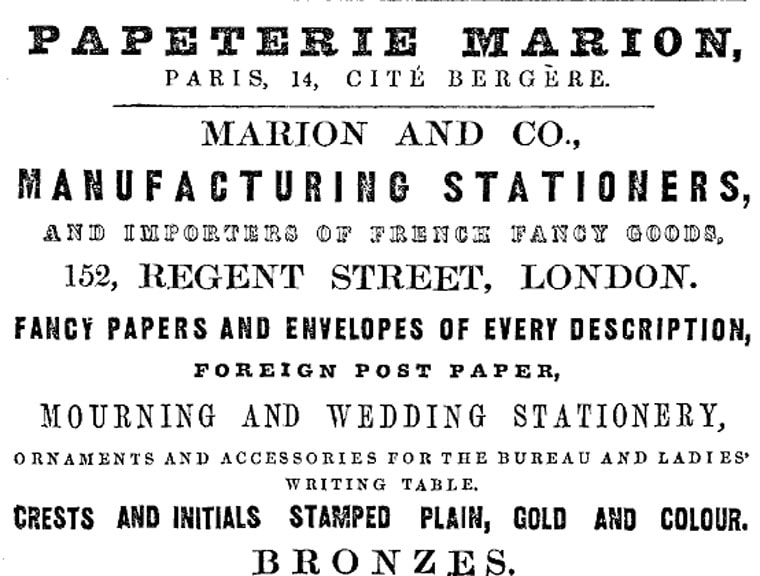
Marion & Co. advert, 1852 (Grace’s Guide to British Industrial History)
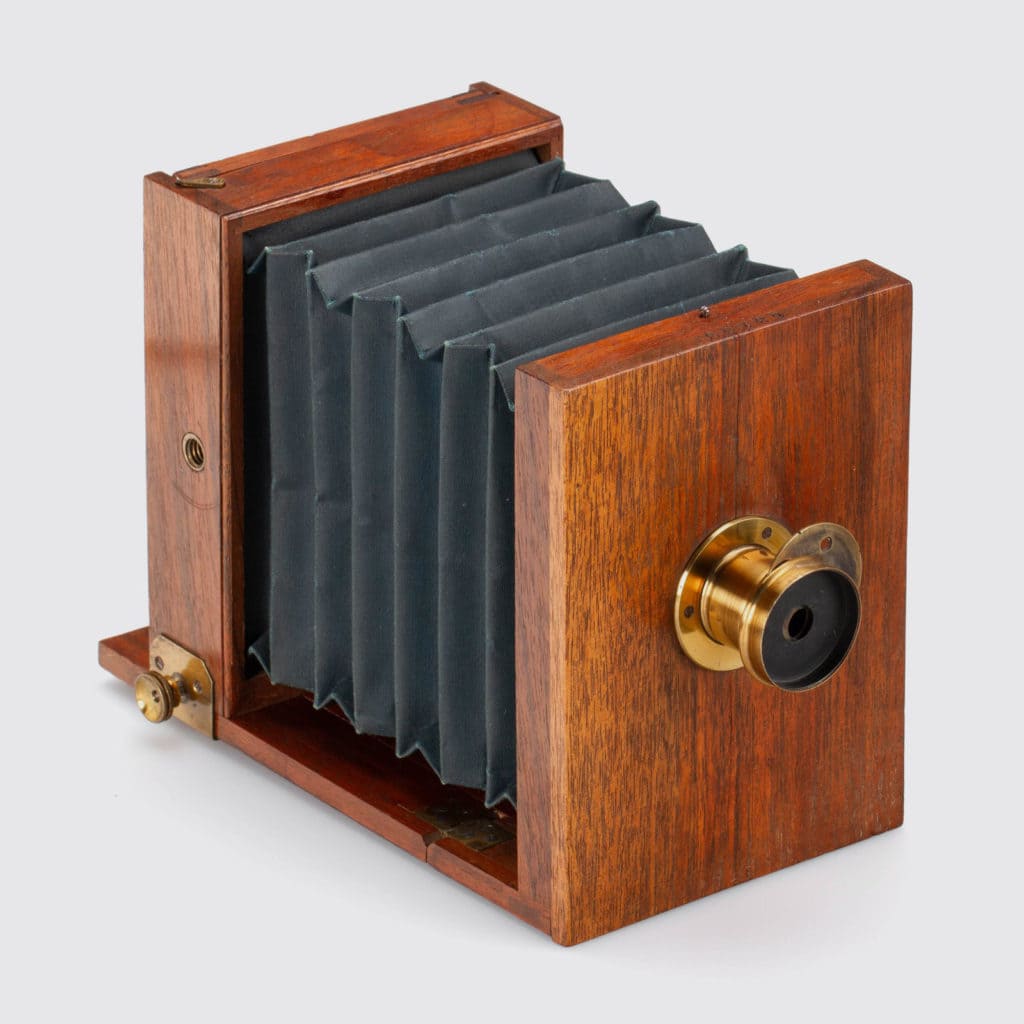
Gradually the opticians, cabinet makers and scientific instrument makers, as well as chemists familiar with the chemical process required for early photography evolved into photographic supply shops and camera manufacturers. French optician Noël Paymal Lerebours was one of the first, and used his skill in optics to manufacture and sell a sliding box whole-plate Daguerreotype camera, working from the instruction manual for Daguerre’s pioneering instrument. W. Butcher and Sons of London started as a pharmacy but evolved into a magic lantern supplier, then a camera importer and finally a manufacturer. George Hare was a joiner, like his father, before he started producing the high quality cameras he became renowned for in London. Frank Brownell, of Kodak Brownie fame, started as a cabinet maker in the 1880s. Another start point was stationery – Marion and Co Ltd, originally an offshoot of Auguste Marion of Paris, started in fancy stationery but widened their business to papers, prints, plates and then onto cameras.
These small firms were economically quite vulnerable. Thomas Ottewill, one of the leading British camera makers, was made bankrupt on several occasions during the 1860s. This was despite his claim in 1856 of ‘having now the largest manufactory in England for the making of cameras’ and having an incredible talent pool. Camera makers George Hare, T. Mason, Patrick Meagher, T. Garland and A. Routledge all worked for Ottewill before establishing their own businesses. Ottewill and brought in partners William Morgan and a Mr Collis after bankruptcy. A partnership arrangement offered greater protection for the business and this model was often adopted by the emerging photographic firms.
The 1850s
A Faster Chemistry Set
The wet plate collodion process of 1851 invented by Frederick Scott Archerwas many times faster than previous methods and enabled photographers to make glass negatives combining the sharpness of a daguerreotype with the replicability of a calotype. However, wet plates needed to be processed wet which required photographers to carry around a portable darkroom as well as the camera.
A commercially viable method of producing a photographic print on paper from a negative was already available for wet plate collodion photographers in the form of the albumen print. This was published in January 1847 by Louis Désiré Blanquart-Evrard. Thin paper was coated with a layer of egg-white (albumen) containing salt and sensitized with a silver nitrate solution, then printed using daylight under a negative. The prints could be toned with a gold solution which gave a purple-brown tint to the image and reduced the risk of fading. This process would became the dominant form of photographic positives from the mid 1850s to the start of the 20th century.
The wet plate collodion process offered an alternative to the Albumen print in the form of glass-based positive made by taking an underexposed negative so that it could be viewed as a positive using a dark backing. This was known as the Ambrotype and was introduced in the early 1850s. The ambrotype quickly grew in popularity because it maintained the image clarity of the earlier daguerreotype —but was faster and cheaper to produce. The finished plate was usually mounted in a decorative presentation cases just as daguerreotypes had been. Also like the daguerreotype, which it replaced, each image was a unique original that could only be duplicated using a camera.
A second collodion-based positive emerged in the form of tintype, or ferrotype, which replaced the Ambrotype’s glass plate with a thin sheet of japanned iron. The process was first described by Adolphe-Alexandre Martin in France in 1853. This type of photography survived well into the twentieth century because of its continued use by street photographers.
Bellows
In the late 1850s sliding-box gave way to a leather bellows with a lens plate at one end, and the light-sensitive plate holder at the other. First came a square design and then a more compact tapering version. In 1856Captain Francis Fowke patented a compact concertina-pattern pleated bellows camera of his own design, which was the first to use cloth bellows, rather than a wooden body between the lens and plate. The tapering design invented the following year by C.G.H. Kinnear, and proved extremely durable. It is still in use in large format cameras today.
The 1860s
First Steps Towards Industrialisation
By the 1860s the medium had started to become industrialized. Instead of mixing chemicals according to their own recipes and hand coating their papers, photographers could buy commercially prepared albumen papers and other ready made supplies. The market was moving increasingly towards the middle-class, which required photographers to produce a greater quantity of cheaper prints. In this new market, the photographers original artisan processes and refined techniques became less important.
The quest for a larger volume of prints gave rise to the he carte de visite (CdV) which was patented by André Adolphe Eugène Disdéri in 1854. His camera featured a moveable chassis and multiple lenses, with which he could make eight exposures on a single glass-plate negative, print the entire plate at once, cut the sheet into eighths, and paste the individual photographs on mounts the size of visiting cards. The carte de visite was slow to gain adoption until 1859, when Disdéri produced CdVs of Emperor Napoleon III’s which caused a sensation a triggered a craze that would last throughout the 1860s as ‘cardomania’ until it was supplanted by the larger ‘cabinet card’ of the 1870s.
The cameras that took multiple images at once were known as “Multiplying Cameras.” The number of lenses varied with some cameras having 4 lenses others 8, 9, 15 or a few a even 36 lenses, but regardless of the number of lenses the multiple images were exactly the same.
The Fast(er) Distortion Free Lens
By 1865 photographers had three types of lenses available to them: the simple landscape meniscus, the Petzval Portrait lens, and the wide-angle Globe lens or the Ross Doublet. What they needed was an intermediate lens with minimal distortion. The Rapid Rectilinear lens which fulfilled this requirements was introduced by J. H. Dallmeyer in 1866. Most previous rectilinear (i.e., distortion less) lenses had been slow (f16), and Dallmeyer was therefore justified in calling his f8 lens rapid. Lenses of this type were fitted to most better quality cameras for nearly sixty years.
The 1870s
Ernemann Alex Tailboard Camera, introduced c. 1895, this example c. 1901 (Coeln Cameras)
The Tailboard Camera
The tailboard camera gradually became more popular – a camera with bellows and rear focusing. Focusing with a tailboard camera is carried out by adjusting the ground glass back’s position forward or backward until the image on the matte screen is sharp. The design goes back to the 1850s but adoption accelerated in the 1860s. A good example is the Hare Tailboard of 1878. Tailboard cameras were still available into the 1890s and 20th century, as typified by the Ernemann Alex shown left.
The End of the Portable Chemistry Set
Dry plates, glass plate coated with a gelatin emulsion of silver bromide, superseded wet plates in the 1870’s. These could be stored until exposure, and after exposure could be brought back to a darkroom for development at leisure. This was far more convenient than the wet collodion process, which required the plate to be prepared just before exposure and developed immediately after. The dry plate could be factory produced. It was still important to have a camera which could fold down to increase portability size even though the photographer no longer required a portable darkroom.
The 1880s
Hand and Detective Cameras
In the 1880s the hand camera, also known early on as the ‘detective camera’ was introduced. The terms ‘detective’ and ‘hand’ camera were used interchangeably during the 1880s. The Oxford English Dictionary records the former term in the British Journal of Photographyin 1881 and the latter term in the Photographic News in 1889 and meaning a hand camera adapted for taking instantaneous photographs. Compared to larger bellows cameras, the design was unobtrusive. Many manufacturers introduced their own designs, including Rouch with the Eureka and Fallowfield with the Facile. The Eureka’s back incorporated a built in changing bag so that the photographer could move an exposed plate and insert an unexposed on ready for his next shot without the need for separate plate holders.
Modern Bellows
The 1880s also saw an evolution of the bellows design with George Hare’s New Patent Camera of 1882, a front focusing model which built on the Kinnear design with a back hinged to the baseboard and a front which pulled out on rails for focusing. The British Journal of photography described the camera as ‘the model upon which nearly all others in the market are based’ – despite Hare’s patent.
The Quest for Flexible, Lightweight Media: Celluloid Plates
A number of photographers experimented with celluloid as a replacement for their heavy and fragile glass plates. John Carbutt, an English photographer who had emigrated to America, was the first to gain some success. He persuaded the Celluloid Manufacturing Co. to produce a thin celluloid film which was sufficiently transparent for photographic purposes around 1884 and started to manufacture cut film using this material in 1888, but it was slow to catch on.
Paper and The Roll Film Holder
In 1883, George Eastman startled the trade with the announcement of film in rolls, with the roll holder adaptable to nearly every plate Camera on the market. His first approach was to coat the photographic emulsion on paper and then load the paper in a roll holder. The holder was used in view cameras in place of the holders for glass plates.
Flexible, Lightweight Roll Film
Eastman was well aware, however, of the serious drawbacks associated with using paper as a photographic support and began experimenting to find a flexible, transparent base from about 1884 onwards. It was not until early in 1888, however, that he began seriously considering celluloid as a possible medium. He set a young research chemist, Henry Reichenbach, to work on the problem, which Reichenbach duly found. The first successful roll-film hand camera, The Kodak, was launched publicly in the summer of 1888, followed by an improved model in 1889. This second Kodak was the Kodak No 1 and featured an easily removable lens board, and an improved shutter.
Independently, the Rev. Hannibal Goodwin had also devised a process for making celluloid film and applied for a patent in 1887. However, due to an unclear patent submission (Goodwin was not a chemist), the patent was not granted until 1898. By this time George Eastman had started production of rollfilm using his own process. It was not until after Goodwin’s death that it was ruled that Kodak had infringed Goodwin’s patent.
Roll Film Processing
Although the Kodak was made possible by technical advances in the development of roll film and small, simple cameras, Eastman’s real genius lay in his marketing strategy. By simplifying the operation of the camera and the processing the film for the consumer, he made photography accessible to the casual amateur, coining the memorable slogan: “You press the button, we do the rest.”
The 1890s
The 1890s Camera – Greater Variety, Faster Shutters and Easier to Use
The 1880s saw a number of significant developments, but in the 1890s this accelerated with faster shutters, daylight loading film, packaged dry ferrotype plates, camera movements, folding cameras and pocket cameras all appearing in that decade.
The Dry Plate Tintype
The dry plate process came to tintype or ferrotype photography with the manufacture of the gelatin tintype in the 1890s. This was followed by the introduction of packaged dry ferrotype plates the following year. This was popularly adopted and was popular into the the 1920s when the widespread use of the roll film camera by the amateur photographer greatly reduced the need for street, country fair and beach vendors.
The First Fast Shutter
In the 1890’s the first fast shutter appeared, patented by Ottomar Anschütz in 1888 in Germany and 1889 in Britain. It was capable of exposures as short as 1/1000 of a second, which at the time was considerably faster than other shutter designs. It was incorporated into the Goerz Anschütz camera, including a collapsible version, which proved both popular and durable. This fast, portable camera made the medium capable of capturing activities such as cycling races, rowing and other sports. These were featured in illustrated periodicals and newspapers that started to incorporate photographs during the 1890s.
Dallmeyer New Naturalist, c. 1896 with focal-plane shutter stamped ‘Ottomar Anschütz’, vertical reflex viewfinder and red leather bellows (Coeln Cameras)
Daylight Loading Film
The 1890s also saw the introduction of daylight loading. Kodak introduced its first daylight-loading camera, the Daylight Kodak, in 1891 which meant that the photographer could now reload the camera without using a darkroom. Film for the Daylight Kodak had a black paper trailer at the beginning and end of the film which covered it during loading and unloading.
Camera Movements
In 1895 Fredrick H. Sanderson patented a mechanism for swinging the front lens panel, resulting in Sanderson’s Universal Swing Front Camera. This was a bellows camera with a variably movable lensboard and the first highly flexibleview camera which introduced large format camera movements which include include rise and fall, lens shift, swing and tilt, and are still in use today. The field camera, a term suggestive of portability compared to heavier studio cameras, was one of several types of cameras available in the late nineteenth century including hand and stand and reflex models. There were as yet no rangefinder cameras, which would not be introduced until 1916 with the Kodak 3A Autographic Special.
The Pocket Camera and the Snapshot
In 1895 The Pocket Kodak was introduced, which was the first mass-produced snapshot camera. The Pocket Kodak was one of the first cameras that use front roll design, daylight film spools and a red window to see the number of the exposure on the back of the film. In a front roll design the feed and take up film spools are located in the front of camera, where there is enough room to the left and right of the incoming light rays. Before this design was introduced, the spools were located behind the plane of focus, making the camera about one third longer.
This small compact camera was also was easy to use: “one button does it” was the Kodak slogan. Photography was no longer restricted anymore by heavy equipment supported by with tripods and casual amateur photography, characterised by the snapshot was born. The term snapshot was coined earlier, in 1860, by Sir John Herschel, based on the hunter’s term for a quick shot made without careful aim, although it took until the 1890s to be matched to a technology. The associated term ‘snapshotter’ was noted by The Oxford English Dictionary from 1899, ‘snap-shottist’ from 1891 with the term ‘snap-shot’ from 1894.
Folding Cameras
The Folding Pocket Kodak of 1897, was a significant milestone in camera development as it was to establish the principals of the folding roll film format, which would continue to dominate camera design from the 1890s to 1930s. This design offered the photographer a camera that would fold up into a compact package that was light and easy to carry via a lens standard panel that pulled out on sprung struts with collapsible bellows. A classic example is the Kodak No. 2 Folding Autographic Brownie which is reviewed on this site.
The Turn of the Century
The Rise of Personal Photography
By the early 1900s Kodak had introduced the first of the Brownie series which brought the snapshot to the masses in the form of an affordable cardboard box camera that took pictures on roll film.
Timeline of Early Cameras
c. 1826 Joseph Nicéphore Niépce uses bitumen of Judea for photographs on metal and makes the first successful camera photograph, View From My Window at Gras
1827 Niépce addresses a memorandum on his invention to the Royal Society in London, but does not disclose details
1829 Unable to reduce the very long exposure times of his experiments, Niépce enters into a partnership with Louis-Jacques-Mandé Daguerre
Charles Chevalier creates a compound achromatic lens to cut down on chromatic aberration, a failure of a lens to focus all colours to the same plane, for Louis-Jacques-Mandé Daguerre’s photographic experiments
1832Robert Hunt’sResearches on Light records the first known description employing platinum to make a photographic print, but does not succeed in producing a permanent image
1835William Henry Fox Talbot makes his first successful camera photograph or “photogenic drawing” using paper sensitised with silver chloride.
1839 The public birthday of photography, from three inventors – Daguerre, Fox Talbot and Bayard
Susse Frères manufactures a daguerreotype camera which is one of the first two photographic cameras ever sold to the public
The first camera to be manufactured in any quantity is the Giroux Daguerreotype
c. 1840 The Voigtländer Daguerreotype is the first camera made of metal. It is the fastest camera lens of its time, with an aperture of f3.6
1840 French optician and daguerreotypist Noël Paymal Lerebours uses his skill in optics to manufacture and sell a sliding box whole-plate camera, copied from the instruction manual for Daguerre’s pioneering instrument
Alexander Wolcott patents the daguerreotype reflector camera which uses a concave mirror to focus the available light onto a photosensitive plate
1841 Charles Chevalier creates a double-box camera that uses a half-sized plate
William Henry Fox Talbot patents the calotype, or paper negative process
The Nouvel Appareil Gaudin camera uses a metal disc with three differently-sized holes mounted on the front of the lens to provide variable f-stops
1843 Joseph Puchberger patents the first hand crank driven swing lens panoramic camera
Two French Physicists, Fizeau and Foucault develop the first recognisable shutter mechanism in order to photograph the sun
1845 The Bourquin of Paris camera is the first camera with the lens in a metal tube using a rack and pinion mechanism for focusing
1849 David Brewster develops the lenticular Brewster Stereoscope.
1851 English sculptor Frederick Scott Archer invents the Collodion process, or collodion wet plate process, which is 20 times faster than all previous methods and is free from patent restrictions
The Great Exhibition transforms stereoscopy from a minor scientific interest to a craze which will not wane until the 1870s
1851 W. and W.H. Lewis introduces the first commercially produced bellows camera in the US, the Lewis-type daguerreotype
1853Thomas Ottewill and Company registers a double folding sliding camera
The Tintype process is first described by Adolphe-Alexandre Martin – an inexpensive direct positive on a thin sheet of metal coated with a dark lacquer or enamel
1854 Andre Adolphe Disderi is the first to devise a way to make multiple Carte de Visite images on a single photographic plate, which requires a new type of camera with a shifting back. Each time the back is moved, a different portion of the plate is exposed allowing a set of several images to be printed at the same time. These cameras soon become known as Multiplying Cameras
James Ambrose Cutting takes out several patents relating to the Ambrotype process, underexposed or bleached wet collodion negatives that appeared positive when placed against a dark coating or backing
1856 Captain Francis Fowke patents a compact concertina-pattern pleated bellows camera of his own design. It is the first to use cloth bellows, rather than a wooden body between the lens and plate. It will be produced the following year by Ottewill & Co. for the British Government
1857 The folding camera with tapering bellows is invented by C.G.H. Kinnear, forming the basis for subsequent bellows designs
David Acheson Woodward patents the solar camera, derived from the earlier solar microscope, using sunlight to make enlargements from glass negatives
c. 1857 Horne & Thornthwaite produces a sliding box wet-plate camera featuring a sliding box movement and a rack and pinion lens movement
1858 John Waterhouse invents Waterhouse stops, a system using plates with different aperture diameters that could be inserted into a slot in the lens barrel which are the earliest selectable stops
1860 P. Meagher introduces an improved version of the Kinnear design called the Improved Portable
1861 The first photographic single-lens reflex camera (SLR) is invented by Thomas Sutton
James Clerk Maxwell’s colour experiment demonstrates the basis of colour imaging.
1862 The Pantoscopic camera is produced by Johnson and Harrison in England. It is one of the first designed to take panoramic photographs (110º view) on glass plates. It produces 7½ x 12 inch images on flat collodion plates
1864 The Dubroni No. 1 is the first successful self-developing camera
1873CharlesHarper Bennett improves the gelatin silver process by hardening the emulsion, making it more resistant to friction
1874 The Scénograph, an early collapsible strut camera ideal for use in the field, is designed by Dr. Condèze of Belgium
1878 G. Hare introduces an Improved Portable Bellows Camera, with bellows and rear focusing. It is focused by adjusting the ground glass back‘s position forward or backward until the image on the matte screen is sharp, an approach which characterises the tailboard camera
1878 Heat ripening of gelatin emulsions is discovered by Charles Harper Bennett, making possible very short exposures and paving the way for the snapshot
W.W. Rouch & Co. produces the Patent Portable, a light weight bellows camera which takes 6 ½” x 8 ½” plates held in slides
1879 The Lancaster’s Gem Camera (Carte Apparatus) is manufactured by J. Lancaster & Son. Gem cameras produce multiple small images, although there is no standard size for ‘gem’ images.
c. 1880 The Photographic Artists’ Co-operative Supply Association introduces the PACSA tailboard camera
1881 Thomas Bolas patents a hand-held, box form camera he calls a detective camera
1882Etienne Jules Marey perfects a chronophotographic gun, a device capable of taking 12 exposures a second and capturing motion sequences.
G. Hare introduces the influential New Patent Camera or ‘1882’ pattern with a back hinged to the baseboard and a front which pulled out on rails for focusing
c. 1882 Transitional wet-plate cameras, which can take both wet and dry-plate slides are sold by companies such as J.H. Dallmeyer
1883 Ottomar Anschütz designs a camera with an internal roller blind shutter mechanism in front of the photographic plate – the first focal-plane shutter in recognisable form
William Schmid patents the first detective camera to be widely sold
1884 The first production SLR with a brand name is Calvin Rae Smith’s Monocular Duplex
The McKellen Treble Patent marks the boundary between the older Kinnear pattern and the newer field camera design that will remain popular to the end of the Edwardian period
1885 The London Stereoscopic Co.’s Carlton may be the first off-the-shelf twin-lens reflex TLR camera, providing continuous reflex viewing through a second lens.
The Waterbury View Camera is offered by the Scovill Manufacturing Company. Its is a light and compact popular camera that becomes available in numerous sizes from 4 x 5 to 8 x 10 inches
1886The first single use camera, the Ready Fotografer, is introduced, using a dry plate, though it appears to have enjoyed very limited success
Thornton-Pickard Manufacturing Co. introduces the Jubilee in readiness for Queen Victoria’s Golden Jubilee incorporating a rotating lens panel able to hold up to four lenses
C.P. Stirn patents the Stirn Concealed Vest Camera (or waistcoat camera in the UK) which becomes a popular and much copied design
George Eastman and Franklin M. Cossitt patent the Eastman Detective Camera. Though it is not successful, it is a precursor of the hand-held Kodak of 1888
c. 1886 J. Lancaster & Son Introduces The International patent tailboard mahogany half-plate camera
c. 1887 The Mayfield Pocket Camera from Mayfield, Cobb & Co. Ltd is one of the first cameras to be made of a plastic-like substance such as ebonite
1887 E. Français introduces the Kinegraphe Grand Angle, one of the first twin-lens reflex cameras
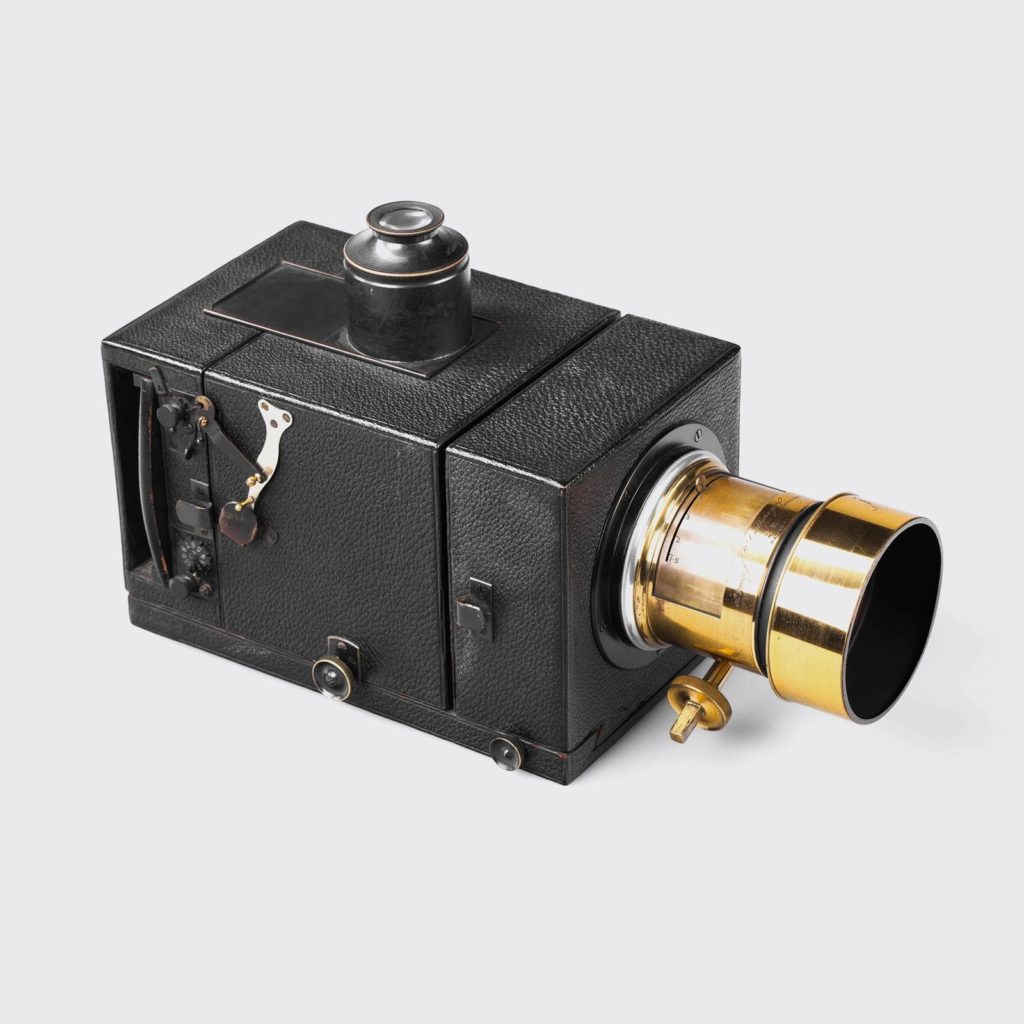
Marion & Co. introduces the New Academy which adds a mirror behind a glass screen to a pair of vertically mounted lenses which slide for focusing making the camera into a twin-lens reflex model
The Interchangeable View Camera is marketed by Eastman Dry Plate & Film Co. It is a plate camera that can also be fitted with an Eastman Roll Holder containing a roll of flexible film
1888 The Kodak is George Eastman’s legendary first roll-film camera bearing the new brand name. It comes pre-loaded with a 100-exposure roll of flexible film. After finishing the roll, the consumer posts the camera back to the factory to have the prints made
‘Krügener’s Taschenbuch’ Patent Book Camera is one of the smallest cameras of its time, with dimensions of just 45 × 100 × 140mm
E & H T Anthony introduces the Fairy, an 8 x 10 inch lightweight folding view camera with a revolving back and bellows so pictures could be taken both horizontally or vertically
1889 The No.1 and No. 2 Kodaks are introduced. They resemble the original Kodak Camera, but have a different shutter and are available with paper-based stripping film or its successor, Eastman transparent film
George Eastman introduces the first transparent plastic roll film, made from highly flammable cellulose nitrate film
The Loman Reflex, the first commercially produced camera with a focal-plane shutter, is introduced
c. 1890 L’Orthoscope by E. Tourtin, is the first French reflex camera, for plates 9 x 12cm
1891 Kodak markets its first daylight-loading camera, the Daylight Kodak, which meant that the photographer could now reload the camera without using a darkroom.
1892 The Boston Camera mfg. Company produces the Bulls-Eye camera, the first to use Samuel Taylor’s new numbered paper backed film, which requires the introduction of a red window
W. Griffiths & Co. Ltd introduces the innovative Zodiac which replaces the usual wooden base of the period with telescoping metal tubes. The rear standard slides along the tubes and for fine focusing they are extended by a worm screw
1893 J. Lancaster & Son, Birmingham, England introduces the Instantograph Patent Camera, a 1/4-plate model complete with Lancaster’s Patent Instantaneous Lens and rubber-band shutter, one of a series of models first introduced in 1888
The first Richard Vérascope stereo camera is launched. It is the best selling stereo camera of its time. The range will continuing through the 1950s
1894 Kodak markets the Flat Folding Kodak in England. It is a folding camera for darkroom loaded roll film, with a capacity of 48 pictures of 4 x 5 inch on one spool
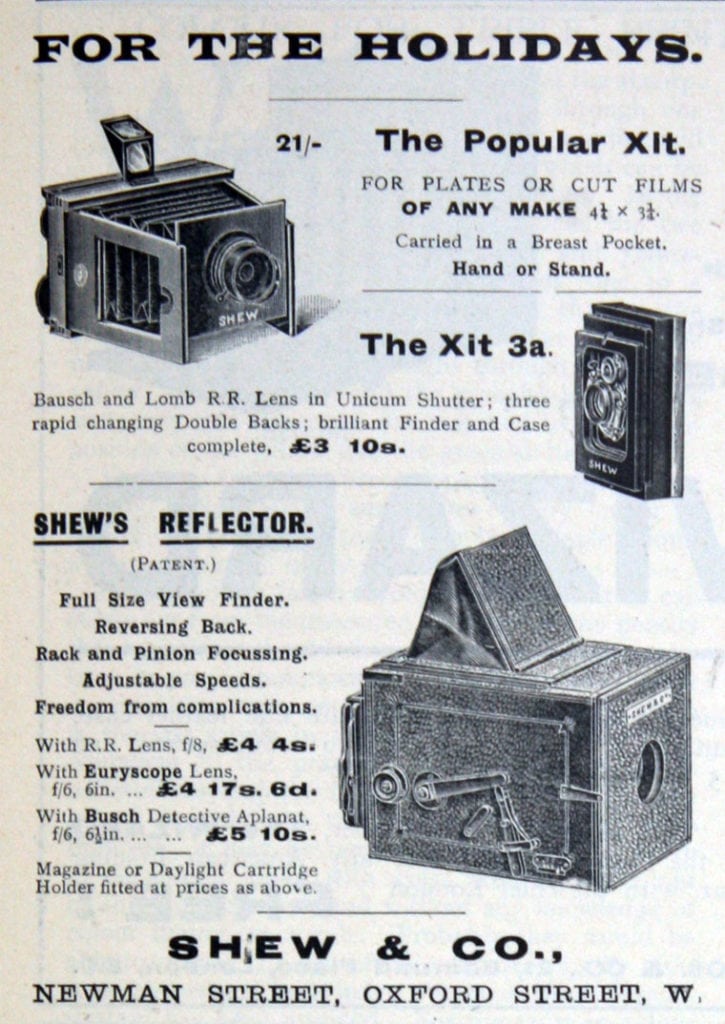
The Xit series of cameras are introduced by J. F. Shew. The folding side-strut design (also known as chambre à joues) makes the camera quite compact when folded. Shew advertises them as “the most portable camera in the world”
1895 The Pocket Kodak appears, the first mass-produced snapshot camera
Sanderson’s Universal Swing Front Camera is introduced, a bellows camera with a variably movable lensboard and the first highly flexibleview camera
The Briefmarken Camera was manufactured by Emil Wunsche, of Dresden Germany featuring 12 lenses to capture 12 stamp size portraits simultaneously on 9 x 12cm size plates
1896 The Zar Camera Company of Chicago launches the Pocket Zar, a miniature glass plate box camera with a body entirely constructed of cardboard, a material never used to such an extent in cameras before
1897 Kodak markets the Folding Pocket Kodak, which produces a 2¼ x 3¼ inch negative
Kodak introduces the No. 4 Cartridge Kodak, which takes 4 x 5 daylight loading roll film and becomes the most successful of the range with more than 90,000 produced between 1897 to 1907
c. 1899 The Pascal is one of the first cameras for roll film, and the first with spring-motorised film advance. It is a box camera, with a wood-and-metal body, with leather covering and makes twelve pictures 40×55 mm on special roll film
1900 Kodak introduces the first of the Brownie series which brings the snapshot to the masses. It is a cardboard box camera with a simple meniscus lens that takes 2 1/4-inch square pictures on 117 roll film
Kodak markets the The No. 3 Folding Pocket Kodak Camera, a camera that would go on to have probably the largest number of model variations of any Kodak camera made.
Early Photography Web Resources
Most of the resources I have found for early photography provide information on British manufacturer’s and their cameras. This is not because that is my exclusive interest, jut what I have come across so far. If you have information on early photography books or websites from Germany, France, the US or any other country, please share them with me and I’d be glad to update this article.
British Camera Makers. This fine book by Norman Channing and Mike Dunn, now out of print, but still available second hand, covers early photography in Britain in detail, extending into the twlighlight of manufacturing in Britain in the 1960s.
A History of Photography in 50 Cameras by Michael Pritchard is one of the best books on cameras I have read and covers some of the most important camera models, including some early cameras
The massive Encyclopedia of Nineteenth-Century Photography appears to be the definitive work on early photography up to the beginning of the twentieth century, with 1,200 essays. It is however, extremely expensive to purchase in print – I’ve read a couple of the essays online but have not purchased it.
I hope you enjoyed this article on cameras through the years and accompanying timeline. If you spot omissions or errors, please let me know in the comments.
There are many strands in a photography timeline – the chemistry of film and processing, the physics of optics, the mechanical engineering of shutters, the electronics of metering and digital photography, and the camera designs that bring everything together. At each end of the photography timeline, the science is bewilderingly complex – from the arcane chemical processes of early photography to the algorithms of computational photography, which enables cameras to go beyond capturing photons to compute pictures.
It’s not a linear journey; digital photography has been accompanied by a resurgence of interest in all things analogue, characterised by toy cameras, digital filters and apps that produce or replicate the look of film as well as the renewed growth of film photography. I started to shoot with film again in 2016 and around the time I first wrote this article, during the lockdowns of 2020, I started to expand my small collection of vintage film cameras and went back to film photography. There is an all-film gallery of the boats of Deal, Kent shot with a variety of film cameras including SLRs, TLRs and rangefinders here. It’s gratifying to see the growth of UK film businesses such as Analogue Wonderland, which supplies a vast range of film stock and The Intrepid Camera Company, which has reinvented large format photography for the twenty-first century. I’m as interested in looking forward as back however, and and follow new developments with great interest.
I’ve reviewed, and borrowed from, many timelines and dozens of articles and books on the history of film, film processes, cameras, lenses, digital technology, phone camera development and computational photography to compile this photography timeline and in an attempt to combine these strands. The sections of the timeline are of my own devising.
I’ve tried to be diligent with my research and check the facts. The sources for many of ther entries are included as URLs. I have also referred to several excellent books: A History of Photography in 50 Cameras by Michael Pritchard; the Taschen books 20th Century Photography and A History of Photography; Photography A Concise History by Ian Jeffrey and Photography, the Definitive Visual History by Tom Ang, all of which I can recommend. If you spot any factual errors please feel free to share them with me along with the source(s).
There are two other timelines on this site, one for nineteenth century cameras and a year by year timeline for cameras from 1900. These exclude lens, photographic process and phone cameras covered in this article.
Photography Timeline 1826-2020
1826-1850 The Genesis of Photography
c. 1826 Joseph Nicéphore Niépce uses bitumen of Judea for photographs on metal and makes the first successful camera photograph, View From My Window at Gras
1827 Niépce addresses a memorandum on his invention to the Royal Society in London, but does not disclose details
1829 Unable to reduce the very long exposure times of his experiments, Niépce enters into a partnership with Louis-Jacques-Mandé Daguerre
Charles Chevalier creates a compound achromatic lens to cut down on chromatic aberration, a failure of a lens to focus all colours to the same plane, for Louis-Jacques-Mandé Daguerre’s photographic experiments
1835William Henry Fox Talbot makes his first successful camera photograph or “photogenic drawing” using paper sensitised with silver chloride,
1839 The public birthday of photography, from three inventors – Daguerre, Fox Talbot and Bayard
Louis-Jacques-Mandé Daguerre’s Daguerreotype becomes the first photographic process to be adopted, creating a unique image on a silvered metal plate of remarkable sharpness.
Hearing of Daguerre’s invention, Fox Talbot announces a paper process to achieve images by action of light and presents his photogenic drawings at the Royal Society in London
Hippolyte Bayard produces direct-positive images (like Daguerre’s process) on sensitized paper (like Talbot’s).
Sir John Herschel suggests fixing images in sodium thiosulphate. He also coins the terms photography, negative and positive.
Stereoscopic depth sensing is first explained by Charles Wheatstone as he invents the stereoscope
1840 The Petzval Portrait becomes the first wide-aperture portrait lens and the first photographic lens where the design was computed mathematically before construction
Alexander Wolcott opens The earliest known photography studio New York City – a “Daguerrean Parlor” for tiny portraits, using a camera with a mirror substituted for the lens
Alexander Wolcott patents a modified Daguerrotype camera using a polished concave mirror to reflect the focused light onto a photosensitive plate
The cyanotype or blue-print is invented by Sir John Herschel, the first photographic process not to use silver
Fox Talbot discovers what will be revealed as the Calotype process the following year, the first known method of multiplying an image
J.F. Goddard uses iodine to shorten exposure times for daguerreotypes
1841 Fox Talbot patents the Calotype process, or photogenic drawings that produces photographic images on salted paper – a negative-positive process that makes multiple copies possible.
The first photographic studio in Europe is opened by Richard Beard in a glasshouse on the roof of the Royal Polytechnic Institution in London
The Royal Academy of Science in Brussels displays the earliest stereographs
Joseph Puchberger patents the first hand crank driven swing lens panoramic camera
1844 Fox Talbot publishes The Pencil of Nature bringing photography to the attention of a wider public
Robert Hunt’sResearches on Light records the first known description employing platinum to make a photographic print, but does not succeed in producing a permanent image
1845 The Bourquin of Paris camera is the first camera with the lens in a metal tube using a rack and pinion mechanism for focusing.
Two French Physicists, Fizeau and Foucault develop the first recognisable shutter mechanism in order to photograph the sun
1847Louis Désiré Blanquard-Evard improves Talbot’s Calotype process and presents his research to the French Academy of Sciences
1848Edmond Becquerel makes the first, temporary, full-colour photographs, though an exposure lasting hours or days is required and the colours sometimes fade right before the viewer’s eyes
1850 The albumen print is announced by Louis-Désiré Blanquard-Évrard, delivering greater density, contrast and sharpness than had been possible with a salted paper print.
1851-1870 Instantaneous Photography
1851 English sculptor Frederick Scott Archer invents the Collodion process, or collodion wet plate process, which is 20 times faster than all previous methods and is free from patent restrictions
The Great Exhibition transforms stereoscopy from a minor scientific interest to a craze which will not wane until the 1870s
1853 The Tintype process is first described by Adolphe-Alexandre Martin – an inexpensive direct positive on a thin sheet of metal coated with a dark lacquer or enamel
1854James Ambrose Cutting takes out several patents relating to the Ambrotype process, underexposed or bleached wet collodion negatives that appeared positive when placed against a dark coating or backing
Parisian portrait photographer André-Adolphe-Eugène Disdéri patents the Carte-de-visite (CdV), a new style of portrait utilizing albumen paper the size of a visiting card that will become commonly traded among friends and visitors
1855 The carbon process is patented by A. L. Poitevin, producing an image resistant to fading which becomes widely used in book illustration
1857 The folding camera with tapering bellows is invented by C.G.H. Kinnear, forming the basis for subsequent bellows designs
1858 John Waterhouse invents Waterhouse stops, a system using plates with different aperture diameters that could be inserted into a slot in the lens barrel which are the earliest selectable stops.
John Harrison Powell registers his design for a portable stereoscopic camera.
Fox Talbot perfects photoglyphic engraving, the forerunner of the they dust-grain photogravure process.
1859 Thomas Sutton introduces the Panoramic Camera, which uses a spherical water-filled lens to create a panoramic photograph
Dr. J.M. Taupenot develops the dry collodion-albumen process, though adoption of dry plate photography would come later with the gelatine dry plate process
1860 John Jabez Edwin Mayall popularises the carte-de-visite with a set of portraits of the Royal Family at Buckingham Palace published in an album
1861 James Clerk Maxwell presents a projected additive colour image, the first demonstration of colour photography by the three-colour method
The first photographic single-lens reflex camera (SLR) is invented by Thomas Sutton
Oliver Wendell Holmes creates but does not patent a handheld, more economical, stereoscopic viewer than had been available before
1862 The first successful wide-angle lens is the Harrison & Schnitzer Globe
1863 The cabinet card is first introduced by Windsor & Bridge in London, a larger form of the carte-de-visite suitable for display in parlours
1871-1900 Instantaneous Photography without the Chemistry
1871 English physician Richard Leach Maddox invents the lightweight gelatin dry plate silver bromide process, assigning the complex and arduous chemistry work photographers had previously to undertake to a factory
1873Charles Harper Bennett improves the gelatin silver process by hardening the emulsion, making it more resistant to friction
The platinotype process, which produces platinum prints, is patented by William Willis.
1877 George Eastman learns to make his own gelatin dry plates, based on the writings of the British innovators, including Charles Harper Bennett
1878 Heat ripening of gelatin emulsions is discovered by Charles Harper Bennett, making possible very short exposures and paving the way for the snapshot
Eadweard Muybridge’s sequential photographs of a galloping horse settle whether all four hooves leave the ground, and establish the photographic analysis of motion.
1879 George Eastman applies for a patent for an emulsion-coating machine, which enables him to mass-produce photographic dry plates
1881 Thomas Bolas patents a hand-held, box form camera he calls a detective camera
1882Etienne Jules Marey perfects a chronophotographic gun, a device capable of taking 12 exposures a second.
1883 Ottomar Anschütz designs a camera with an internal roller blind shutter mechanism in front of the photographic plate – the first focal-plane shutter in recognisable form
William Schmid patents the first detective camera to be widely sold
1885 The first flexible photographic roll film was sold by George Eastman, though this original “film” was actually a coating on a paper base
1886 Frederick E. Ives develops the halftone engraving process, making it possible to reproduce photographic images in the same operation as printing text
The first single use camera, the Ready Fotografer, is introduced, using a dry plate, though it appears to have enjoyed very limited success
1887The Rev. Hannibal Goodwin files a patent application for camera film on celluloid rolls, though it will be not granted until 1898, by which time George Eastman has started production of roll-film using his own process
Adolf Miethe and Johannes Gaedicke produce Blitzlicht – the first ever widely used flash powder
1888 The Kodak n°1 box camera, the first ready-loaded, easy-to-use camera is introduced with the slogan “You press the button, we do the rest.”
1889 George Eastman introduces the first transparent plastic roll film, made from highly flammable cellulose nitrate film
The Loman Reflex, the first commercially produced camera with a focal-plane shutter, is introduced
Eastman’s celluloid roll film is adopted by Thomas Edison for his 35mm motion picture format, fixing the film width that will later dominate still photography.
1890 The Zeiss Protar, the first successful anastigmat photographic lens, designed Dr Paul Rudolph, is introduced
Hurter and Driffield introduce the “S” shaped characteristic curve which is central to sensitometry, the science of light-sensitive materials
The Ilford Manual of Photography is first published, providing detailed technical information regarding optics, chemistry and printing.
W.W. Rouch and Co. introduce the Eureka, which will become a popular detective, or hand, camera
The German manufacturer C.P. Goerz incorporates the Anschütz focal-plane shutter into a camera
Jacob Riis publishes How the Other Half Lives, the first sustained use of flash photography for social documentary.
1891 Bausch and Lomb introduce the first of their iris diaphragm shutters, incorporating an f-stop and shutter speed setting device
1892 Samuel N. Turner applies for a US patent for paper-backed, daylight-loading roll film. The backing paper is printed with white exposure numbers which can read through a red window in the back of the camera. The idea is incorporated in the Boston Manufacturing Company’s ‘Bullseye” camera of the same year.
1893 The Cooke triplet lens is patented by Harold Dennis Taylor of T. Cooke & Sons, the first lens system that eliminates most of the optical distortion or aberration at the outer edge of lenses
1895 The Pocket Kodak appears, the first mass-produced snapshot camera.
George Eastman recognises the potential of Samuel N. Turner’s daylight loading process and acquires his company, having licensed the process initially.
1896 The Zeiss Planar lens, designed by Dr Paul Rudolph, is introduced.
The Dallmeyer-Bergheim soft-focus lens produces soft definition without losing the natural structure of the object being photographed
A collapsible version of the Goerz Anschütz camera, the Ango, is introduced, which becomes popular and is widely copied
1897 Kodak markets the Folding Pocket Kodak which produces a 2 1/4″ x 3 1/4″ negative – the standard size for decades
1899 The Sanderson hand camera, the first highly flexible view camera that allows photographers to retain the correct perspective, is introduced
1900-1947 The Rise of Popular Photography
1900 Kodak bring the Brownie, an inexpensive user-reloadable point-and-shoot box camera and the most successful camera range of all time, to market
1901 The popular medium format film 120 film is launched by Eastman Kodak for its Brownie No. 2, and will become the longest surviving roll film format
1902 Carl Zeiss introduces the Tessar lens, an inexpensive design that becomes extremely popular
Alfred Stieglitz founds the Photo-Secession, the movement that presses photography’s claim to be an art in its own right.
The Thornton-Packard Company introduces The Royal Ruby, a field camera in polished mahogany with brass fittings and leather bellows, as the King of Cameras
1903 To compensate for the curl resulting from gelatine emulsion, Kodak adds a layer of gelatine coating to the back of the film and introduces it as N.C. (Non Curl) film.
1904 Realising that tarnish reduces reflection, Dennis Taylor of Cooke Company develops a chemical method for producing lens coatings
The term Straight Photography is first used in the journal Camera Work as response to Pictorialism
The Midg No. 0, a quarterplate magazine camera that takes twelve glass plates in metal holder is introduced.
1905 The Soho Reflex large-format single-lens reflex camera is introduced and becomes the definitive SLR model until after WWII
The first telephoto lens optically corrected and fixed as a system is introduced – the f/8 Busch Bis-Telar
Thomas Manly introduces the Ozobrome process, a simplified carbon process, which becomes a favourite amongst Pictorialists
1906Panchromatic plates, sensitive to all wavelengths of visible light, are marketed by Wratten and Wainright in England
c.1906 The Ticka, a watch-style disguised camera, is introduced and goes on to become the most popular watch-form camera ever made. It is loaded with a film carried in a one-piece drop-in cartridge.
1907 The Autochrome plate is introduced, the first commercially successful colour photography product.
1908 Kodak produces the world’s first commercially practical safety film using cellulose acetate base instead of the highly flammable cellulose nitrate base.
c. 1910 Adoption of the bromoil process begins, creating the soft images reminiscent of paint popular with the Pictorialists
1911 In Italy, The Bragaglia brothers begin experiments in photodynamism
The Graflex Speed Graphic press camera is introduced and will continue in production until 1973
1913 Kodak introduces Eastman Portrait Film and begins supplying 35mm cine stock in forms suited to still photography; the 35mm width itself dates from 1889 to 1892.
Oskar Barnack, creates the Ur-Leica, the prototype of a small-format 35mm camera, doubling the width of 18x24mm cinema film and running it horizontally, rather than vertically as in cinema cameras of the time
The introduction of Eastman Portrait Film begins the transition to sheet film instead of glass plates for professional photographers
1917 Paul Strand’s essay Photography and the New God in the final issue of Camera Works argues for images to be sharply focused and clearly camera-made
1924 The first common wide aperture lens becomes available with the f/2 Ernemann Ermanox
1923 The first fisheye lens is the Beck Hill Sky (or Cloud in the UK) lens designed for scientific cloud cover studies
1925 Leica introduces the Leica I, a watershed design that makes the 35mm format truly viable
The wide aperture Ermanox becomes available with an f/1.8 lens
1928 The Rolleiflex offers photographers superb build quality, superior optics and bright viewfinders
The Zeiss Sonnar lens is patented by Zeiss Ikon. It is notable for its relatively light weight, simple design and fast aperture.
The Vacublitz, the first true flashbulb made from aluminium foil sealed in oxygen, is produced in Germany by the Hauser Company.
1929 Minolta, originally named the Nichi-Doku (which means “Japan-German”) Photographic Company, introduces its the first camera, the Nicalette, which is equipped with a German shutter and lens.
1930 The Leica I Leica Thread Mount (LTM) offers a camera with interchangeable lenses.
c. 1931 Dr Harold Eugene “Doc” Edgerton, invents of the ‘strobe’ flash, transforming the stroboscope from an obscure laboratory instrument into a common device
Rodenstock introduces the Imagon, which will become one one of the classic professional soft-focus portrait lenses, a look strongly associated with images of Old Hollywood
Kodak introduces Verichrome film, offering greater latitude and finer grain than the Kodak NC (Non-Curling) Film that had been the standard since 1903.
1932 The Leica II is launched, the first Leica camera with a rangefinder, which becomes a signature of the company
Group f.64 is formed – an association of California photographers who promote sharply detailed, purist photography
The first Agfacolor film is introduced, a film-based version of their Agfa-Farbenplatte (color plate) product which is similar to Autochrome
The first photo-electric light meter is introduced, the Weston Model 617
Voigtländer introduce the Prominent, a a6x4 folding bed, coupled rangefinder camera, Voigtländer’s first rangefinder camera
1933 The Leica III is introduced and is produced in parallel with the Leica II, and will remain in production in various iterations until 1960
The first Rolleicord is introduced, a simplified version of the Standard Rolleiflex, with a cheaper 75mm Zeiss Triotar lens
1934 Kodak releases the first preloaded 35mm film, the 135 film cartridge, removing the need for photographers to load their own film into reusable cassettes in a dark room
Minolta creates the first Japanese camera to use the 6 x 4.5cm format – the Semi Minolta I.
1935 Eastman Kodak markets Kodachrome film, the first colour film that uses a subtractive color method to be successfully mass-marketed
Zeiss Ikon introduce the Super Ikonta B, a premium quality, folding medium format rangefinder camera notable both for its build and image quality
Canon introduces the Hansa, the first Asian 35MM camera.
Leica introduces the Thambar, a legendary 90mm f2.2 soft focus portrait lens
Interference-based anti-reflective coatings are invented and developed by Alexander Smakula of the Carl Zeiss optics company
1936 the first widely-distributed 35mm SLR camera, the Kine Exakta, is introduced, with a design that will influence many subsequent SLRs.
Zeus Ikon launch the Contax II, the first camera with a rangefinder and a viewfinder combined in a single window.
1937 The Rolleiflex Automat introduces automatic film loading and transport.
The Minox subminiature camera is introduced, becoming one of the most suitable cameras for covert use.
1938 Kodak Introduces the Super Six-20, the world’s first camera with built-in photoelectric exposure control
The first hot shoe appears on the Univex Mercury, though hot shoes did not become common until the 1960s.
Jaeger-LeCoultre produce the Compass Camera, an Ultra-Compact 35mm Camera, machined out of solid aluminium and designed by Noel Pemberton Billing
1939 The Argus C3 is introduced and becomes the world’s best-selling 35mm camera, offering affordable 35mm rangefinder photography to amateurs
Kodak adds a ready-mount Service for 35 mm Kodachrome Film. This makes it possible to project slides as soon as they are received from the processing laboratory.
1940 Kodak introduces Tri-X film in sheet film formats
The first Minolta-made lens with the “Rokkor” name appears on a portable aerial camera used for military purposes, named in honour of Mt. Rokko.
1941 The Kodak Ektra 35mmRF is introduced with the first complete anti-reflection coated lens line for a consumer camera
1942 Eastman Kodak introduces Kodacolor – the first negative film for making colour paper prints.
1945 The Kodak dye-transfer process is introduced
1946 Kodak markets Ektachrome Transparency Sheet Film, the company’s first colour film that photographers could process themselves using newly marketed chemical kits
1947 Robert Capa, Henri Cartier-Bresson, David Seymour, and George Rodger found Magnum Photos, the first picture agency owned by its photographers.
1948-1984: The Refinement of Film Photography and the Birth of Digital
1948 Instant photography is introduced with the first instant-film camera, the Land Camera 95 or Polaroid camera.
The iconic Hasselblad 1600F camera is introduced and goes on to develop a reputation as the ultimate professional camera.
Nikon introduces the Nikon 1 rangefinder, the first Nikon-branded camera ever produced. The design is based on the Contax rangefinder but with a simpler shutter similar to that used by Leica.
1949 The modern lens aperture markings of f-numbers in geometric sequence of f/1, 1.4, 2, 2.8, 4, 5.6, 8, 11, 16, 22, 32 etc. is standardised
The Contax S camera is introduced, the first 35 mm SLR camera with a pentaprism eye-level viewfinder
Kodak introduces high-speed Tri-X black and white film on 35mm and roll film. Aimed squarely at photojournalists, it was the first fast film for general use.
1955 The Kilfitt Makro-Kilar f/3.5 is the first macro lens to provide continuous close focusing
1957 The Asahi Pentax SLR is introduced, placing controls in locations that would become standard on 35 mm SLRs
Hasselblad introduces the medium format 500 C system camera, which will go on too become one of most influential and successful cameras of all time
1958 Minolta introduces the first achromatic lens coating – two layers of magnesium fluoride deposited in different thicknesses to radically reduce glare and flare.
1959 The Nikon F is introduced, Nikon’s first SLR and the first SLR aimed at professional photographers
The the first production varifocal (zoom) lens for still 35mm photography is produced – The Zoomar 36-82mm f/2.8 for Voigtländer Bessamatic 35mm SLRs
Kodak High Speed Ektrachrome film becomes the fastest colour film on the market
1960 Konica introduces the Konica F, featuring the Hi-Synchro, the first SLR shutter with a speed of 1/2000s
1961 Eastman Kodak introduces faster Kodachrome II color film
1962AGFA introduces the first fully automatic camera, the Optima, with an automatic programmed exposure, using a selenium-meter-driven mechanical system
The Nikkorex F is the first production single-lens reflex camera with the metal Copal square shutter
1966 The VEB Pentacon Prakica is the first SLR with an electronically controlled shutter
Zeiss produce the Planar 50mm f/0.7, the world’s fastest lens, used by NASA to photograph the far side of the moon
The Rollei 35 is introduced as the smallest full-frame 35mm camera in the world
1967Nikon F Photomic SLR is the first camera with a centre-weighted exposure metering system
1969 The foundations for digital photography are established with the development of the charged-couple device (CCD) at Bell Labs.
1971 Nikon introduce the F2 to succeed the legendary F with a variety of finder options.
1972 Kodak reduces the popular Instamatic Camera to pocket size with the introduction of the Pocket Istamatic Camera with the new easy-load 110 Film Cartridge, extending the cartridge loading principle to what had hitherto been known as the sub-miniature camera.
Polaroid introduces the SX-70 an improvement on previous models that ejects pictures automatically and without chemical residue.
The Copal Compact Square Shutter (CCS), one of the most notable focal plane shutters of the ’70s, is introduced with the Konica Autoreflex TC
1977 Fuji introduces the first zoom lens to be sold as the primary lens for an interchangeable lens camera – the Fuji Fujinon-Z 43-75mm f/3.5-4.5
The Minolta XD11 is the world’s first camera with aperture priority and shutter priority, as well as a fully metered manual mode.
Kodak enters the instant picture field with a range of cameras and a new film. Kodak instant cameras do not need a mirror to reverse the image laterally, which is a requirement for Polaroid cameras, but litigation from Polaroid soon follows.
Kodak introduces the DC 210, the first “Megapixel resolution” digital camera selling for under $1000 ($899).
1978 Konica introduces the C35 AF, the first point-and-shoot autofocus camera.
1979 The highly portable and collapsable medium format Plaubel Makina 67 is released
Olympus launch the XA series, one of the smallest rangefinder cameras ever made, featuring a fast 35mm f2.8 F. Zuiko lens, and aperture priority metering.
1980 The Ricoh AF Rikenon 50mm f/2, the first interchangeable autofocus SLR lens, is introduced
Nikon introduces the F3, with manual and semi-automatic exposure control.
1981 Sony introduces the Mavica, a TV camera that records TV-quality still images on magnetic floppy discs.
The Sigma 21-35mm f/3.5-4 becomes the first super-wide angle zoom lens for still cameras.
International speculation on the silver market causes a significant rise in the price of silver, an important base material for the photographic industry. Agfa-Gevaert’s struggles results in the group being acquired by Bayer.
The low-tech plastic Holga camera is introduced, which will later attain cult status with the advent of Lomography and become a major source of inspiration for Instagram.
1982 Nikon introduces the FM2, which uses an improved Copal Square Shutter to achieve an unheard-of speed range of 1 to 1/4000th second and a fast flash X-sync speed of 1/250th second.
Kodacolor VR 1000 film is announced at Photokina. It is a T-Grain film, which makes possible such a high speed film with tolerable grain.
1983 The Olympus OM-4 is the first camera with a multi-spot exposure meter, taking up to eight spot measurements and averaging them
Nikon introduces the FA, the first camera to offer a multi-segmented (or matrix or evaluative) exposure light meter, which uses two segmented silicon photodiodes to divide the field of view into five segments.
1984 LOMO begin mass-producing the LC-A, achieving popularity within the USSR and kickstarting Lomography.
The Contax T, the first in a series of high quality, exceptionally compact 35mm rangefinder cameras is introduced
Leica introduces the M6, which resembles the Leica M3 but adds a modern, off-the-shutter light meter with no moving parts and LED arrows in the viewfinder.
1985-2006: Autofocus to Camera Phones
1985 Minolta introduces the world’s first fully integrated autofocus SLR with the autofocus (AF) system built into the body – the Maxxum 7000.
1986 The disposable camera is popularised by Fujifilm with the 35mm QuickSnap, which helps to define consumer photography in the late ’80s and ’90s
The Canon T90 marks the pinnacle of manual-focus 35mm SLRs
Canon launches the RC-701 ‘Realtime camera’ the first commercially available Still Video Camera
Kodak introduces T-MAX film which is smooth, fine grained and sharp – characteristics due to its use of a tabular grain emulsion. T-MAX 100 has a very high resolution of 200 lines/mm and is often used for testing the sharpness of lenses.
1987 Canon launches the EOS (Electro-Optical System), an entirely new system designed specifically to support autofocus lenses.
Canon becomes the first camera maker to successfully commercialise Ultrasonic Motor (USM) lenses which appear with the introduction of the EF 300 mm f/2.8L USM lens
1988 The Fuji DS-1P, the first digital handheld camera, is introduced, though it does not sell
The JPEG and MPEG standards are set.
1989 Canon introduces the 50mm f/1.0L, the fastest AF EF mount lens, and one of the fastest lenses in the world.
1990 Adobe Photoshop 1.0 image manipulation program is introduced for Apple Macintosh computer.
Eastman Kodak announces the development of its Photo CD system
The gum oil process, a painstaking and highly expressive photographic method, is invented by Karl P. Koenig.
1993 The f2 35 mm autofocus Konica Hexar is introduced, one of the quietest of 35mm cameras
The instantly recognisable Nikon 35Ti compact camera is released with a distinctive analog display on top
The Canon EF 1200mm f/5.6L USM is introduced, which Canon claims as the longest focal length lens available for any interchangeable-lens autofocus SLR.
Eric Fossum and colleagues at NASA’s Jet Propulsion Laboratory develop the CMOS active pixel sensor, the technology that will make the camera phone possible.
1994 The Apple Quicktake 100 is among the first consumer colour digital cameras, connecting to a Macintosh by serial cable.
SanDisk introduces CompactFlash, the first removable digital storage format to be widely adopted by camera makers.
1995 The Casio QV-10 is the first camera to incorporate an LCD screen on the back for image preview and playback
1996 Eastman Kodak, FujiFilm, AgfaPhoto, and Konica introduce the Advanced Photo System (APS), enabling the camera to record information other than the image
The Canon IXUS is the firstIXUS APS camera, Canon’s contribution to the launch of the APS film system and an important milestone in compact camera design
Hasselblad introduces the V-system 503 C/W medium format film camera which will continue into production until 2013
1997Philippe Kahn publicly shares a picture via a cell phone for the first time
1998 Leica launches The M6 TTL to replace the M6 with a larger, reversed shutter dial and TTL flash capability
Kodakintroduces the Portra family of daylight-balanced professional colour negative films for portrait and wedding applications.
Fujifilm launches Instax, which by the 2010s outsells every digital camera line and becomes the largest surviving film business.
1999 The first commercial camera phone, the Kyocera Visual Phone VP-210, is launched in Japan
The Nikon D1 is the first fully integrated digital SLR designed from the ground up, rather than a digital modification to a film SLR
2000 Sharp and J-Phone introduce the first mass market camera-phone in Japan, The J-SH04
Canon introduces the EOS D30, the company’s first digital SLR produced in-house. Previously Canon had a contract with Kodak to rebrand DCS models. It was also the first DSLR with a price tag affordable to enthusiasts.
2001 Nikon produce the manual focus FM3a, the last manual focus 35mm SLR released by a major maker
Adobe releases Lightroom, which establishes the catalogue and develop workflow that becomes standard for digital photographers.
2008 Panasonic releases the Lumix G1, the world’s first mirrorless interchangeable-lens camera – which uses the main image sensor for autofocus, metering and full-time electronic viewing.
The Nikon D90 is the first DSLR with HD video recording capabilities
Olympus and Panasonic announce the Micro Four Thirds standard, the first shared mirrorless system mount.
Polaroid ends instant film production, and the Impossible Project acquires the last factory, restarting production in 2010.
2009 FujiFilm launches world’s first digital 3D system
The FinePix Real 3D System includes includes the FinePix Real 3D W1 digital camera, FinePix Real 3D V1 picture viewer and 3D print capability
The Leica M9 is the first full-frame digital Leica M.
Sony introduces the first consumer back-side illuminated (BSI) sensor, the “Exmor R“, which improves low-light performance
2010 Instagram, the photo and video-sharing social networking service is launched on iOS.
Worldwide demand for photographic film falls to less than a tenth of what it had been ten years before
c.2010 Photographers start to use social media filters and apps such as Hipstamatic s part of a wave of analogue nostalgia
2011Lytro releases the first pocket-sized consumer light-field camera, capable of refocusing images after they are taken
The Fujifilm FinePix X100 is introduced, the first model in the Fujifilm X-series, a range that makes the case for the benefits of APS-C over full-frame cameras
Instagram adds hashtags to help users discover both photographs and each other
2012 Sony launches the world’s first full frame compact camera – the RX1, with a fixed 35mm F2 lens
Sigma launches its Art line, the point at which independent lens makers begin to compete with camera manufacturers on quality rather than price.
Olympus introduces the OM-D E-M5 with a 5-axis sensor-shifting image stabilisation system – the first of its kind in a consumer camera
Nokia launches the Lumia 920, the first cell phone with an optical stabilised sensor
The Nikon D800 is introduced with the world’s highest resolution DSLR sensor
Eastman Kodak files for Chapter 11 bankruptcy protection.
2013 Sony announces the ⍺7 which starts the full frame mirrorless revolution.
Nokia launches the Lumia 1020 phone with a 1.5 inch 41 megapixel rear sensor
Sales of digital cameras in the United States of America start to fall in terms of revenue and in unit shipments, as more consumers turn to smartphones and social media
Hasselblad discontinues the 503CW medium format film camera
Leica introduces the Leica T (Typ 701) with Leica’s first fully-electronic, designed-for-mirrorless lens mount
Google introduces HDR+, which merges a burst of underexposed frames into a single image, establishing the capture and merge principle underlying modern computational photography.
2015 Google Photos delivers AI-based organisation of images
Sony announces the first camera to employ a back-side illuminated full frame sensor, the α7R II.
Leica announces the full frame, fixed-lens compact Leica Q (Typ 116) – the first full-frame Leica to incorporate an autofocus system.
2016 Apple introduces Portrait Mode, which uses the dual backside cameras to create a depth map to isolate a foreground subject and then blur the background
Apple introduces the iPhone 7 Plus. The iPhone offers a dual camera setup with different focal lengths, 23mm and 56mm, entering the realms of telephoto on a phone.
The Google Pixel applies machine learning to HDR+ under Marc Levoy, and processing rather than optics becomes the principal difference between phone cameras.
2017 The Sony a9 introduces a stacked CMOS sensor with blackout-free shooting at twenty frames a second, the design that will define professional mirrorless cameras.
Intrepid Camera launches its Kickstarter project for a light-weight, low cost, compact 10X8 film camera.
2018 The Huawei P20 Pro provides a new triple camera system
Leica, Panasonic, and Sigma form the L-Mount Alliance, the first shared full frame mirrorless mount.
Canon officially discontinues the EOS-1V, the company’s last remaining film camera
Nikon introduces the Z6 and Z7 mirrorless cameras.
Google Night Sight achieves similar results to a camera on a tripod with a handheld Pixel camera phone using consecutive shots reassembled into a single image via an algorithim
Leica introduce the Leica M10-D, a digital camera without an LCD screen designed to combine the excitement of film with digital technology.
Researchers at Dartmouth College announce the Quanta Image Sensor (QIS) which replaces pixels with jots, where each jot can detect a single particle of light (photon)
Mirrorless cameras overtake DSLRs based on value (CIPA data)
2019 Xiaomi introduce the CC9 Pro, with five rear cameras including one with 108-megapixels
The Fujifilm GFX 100 is the world’s first medium format camera to offer in-body image stabilization, with a 102MP BSI-CMOS sensor
4.5 million digital single-lens reflex (DSLR) cameras manufactured by CIPA companies are shipped, down from 16.2 million in 2012
Apple introduces Deep Fusion, which merges nine exposures at the pixel level.
2020 Samsung Introduces the Galaxy S20 Ultra with five cameras to capture 108MP photos, 100 x zoom and 40MP selfies
Apple introduces ProRAW, delivering computationally processed images in an editable raw file.
Apple adds a LiDAR scanner to the iPhone 12 Pro, giving depth measurement rather than depth estimation.
Nikon’s introduces the D780, its first DSLR to incorporate on-chip phase-detection autofocus, a feature inherited from its mirrorless Z series
Canon launches the EOS R series next-generation full-frame mirrorless cameras featuring Dual Pixel CMOS AF technology that provides autofocus in low-light conditions previously too dark to focus in.
The Apple 12 ships, with a new 7-element design with an ƒ/1.6 aperture for the primary camera as well as advancements to Smart HDR and Deep Fusion.
Digital camera shipments drop to a new low of 8.9 million units, down from 121 million units in 2010.
Mirrorless cameras overtake DSLRs based on unit volume (CIPA data)
The first large-scale image recognition system based on transformers, Vision Transformer (ViT), is introduced by Alexey Dosovitskiy and Thomas Kipf
2021 Sony introduces the ⍺1, a 50.1MP, 8.6K camera capable of shooting bursts at up to 30fps blackout-free, with 15 stops of dynamic range, real-time animal eye AF and anti-distortion shutter technology.
Olympus exits the camera market, completing the sale of its camera business to JIP, a Tokyo-based venture capital firm.
The Coalition for Content Provenance and Authenticity is founded, establishing the C2PA standard behind Content Credentials.
Nikon announces, and very late in the year, ships, the Z9 – the first professional camera to arrive without a mechanical shutter without rolling shutter thanks to its fast stacked shutter. It also offers the world’s fastest still image frame rate of 120 fps.
2022 OpenAI launches DALL-E 2. A portmanteau of ‘Dali’ (as in Salvador) and Pixar’s ‘WALL-E’, it offers a massive upgrade on its predecessor, with more realistic results and four-times higher resolution
Stability AI launches Stable Diffusion, a deep learning, text-to-image model based on diffusion techniques.
Apple introduces the Photonic Engine with the iPhone 14, a computational photography technique that enhances photos taken in mid-to-low lighting conditions.
Leica introduces the M11 with a 60MP full-frame back side illuminated sensor
Japanese media organisation Nikkei reports that the compact ‘point-and-shoot’ market has retracted to 3.01m units as of 2021, a drop of 97% from its peak of 110.7m cameras in 2008.
2023 Sony launches the a9 III which delivers the world’s first full-frame global shutter sensor, which allows the camera to freeze motion in captured images with a max shutter speed of 1/80,000 second and 120 fps continuous shooting.
The Leica M11-P becomes the first production camera to sign images with C2PA Content Credentials at the moment of capture.
Nikon introduces the Zf which draws inspiration from the FM2 film camera and features brass dials.
Leica releases the Q3, the third-generation model in its fixed-lens full-frame compact series, featuring a 60MP BSI CMOS and phase detection autofocus, which enhances focus speed and accuracy.
ChatGPT expands its capabilities by adding voice and image functionalities.
According to Nikkei, global shipments of digital cameras in 2023 totaled 7.18 million units, a slight decrease of 0.3% from the previous year.
Google introduces Magic Editor on Pixel devices, enabling context-aware, AI-powered edits like repositioning subjects, removing objects, and enhancing skies with simple gestures.
Adobe unveils Firefly, its generative AI engine, integrating text-to-image and inpainting tools into Photoshop and other Creative Cloud apps.
2024 Canon launches its mirrorless flagship, the EOS R1, featuring a newly developed full-frame stacked CMOS sensor that enables ultra-fast readout speeds and blackout-free continuous shooting. The camera’s Dual Pixel CMOS AF system uses deep learning algorithms for real-time subject recognition and tracking.
Google launches “Add Me” and “Reimagine” tools in the Pixel 9 series, allowing users to generate alternate facial expressions and poses or insert missing subjects using AI.
The year passes with no new releases of DSLRs, marking a near-total shift to the development of mirrorless cameras.
2025 Hasselblad launches the 907X 100C, a modular medium format system combining the CFV 100C digital back with the 907X body, offering a 100MP sensor and compatibility with vintage lenses
Fujifilm announces the development of the GFX ETERNA, its first medium format camera designed specifically for filmmaking, featuring a 102MP sensor.
Huawei’s Pura 80 Ultra merges two periscope lenses and a 1″ sensor, using AI to fuse data for improved dynamic range and enhanced detail. 2025 Sigma introduces the BF, a full frame camera milled from a single billet of aluminium with a radically reduced control set, and the year’s clearest statement that design has become a point of competition.
Fujifilm introduces the GFX100RF, the first fixed-lens compact camera built around a medium format sensor, at 102 megapixels.
Fujifilm introduces the X half, a digital half-frame compact with a vertical sensor and a simulated film advance, aimed directly at analogue nostalgia.
Sony revives its full frame fixed-lens line with the RX1R III, a 61 megapixel compact.
Nikon introduces the ZR, the first camera to come from its acquisition of RED Digital Cinema.
Hasselblad introduces the X2D II 100C, which uses LiDAR to assist autofocus in a medium format camera.
Ricoh introduces the GR IV, and premium compacts including the Fujifilm X100VI, the Leica Q3, and the Sony RX1R III sell out, confirming a compact camera revival driven by younger photographers.
Google releases Gemini 2.5 Flash Image, known as Nano Banana, and Adobe adds it and Black Forest Labs’ FLUX.1 alongside Firefly in Photoshop’s Generative Fill, so a photographic editor can call on competing generative models within one workflow.
The Google Pixel 10 becomes the first consumer smartphone to sign every photograph with C2PA Content Credentials at capture, using hardware-backed keys held in a secure element.
Google releases Nano Banana Pro, built on Gemini 3 Pro, which generates and edits at 4K resolution.
2026 CIPA reports that 9.4 million cameras were shipped worldwide in 2025, eleven per cent up on 2024, with fixed-lens compacts up about thirty per cent by volume and roughly fifty per cent by value, and DSLR shipments down to about 690,000 units.
Ricoh introduces the GR IV Monochrome, and Fujifilm the Instax Mini Evo Cinema, the only notable launches of the first quarter.
Nikon’s C2PA implementation for the Z6 III is suspended and its certificates revoked after a signing vulnerability is found, the first significant setback for camera-level content authentication.
Megadap shows the first autofocus adapter for Leica M lenses on Canon RF bodies, part of a wider move towards cross-system compatibility.
Content authentication becomes more of a system than a single standard, combining C2PA signing at capture, invisible watermarking such as Google SynthID for generated images, and platform-level labelling, as regulatory pressure builds through the EU AI Act.
Brassaï is one of those photographers whose work had an immediate and profound effect on me. His dreamlike nocturnal street photography and sharply observed portraits of life after dark provide a unique set of images that is as close to a time slip into 1930s Paris as most of us will ever encounter.
Paris de Nuit
His most famous work (Paris de nuit, 1933 and Voluptés de Paris 1935) opened up a dark realm that had only been captured by painters before. He was not the first to shoot at night – Alfred Stieglitz amongst others had worked at night previously, but he was the first to produce a substantial body of work. After Paris by Night, other photographers took to sustained nocturnal photography – Bill Brandt captured London in the late 1930s (it was Brassaï’s publisher who commissioned Brandt night time work) and Weegee did the same in New York in the 1940s.
“Night does not show things, it suggests them. It disturbs and surprises us with its strangeness.”
As a self-taught pioneer of night photography in his adopted home of Paris (he was a Hungarian émigré), Brassaï faced the relatively new photographic challenges of working at night, equipped as he was with a Voigtlander 6.5 x 9cm camera, slow f4.5 lens and a wooden tripod. His atmospheric landscape shots needed long exposures and were subjected to excessive contrast from street lights. Ingeniously, he used the varying lengths of his smokes, inevitably including a Gauloise, to time his exposures. He also carried copies of his work to explain his late night activities to local law enforcement. An article on Imaging Resource describes his technique:
Using his training as a painter, Brassaï framed his shots so that small areas of light pierced large areas of blacks and shadows. Light reflected in wet streets and diffused by fog, would define shapes within the dark. This contrast gave his printed images richness and depth and he called these prints his “little boxes of night.”
Ground-breaking though his night photography was, Brassaï had a wide palette. His work ranges from surgically precise photojournalism to avant garde dreamscapes. He combined the eye of an expert people watcher with a painterly ability to shade and tone his work with beautifully diffused light. A polymath, he was a journalist, artist and sculpturer as well as a master photographer. He cited Henri de Toulouse-Lautrec as an influence and was friends with Dali, Picasso and Matisse.
Curiously, Brassaï started out with a dim view of photography, comparing it unfavourably to the art he originally pursued, but it became a requirement of his journalistic assignments, and having seen the beauty of Paris at night he became determined to capture it – defining night photography in the process. He was influenced by his friend and fellow Hungarian André Kertész, a pioneer of photojournalism, of whom Henri Cartier-Bresson said: “Each time Andre Kertész’s shutter clicks, I feel his heart beating.”
A walk on the wild side
Brassaï’s walks in the Montparnasse district of Paris brought him into contact with a night time cast of prostitutes, street toughs, lamp lighters, transvestites and pleasure seekers. He is most famous for the ground-breaking and gritty images he captured of those night folk. In his own words: “Night does not show things, it suggests them. It disturbs and surprises us with its strangeness.” As he was well connected, Brassaï’s work also includes images of high society, including ballet, opera, artists (including Picasso) and the intelligentsia. Consequently his work documents 1930’s Paris from the most marginalised to high society. A New York Times Article published in 1984, the year he died, captured perhaps the most celebrated aspect of his unique vision:
A Transylvanian transplanted to Paris, he managed in the 1930’s to capture aspects of French life that had never before submitted themselves to the camera, and to do so with a directness and vigour that is a hallmark of greatness in the medium. No doubt as a émigré he saw Paris more acutely than most of its natives, but he also was able to penetrate its darker demimonde because of a relentless passion for the forbidden and deep sympathy with the outcast.
Brassaï, like William Klein and Fan Ho (all hugely influential) was an outsider in the environment he chose to shoot in and that contributes, as noted above, to his unique perspective. Although most famous for night photography and Parisians of the night, Brassaï’s work is multi-faceted. Beyond his night time shooting he used the soft, diffuse light of fog and the muted tones of rainy days to capture the essence of Paris and its inhabitants just as beautifully in daylight. He was also a connoisseur of graffiti. Day or night, high society or underground, documentary or pictorial, Brassaï’s eye captured it all.
Flash of Darkness
Manage Consent
This site counts visits with Google Analytics, which needs one cookie. Nothing here identifies you, and nothing is passed on. Say no and the site will still work fine.
Functional
Always active
The technical storage or access is strictly necessary for the legitimate purpose of enabling the use of a specific service explicitly requested by the subscriber or user, or for the sole purpose of carrying out the transmission of a communication over an electronic communications network.
Preferences
The technical storage or access is necessary for the legitimate purpose of storing preferences that are not requested by the subscriber or user.
Statistics
The technical storage or access that is used exclusively for statistical purposes.The technical storage or access that is used exclusively for anonymous statistical purposes. Without a subpoena, voluntary compliance on the part of your Internet Service Provider, or additional records from a third party, information stored or retrieved for this purpose alone cannot usually be used to identify you.
Marketing
The technical storage or access is required to create user profiles to send advertising, or to track the user on a website or across several websites for similar marketing purposes.