The Hasselblad 200-series cameras are much less common than the 500 series. Of the Hasselblad shooters I know, I am the only one with a 203FE. Although they look similar and accept many of the same magazines, finders, and some of the same lenses, they are seen as very different and potentially troublesome.
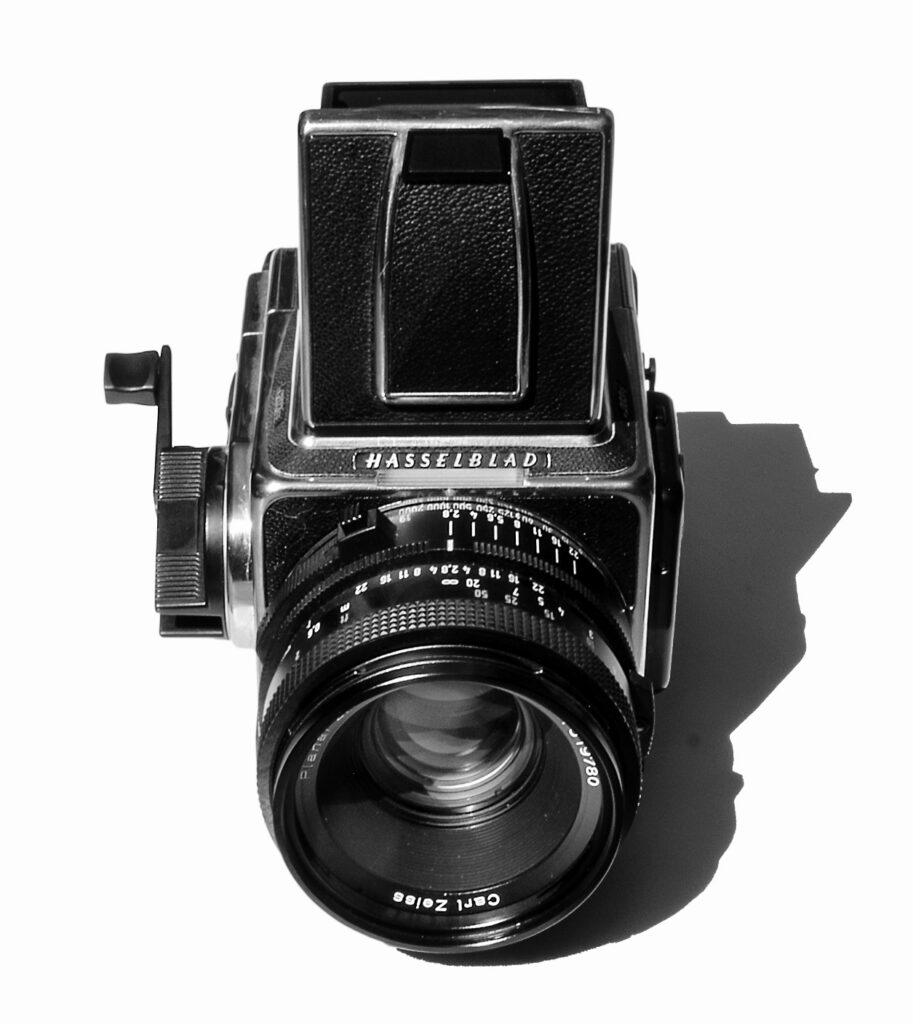
This is not an unfair perspective. The 203FE is easily the most complex camera I have ever used and the only one I have got into enough trouble with to have to find a specialist and phone for help. Despite that, and the ongoing risk that the electronics will fail and leave me with a costly piece of unusable camera history, I think it is one of the finest film cameras ever made. In this article, I will cover why, some of the pitfalls and the differences between it and the other two late models (205FCC and 202FA), which are the most developed versions of the 200 series idea.
The biggest difference between the 200 series and the 500 series is the type of shutter they use. The 500 series need a leaf shutter in every lens, while the 200 series cameras have a focal-plane shutter in the camera body. This allowed Hasselblad and Carl Zeiss to make faster lenses without shutters, most famously the Planar 110mm f/2, and allowed Hasselblad to add sophisticated through-the-lens metering and electronic automation.
The result is an intriguing contradiction: the 203FE is an exceptionally capable film camera, perhaps the most capable Hasselblad ever made, while a 500-series body is the safer camera to own.
Origins
Hasselblad’s first consumer camera was the focal shutter equipped Hasselblad 1600F, introduced in 1948, but the origins of the 200 series began with the 2000FC in 1977. Removing the shutter gave Zeiss greater freedom to produce large-aperture optics and allowed the camera body itself to provide speeds as high as 1/2000 second.
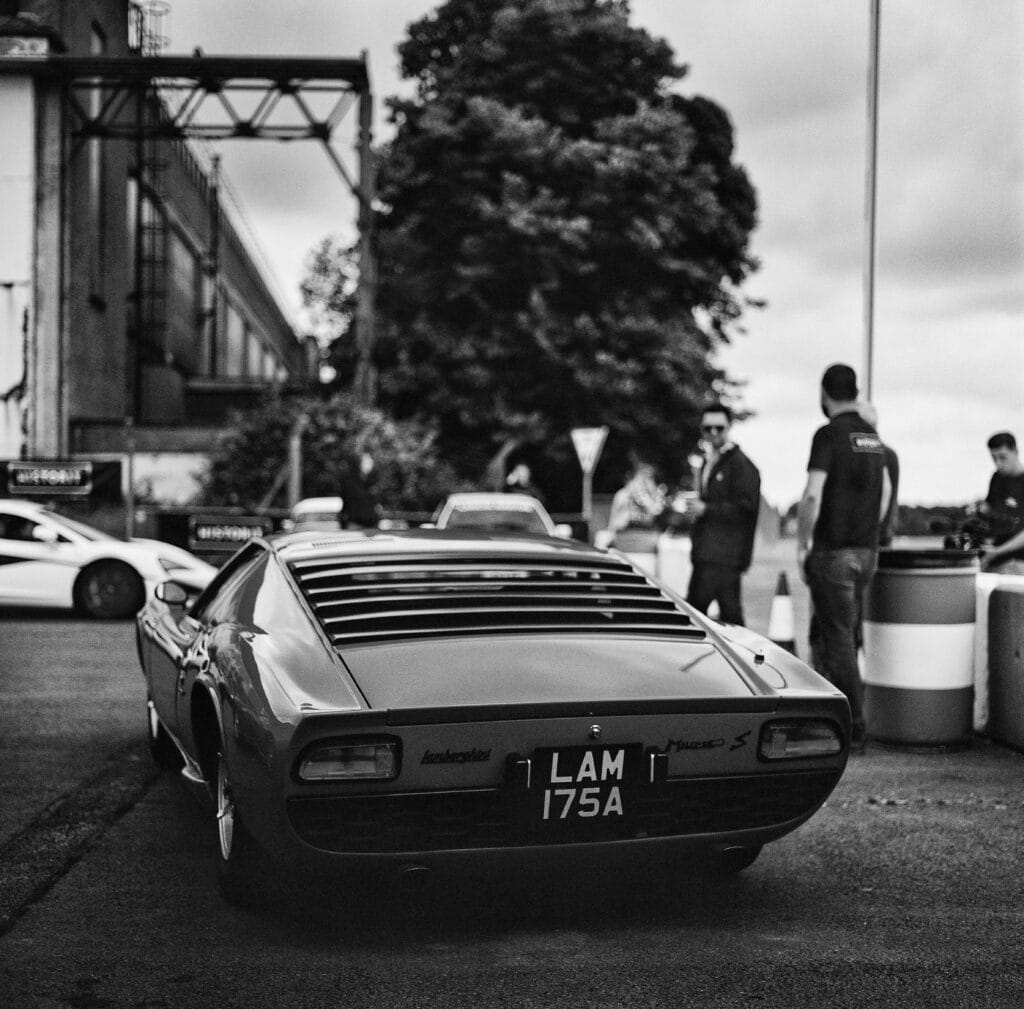
The 2000 series cameras had a weakness in their thin titanium focal-plane shutter. Early cameras could have their curtains damaged remarkably easily when a film magazine was removed. As a result, Hasselblad introduced mechanisms that retracted the shutter when the rear of the camera was exposed. The 2003FCW of 1988 added a protective internal coating and Acute-Matte screen, but the vulnerability wasn’t eliminated.
The 200 Series
An extensive redesign came in the form of the 205TCC in 1991. TCC referred to Tone and Contrast Control. The fragile titanium curtains gave way to horizontally travelling fabric curtains, while the electronics were integrated better into the camera. The 205TCC introduced electronically communicating lenses and magazines, spot metering, automatic exposure and Hasselblad’s elaborate implementation of Zone System metering.
In 1994 came the slightly simpler 203FE and unmetered 201F. The F denotes the focal-plane system and the E for the electronic interface. The 205TCC evolved into the 205FCC in 1995, and finally the 202FA arrived in 1998 as a less expensive electronically metered model. When the terminology was revised in 1995, the camera became the 205FCC and the corresponding TCC lenses became FE lenses.
The principal 200 series models
Figures below are from Hasselblad’s service manuals, dated May 1997 and April 1998. I have included the 201F and 205TCC for completeness.
| 201F | 202FA | 203FE | 205TCC | 205FCC | |
| Introduced | 1994 | 1998 | 1994 | 1991 | 1995 |
| Built-in ambient meter | No | Yes | Yes | Yes | Yes |
| Meter type | none | Selective, about 20% of frame | Selective, about 20% of frame | Spot, about 1% of frame | Spot, about 1% of frame |
| Metering range at ISO 100, f/2.8 | none | EV 0.5 to 21.5 | EV 0.5 to 21.5 | EV −1 to 20 | EV −1 to 20 |
| Aperture-priority AE | No | Yes | Yes | Yes | Yes |
| Manual exposure | Yes | Yes | Yes | Yes | Yes |
| Differential metering | No | Yes | Yes | Yes | Yes |
| Exposure adjustment | none | ±5 EV in 1/3 EV | ±5 EV in 1/3 EV | ±5 EV in 1/4 EV | ±5 EV in 1/4 EV |
| Zone System mode | No | No | No | Yes | Yes |
| Auto bracketing | No | No | Yes | No | Yes |
| Maximum focal-plane speed | 1/1000 | 1/1000 | 1/2000 | 1/2000 | 1/2000 |
| Slowest automatic speed | 1 s | 90 s | 90 s | 16 s | 90 s |
| Longest manual exposure | 1 s | 34 min | 34 min | not stated | 34 min |
| Focal-plane flash sync | 1/90 | 1/90 | 1/90 | 1/90 | 1/90 |
| Leaf-shutter operation | Yes | No | Yes | Yes | Yes |
| FE electronic aperture coupling | No | Yes | Yes | Yes | Yes |
| E-magazine ISO coupling | No | Yes | Yes | Yes | Yes |
| Battery-independent with shutter lens | Yes | No | Yes | Yes | Yes |
| Shutter-speed control | Body dial | Electronic controls | Conventional body dial + electronics | Conventional body dial + electronics | Conventional body dial + electronics |
203FE
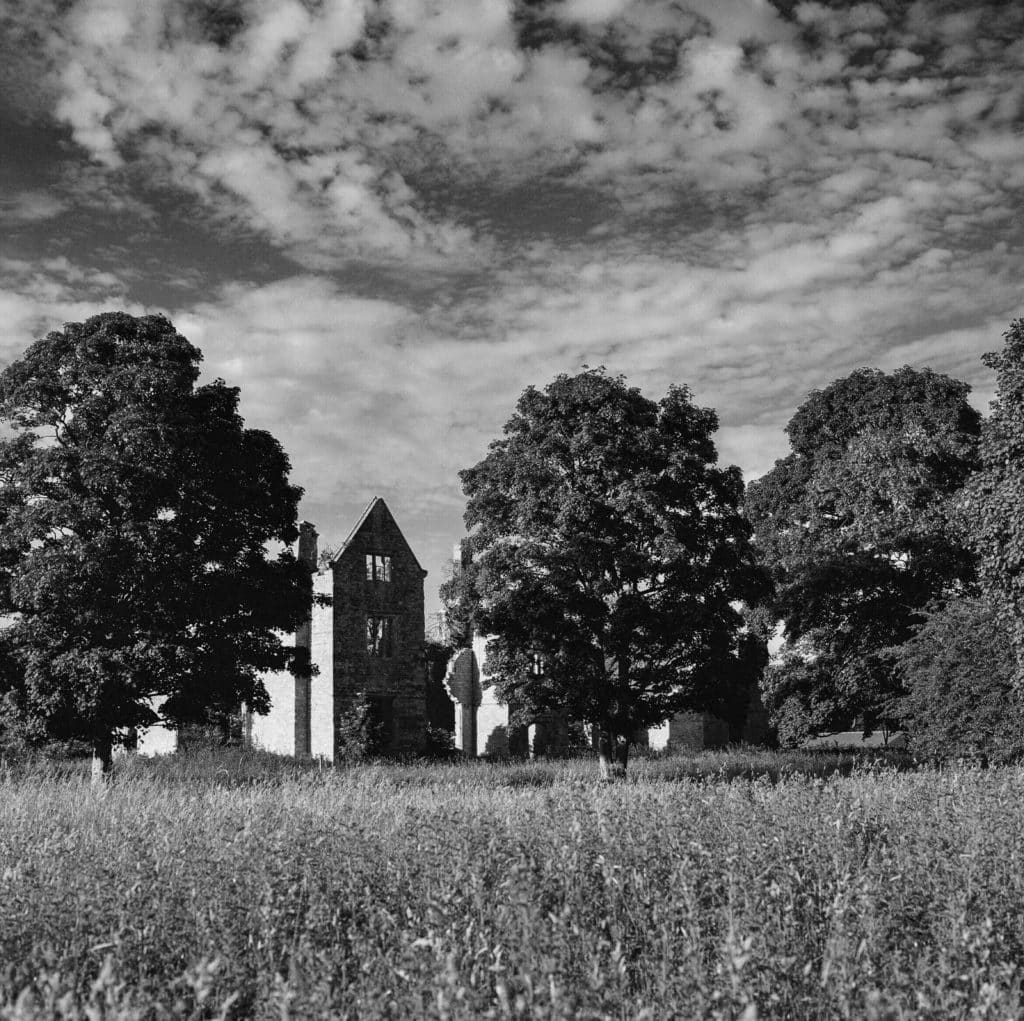
Hasselblad described the 203FE as a camera for professional photographers working under unpredictable available light and rapidly changing conditions. This is true, as the built-in TTL light meter and aperture-priority automation make it a relatively fast machine. It also features clever differential exposure measurement, auto bracketing and a shutter capable of both fast 1/2000 second and extremely long electronically timed exposures — up to around 34 minutes in manual operation.
The light meter is superb. One reviewer referred to it as supernatural, and whilst that might be slightly overstating it, is by far the best meter I have ever used on any film camera. The electronics require small 6V PX28L lithium or 4LR44 alkaline batteries. The difference is that the lithium version delivers a consistent 6V output until it is nearly depleted, while the more readily available alkaline 4LR44 battery’s voltage drops gradually as it drains.
205FCC
The 205FCC’s centrepiece is a sensitive spot meter integrated with Hasselblad’s zone system implementation in Z mode. Rather than simply telling the photographer whether an exposure is correct, it lets you assign selected areas of the scene to zones and evaluate the tonal range. This is described in more detail later.
It also has differential measurement, aperture-priority AE, manual operation and programmable automatic bracketing. In the mid 1990s, this was a technical tour-de-force. However, its price and complexity inevitably limited its appeal.
The service manual describes the size of the spot meter: approximately 1% of the image area, an angle of between one and seven degrees depending on the lens. The 203FE’s patch is about 20%, so the 205 measures roughly twenty times finer.
202FA
What Hasselblad removed from the 202FA was principally the 203FE’s 1/2000 speed, automatic bracketing and its ability to operate the shutters inside leaf-shutter lenses. That last decision explains much of the 202FA’s relatively poor reputation.
A CF or CFE lens can be mounted, but it must be set to F mode, leaving its leaf shutter open while the camera’s focal-plane shutter makes the exposure. Hasselblad’s manual states that the leaf shutters of C and CF lenses cannot be used on the 202FA.
As a result, it sacrifices one of the greatest advantages of the 203FE and 205FCC: the ability to choose between focal-plane and leaf shutters.
Shooting with the 203FE
Shooting with the 203FE is the most satisfying and straightforward aspect of 203FE ownership. The main complexity whilst shooting is differential mode, which I will come to.
With the waist-level finder open, you compose on the large ground-glass screen, then flip up the built-in magnifying loupe for critical focusing. Bringing your eye close to the loupe also makes the illuminated exposure display beneath the focusing screen easy to read. Focusing can cause a bit of composition drift and I lower the loupe to shoot. I mostly operate in aperture-priority mode.
Winding the crank advances the film and cocks the shutter in one movement. It is, to my mind, the classic waist-level finder Hasselblad experience, but with metering and auto exposure capabilities.
Differential Mode
The 203FE’s Differential mode (D) had me scratching my head at first, but after using it on a few rolls of film, I think of it as AE lock with contrast measurement.
To use it, you point the camera’s selective TTL meter at a part of the subject that you want to use as your reference and press the AE-lock, and the camera stores that light value. From then on, as you move the metering area across other parts of the scene, the finder continuously reports how much brighter or darker each area is than the stored reference. It is a clever way to get a really accurate exposure, but it does require a photographer who is prepared to take the time to use it. If the light is good, but likely to change, or if the subject might move, I like to get a quick shot in with Aperture mode and then be more thoughtful about the exposure.
Z Mode
The 205FCC also has Differential mode, but it reports differences in 1/4 EV rather than the 203FE’s 1/3 EV, and allows exposure adjustment in 1/4-EV increments.
However, the 205FCC has a separate Z—Zone mode. This changes what the meter tells you from “this area is +2 EV relative to your reference” in D mode, to “this area will fall on Zone VII.” This actually predicts the tonal placement in the eventual photograph; it is not just a measurement of scene brightness differences. Hasselblad states that “zone” in this mode refers to zones in the final print or slide.
N+/N− development
If that wasn’t enough, the 205FCC goes another step further with its FCC film magazine. This has not only an ISO setting but also boasts film-contrast control! This lets you tell the camera that the film will receive altered development intended to contract or expand its tonal range.
For example, if your measured scene range is too great for normal development, you might decide on reduced development, which is the Zone System’s N− idea.
The camera can then modify its calculations so that the zones displayed in the finder represent the expected tonal relationships after that development correction. Hasselblad states that Zone mode provides “automatic compensation of the exposure and the zone display indication when planned film development corrections are made”.
The implementation has a limitation. In Ansel Adams’ Zone System, film development decisions are applied to individual sheet-film negatives. A Hasselblad magazine contains an entire roll, so an N− or N+ development decision applies to the whole roll, unless you were to dedicate separate magazines to different development regimes.
Identifying the models
Physically, all three models retain the familiar Hasselblad cube, detachable waist-level finder and interchangeable magazine. There is a model designation on each body and the body, lens and back carry a pair of blue stripes.
Dating a body from its serial number
| V | H | P | I | C | T | U | R | E | S |
| 1 | 2 | 3 | 4 | 5 | 6 | 7 | 8 | 9 | 0 |
Hasselblad uses the ten-letter word VHPICTURES to encode the manufacturing year. Each letter maps to a digit from 1 to 0. From 1990 a two-digit product code sits in front of the letters, so a full number can read, as mine does, like this: 18EC10748. Mine is a 1995 example. The table below shows the coded letters across the 203FE’s production run from 1994 to 2004:
| Year | Code | Year | Code |
| 1994 | EI | 2000 | SS |
| 1995 | EC | 2001 | SV |
| 1996 | ET | 2002 | SH |
| 1997 | EU | 2003 | SP |
| 1998 | ER | 2004 | SI |
| 1999 | EE |
Backs and insert serial numbers
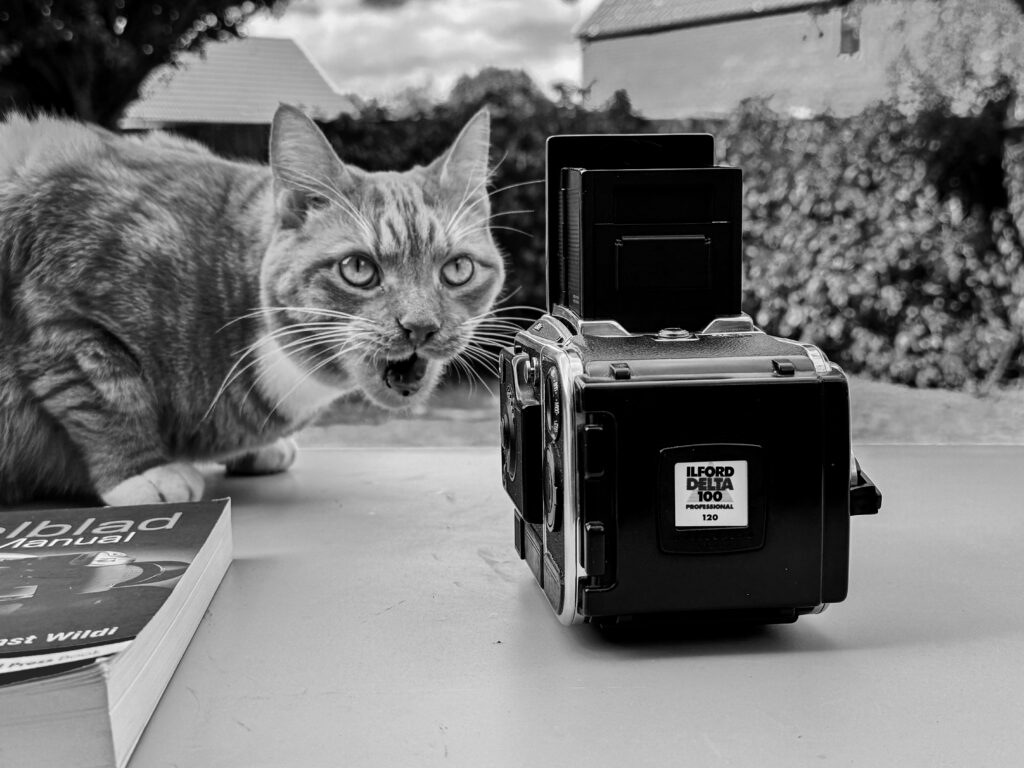
The Hasselblad 203FE works best with an E-type back (E12 in my case), which has an ISO dial and electronic contacts to transfer the ISO setting you set to the camera. It will also work with A-type backs. ECC or TCC backs have an additional dial for use with Z mode and zone system.
It’s worth knowing that backs and their film inserts have serial numbers that should line up. According to the excellent Hasselblad Manual by Ernst Wildi (7th Edition), ‘Magazine shells have serial numbers on the plate that attaches to the camera; film inserts have a three-digit number engraved between the film spools. These three numbers should correspond to the last three digits as they were matched in the factory to produce maximum film flatness.’ The Hasselblad manual goes on to explain that inserts that have been switched still work, but spacing between images might be affected. When I learned that, I was pleased to see that the two lined up as they should.
Film loading tips
There are plenty of good YouTube videos on how to load a Hasselblad, but the Hasselblad guide mentioned above provides some good tips, which I’ve reproduced here in full.
- The take-up side on the insert is easily distinguished by the knurled knob.
- Make certain the film comes off the spool so that the black side is outermost; the emulsion faces the lens. The film needs to curl the opposite way from the way it is wound on the spool.
- Make certain the film rides under the side guide, not over it. I press my thumb against the paper next to the guide to keep it under the guide. It eliminates the need for using the insert lock.
- For proper spacing, the black arrow on the paper must be placed opposite the red triangle. Most film has only one arrow going across the paper backing. Some 220 film has a black dotted line followed by an unbroken black arrow a few inches later. Advance the film to the line with arrow.
- Before placing the insert into the magazine, ascertain once more that the edge of the film is underneath the side guide.
- Make certain to turn the magazine’s winding crank until it stops and the number 1 is in the frame counter window before you start to take pictures. At this point, the crank is locked and cannot be turned again until after the first exposure. Do not turn the film winding crank until the end of the film.
C and F Settings
Putting a CF or CFE lens on a 203FE or 205FCC and setting the lens to F uses the body’s focal-plane shutter, and you gain the body shutter’s high speeds and automatic exposure. Alternatively, you can set the body to C, activate the shutter in the lens, and the camera largely behaves as a 500 series. The focal-plane curtains cease to function as the exposure shutter and instead act as a protective auxiliary curtain. You regain full leaf-shutter flash synchronisation and can make exposures even when the camera battery is unavailable.
The 202FA can’t do this. It must make the exposure with its focal-plane shutter even when a CF or CFE lens is attached.
Lens compatibility
When I first started to get familiar with Hasselblad cameras, I found the terminology confusing. Below is just a very short summary of a large and complex series of lens ranges. For a more detailed account, head to the Emulsive articles.
- FE lenses contain no shutter and communicate the selected aperture electronically to the camera. These lenses carry the double blue stripe that identifies the 200 series cameras with databus electronics.
- CFE lenses combine a leaf-shutter with Databus electronics. On the 203FE, they allow electronic aperture communication and the choice of focal-plane or leaf shutter.
- F lenses were designed for the 2000 F series of bodies, and lack electronic aperture communication.
- CF lenses contain a leaf shutter. Unlike C lenses, they offer F mode which locks the lens’s internal leaf shutter fully open so you can mount the lens on 200 series camera bodies and use the body’s built-in focal plane shutter.
- C lenses were developed for the 1957 500C camera. According to Emulsive: ‘C lenses cannot be used with the 202FA body. When using these lenses with other 200 or 2000 series bodies, simply set them to “B” mode to use them in conjunction with the camera’s focal plane shutter.‘
The 202FA requires a bit of caution. Hasselblad approved F, FE, CF and CFE lenses, but CF lenses must remain in F mode.
I have the 80mm f/2.8 FE Planar, which is a good general-purpose lens and reasonably compact. I briefly owned a 150mm f/2.8 FE Sonnar, but I had to return it to the seller because of a fault. The 110mm f/2 Planar FE is high on a short list of lenses I would like to own, but it is extremely expensive, and hard to come by.
| Lens | Aperture | Closest focus | Filter |
| 50mm Distagon FLE | f/2.8 to f/22 | 0.32 m | M 86 x 1 |
| 80mm Planar | f/2.8 to f/22 | 0.6 m | Bay 50 |
| 110mm Planar | f/2 to f/16 | 0.8 m | B 77 |
| 150mm Sonnar | f/2.8 to f/22 | 1.4 m | B 77 |
| 250mm Tele-Tessar | f/4 to f/32 | 2.5 m | B 77 |
| 300mm Super-Chromat | f/2.8 to f/22 | 2.5 m | Barrel slot |
| 350mm Tele-Tessar | f/4 to f/32 | 1.9 m | M 96 x 1 |
Flash sync
For flash users, flash synchronisation is slower than regular V system cameras. The focal-plane shutter has to travel across the 6 x 6 cm image aperture, so flash synchronisation is only 1/90 second. The leaf shutters in CF/CFE lenses synchronise throughout their shutter-speed range.
200 series cautions
As with other V-system Hasselblads, never force a lens, as these cameras depend on the body and lens mechanisms being correctly synchronised. If a lens is fitted or removed when one mechanism is cocked and the other is not, the two can become jammed. On the 500-series cameras this can sometimes be corrected from the rear of the body with a Hasselblad unjamming tool, which reaches through the open shutter path to recock the lens drive. That approach is not available on the 200 series because the focal-plane shutter prevents access to the mechanism. As a result 200 series cameras require a different reset procedure or professional attention rather than use of the 500-series tool. I experienced this, and needed to call Classic V Hasselblad service and repair for help. They managed to talk me through unjamming the camera, for which I am most grateful.
With a 203FE or 205FCC and a CF lens, be certain whether you have selected F operation or C operation. The body and lens must be configured for the shutter you intend to use.
The biggest worry with the 200 series cameras is their complexity. A 500C/M is a mechanical camera body with relatively simple servicing requirements. A 203FE contains electronic metering, displays, data communications, solenoids and an electronically controlled shutter. Parts are hard to come by, and few Hasselblad repairers will touch them. I wouldn’t say they are unrepairable, but they come perilously close.
There are also some known ageing problems, such as the upper mirror/light baffle problem. This is a rubberised light-sealing strip which can deteriorate or detach. I have experienced this and found a black line across a roll of film, but I was able to remove the material, and the camera, surprisingly, has stayed light tight without a replacement.
Buying a 203FE – what to test
I bought my 203FE from a reputable dealer (Coeln Cameras) online, but this is what occurs to me if you are able to test the camera before purchasing.
As with any film camera, run the camera through every shutter speed. Check that both curtains complete their travel consistently and that the mirror returns correctly. I would test the meter against one you know is accurate. Attach an FE lens and confirm that changing aperture is recognised electronically. If an E magazine is available, change its ISO and verify that the body responds. Inspect the rear curtains carefully without touching them. Look inside the mirror box for loose or deteriorated black light-baffle material. Test a CF/CFE lens both ways: once using the focal-plane shutter and once using the lens shutter with the body on C.
Digital afterlife
Hasselblad’s CFV II 50C and CFV 100C are unusual among modern digital backs because they were designed not just for the contemporary 907X camera, but for use with classic Hasselblad V-System bodies. The CFV II 50C, introduced with the 907X in 2019, uses a 50-megapixel sensor and provides up to 14 stops of dynamic range.
The CFV 100C, introduced in 2024, retains the same sensor dimensions but doubles resolution to 100 megapixels, uses a back-illuminated CMOS sensor and increases the dynamic range to 15 stops. Hasselblad lists the 200 series among the V-System cameras that can be used with the CFV 100C. I would love to try this!
Conclusion
The 203FE is an extraordinary camera. It preserves everything I love about the classic Hasselblad: interchangeable backs and finders; the square 6×6 negative, waist-level viewing and superb Zeiss lenses, while adding capabilities that make it easier and faster to respond to changing conditions: 1/2000-second exposure, aperture-priority automation, TTL metering and lenses as fast as f/2. I just hope it lasts…
Other Medium Format Camera Articles
The Voigtländer Perkeo E (III) Compact Medium Format Camera
