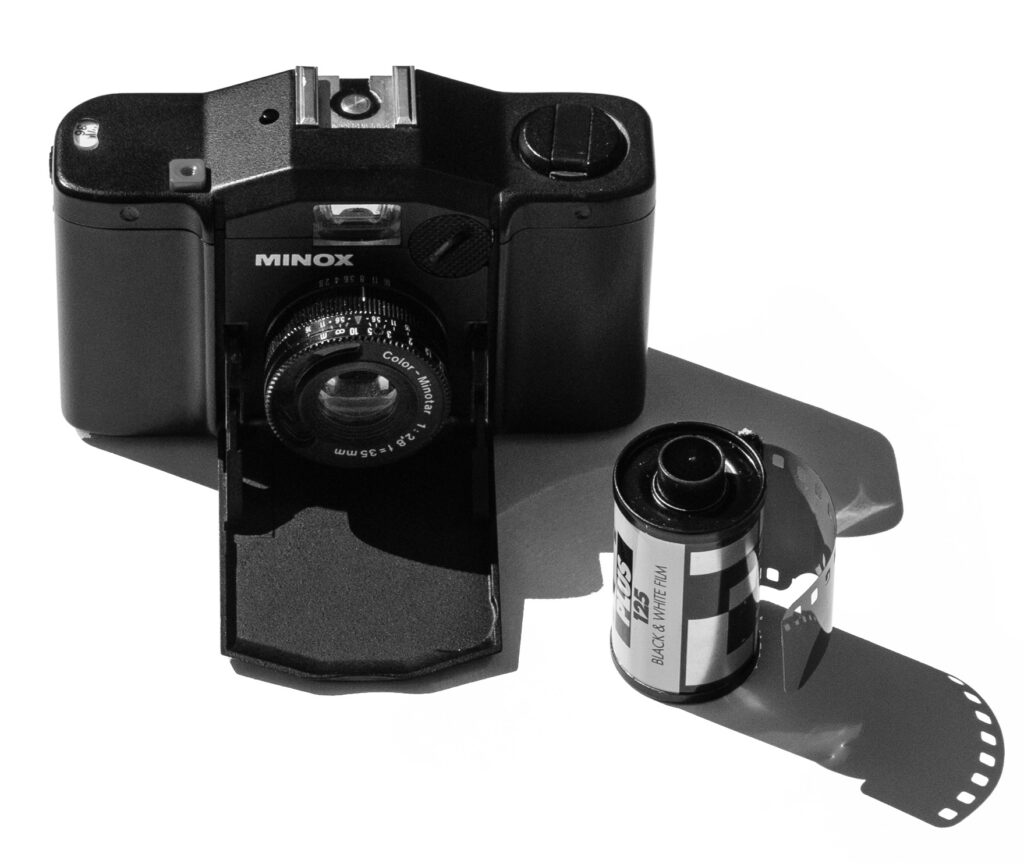
I bought my Minox 35 EL (AKA Minox EL 35) in Bologna, in one of those wonderful independent camera shops you sometimes stumble across. The tiny, featherweight camera was boxed, and came with its original flash. Its serial number, 3727317, is from late 1977, which is about 40 years after the launch of the original Minox subminiature camera so beloved by Cold War intelligence services.
Minox was the brainchild of Walter Zapp, a Baltic German designer born in Riga in 1905, who lived to 97 years old. During the 1930s he developed the idea of a camera small enough to disappear into a closed hand. The result was the original Minox, manufactured by VEF in Riga from 1938. It used a tiny 8 × 11 mm negative and was an extraordinary feat of miniaturisation.
Design of the Minox 35 EL
The distinctive exterior design of the Minox 35 EL was the work of Professor Richard Fischer of the Hochschule für Gestaltung (German university of art and design), who Minox development chief Rolf Krull knew from his earlier career at Braun. Prof. Fischer was a product designer and long-serving professor and gave the camera its external appearance, while the engineering was the product of a wider development team.
The design is often credited to Dr Richard Fischer of the University of Vienna, but he appears to have been a physicist/physical chemist who worked in mineralogy, crystallography and computing, and I can find nothing in his university biography connecting him with either industrial design or Minox.
I’d go so far as to argue that the 35 EL and Jony Ive-era Apple products share a recognisable design philosophy: reduction of visual clutter, little decoration, restrained branding, and an attempt to make engineering complexity disappear behind a simple exterior. That is particularly obvious when the EL is closed, when the lens, focusing and aperture controls disappear behind the folding cover – leaving an unusually clean object.
There is also a connection between the two, though it is indirect. Prof. Fischer came from the German industrial-design school of thought, while Sir Jony has acknowledged the influence of Dieter Rams and Braun on his thinking. Rams characterised the Braun approach as economy of form and colour, avoidance of unnecessary complexity and ornament, and judging details by whether they serve function and handling. Those principles describe the EL remarkably well.
Not Just a Small Camera
It is not only small (the official dimensions of the closed camera are 100x61x31), but extremely light and the case has smooth, enclosed surfaces. As a result, it is the most pocket friendly 35mm film camera I have encountered. As testimony to this, I could carry it in the lightweight shorts I wore in Italy which would not tolerate most items I wanted to put in my pocket without slipping.
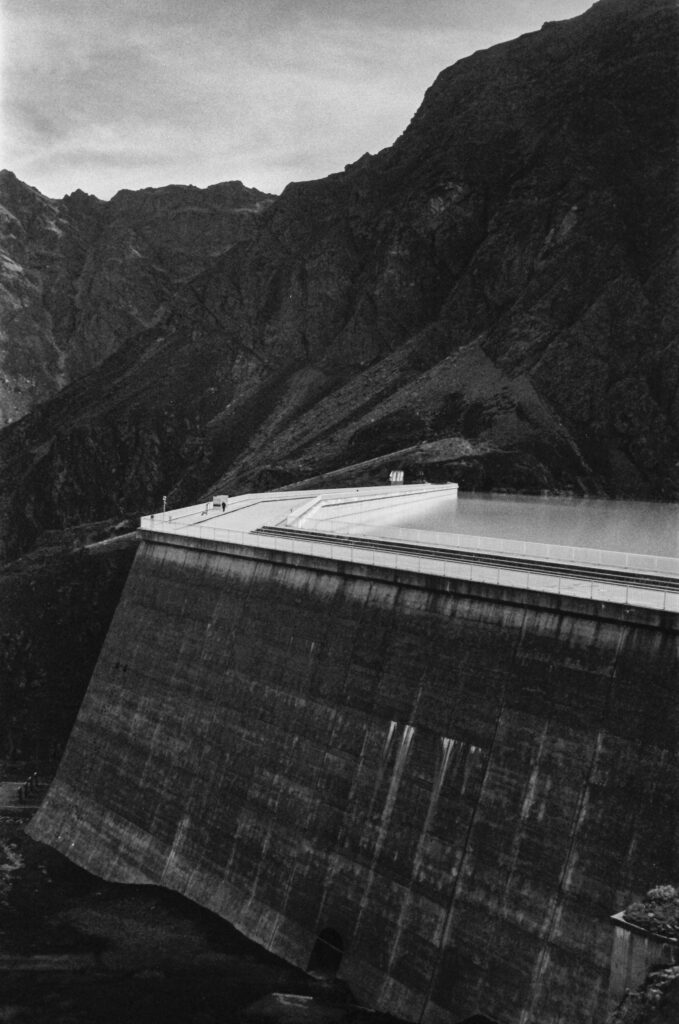
However, portability does not come at the cost of optical performance. The 35 EL’s Color-Minotar 35mm f/2.8 lens is one of the camera’s strongest features. The four-element, three-group design has a strong reputation for producing sharp, contrasty images from such a small package, particularly in the centre of the frame, although performance towards the corners improves as the lens is stopped down. The 35mm focal length also suits the camera particularly well.
The Cost of Miniaturisation
Whilst small and light, the Minox is not effortless to shoot with. It disappears into your pocket more readily than just about any other camera, but it isn’t a point-and-shoot. In particular, scale focusing demands judgement and the meter needs watching (depending on your battery choice). Handling (particularly rewinding) also suffers slightly, as you would expect from such a small package. Minox did improve various aspects of this over time, adding backlight control and self timer and improving the film advance and rewind ergonomics.
Shooting with the Minox 35 EL
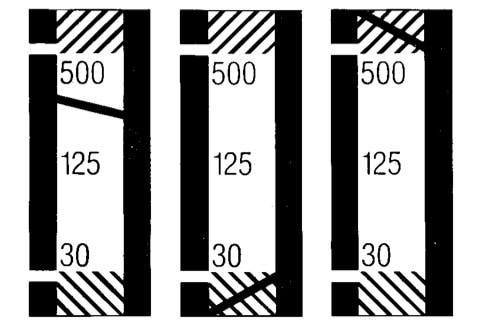
To shoot with the Minox 35 EL you frame in the luminous finder, set the aperture and check the exposure, ensuring the needle at the right of the finder is showing an acceptable reading. If it is below 1/30 second, the Minox treats it as a slow-speed warning. An indication exceeding 1/500 requires turning the aperture ring to a smaller setting. I was shooting in bright sunlight with Ilford FP4 at ISO 100 in Italy and found I often needed f/11 to keep the shutter speed below 1/500 second.
Next, set the focus using the aperture and depth-of-field scales. The manual says that with the camera set to f/8 and 20 ft, acceptable sharpness extends approximately from 10 ft to infinity, so it is relatively friendly. The scale on my model is metric, so for zone focusing, I set it to just over the 5 metre mark.
LiDAR for Close Focus
For close focus, I use the Rangefinder LiDAR app on my iPhone. This minimalist utility, developed by British photographer William Benjamin Burrard-Lucas, provides an instant distance readout in meters or feet using the iPhone’s time-of-flight depth sensor. This is available on Pro and Pro Max iPhone models, and works extremely well.
Framing and Film Advance
Check your framing once more and squeeze the exceptionally light shutter release, which is a square, red button on my model. Exceptionally light doesn’t convey the pressure the shutter release requires very well; it requires the barest touch to fire it. Handing a photographer friend the camera, he immediately fired the shutter accidently without realising it, and didn’t believe me when I told him.
The Minox 35 EL uses a double-stroke film advance, so, after taking a photograph, you slide the small advance lever twice. The double-stroke allows Minox to use a very short lever movement, which was part of the design that allowed the EL to remain so small. The film advance can be operated with the camera front open or closed.
The Twin CdS Circuit Surprise
The Minox 35 EL comes with a surprise, largely due to its two CdS circuits. The shutter-speed needle in the viewfinder is a prediction/indication system controlled by one circuit whilst the actual shutter timing is electronically controlled by the other. This means that a responsive finder needle is not proof that the actual shutter timing mechanics are working properly. This gave me some anxiety whilst waiting for my first films to come back from the developer.
Minox 35 EL Specification
The EL model established a formula which Minox used with refinements for almost three decades: a lightweight, pocket-sized camera, equipped with a good lens and exposure automation.
| Specification | Minox 35 EL |
| Camera type | Ultra-compact direct-view 35 mm camera; aperture-priority automatic exposure; fixed retracting lens. |
| Film | Standard 135 / 35 mm cartridge film |
| Lens | Color-Minotar 35 mm f/2.8, four-element/three-group Tessar-type design. |
| Aperture | Continuously variable f/2.8–f/16. |
| Focusing | Manual scale focus, 0.9 m to infinity; metric or imperial scales according to version; engraved depth-of-field scale. |
| Shutter | Electronically controlled lens/central shutter. Maximum 1/500 s; longest automatic duration depends on film speed: approximately 30 s at ASA 25, 16 s at 50, 8 s at 100 etc. |
| Flash synchronisation | Hot shoe; inserting a compatible flash automatically selects 1/30 s X-sync. |
| Metering | Uses two CdS cells: one for shutter timing and one for the viewfinder indication. |
| Exposure mode | Aperture-priority automation. |
| Film-speed setting | ASA/ISO 25–800 / corresponding DIN values. |
| Viewfinder | Direct bright/luminous-frame finder with shutter-speed/exposure indicator at the right. Needle scale includes 1/30, 1/125 and 1/500 regions plus slow-speed and overexposure warnings. No focusing aid. |
| Film advance | Manual double-stroke advance lever |
| Rewind | Folding manual crank; rewind-release button on camera underside. |
| Frame counter | Counter 0–36, automatically reset after back removal/shutter operation. |
| Shutter release | Feather light top (oversensitive!) release with threaded cable-release socket; mechanically blocked with front cover closed. |
| Battery | Original 5.6 V PX27-class mercury battery: Battery powers shutter and exposure indication. |
| Battery test | With camera open and shutter cocked, press test button; finder needle should reach 1/125 or above. |
| Body material | Glass-fibre-reinforced Makrolon (Bayer’s trade name for polycarbonate, a high-strength engineering thermoplastic) |
| Dimensions, closed | 100 × 61 × 31 mm. |
| Weight | 190 g. |
| Tripod socket | Standard ¼-inch socket. |
| Other facilities | Hot shoe, cable-release thread, battery test |
Minox 35 models
The Minox 35 evolved from the EL to the GL in 1979, which added a 2× backlight-compensation switch, while the GT (1981) added a self-timer and became the defining, and most popular, Minox 35.
Minox also experimented with program exposure in the PL and later the ML, which offered both program and aperture-priority modes. The GT-E (1988) modernised the classic GT with a redesigned body, multicoated Minoxar lens and integral protective filter; the MDC (1992) was the upmarket metal-clad version of the ML.
Late models including the GSE, GT-X, second-generation GT-E and GT-S progressively refined the original concept, with features such as snapshot settings and DX film-speed coding. Despite those changes, the essential idea remained remarkably constant for roughly three decades: a genuinely pocketable, manually focused 35mm camera with an excellent 35mm lens and sophisticated automatic exposure.
Minox 35 Model History
| Model | Introduced | Description |
| 35 EL | 1974 | Original Minox 35. Manual focus, aperture-priority AE, Color-Minotar 35mm f/2.8, 25–800 ASA. The basic folding-front, removable-back design from which the family developed. |
| 35 GL | 1979 | Added the 2× backlight compensation control and continuous/intermediate settings across ASA 25–800 film-speeds |
| 35 GT | 1981 | The classic mature version of the original design – the GL plus 10-second electronic self-timer. |
| 35 PL | 1982 | Adds programmed automatic exposure. |
| 35 PE | 1983 | Program-exposure model. |
| 35 GT Golf/Sport | 1984 era | Special editions of the GT |
| 35 ML | 1985 | Major redesign, including a new body. Offered both aperture-priority and programmed AE, exposure memory lock and replaced finder needle with red LEDs. |
| 35 MB | 1986 | Simplified M-series camera, retaining aperture-priority automation. |
| 35 AL | 1987 | Simplified program camera with fixed focus and weather-symbol exposure settings. Black and white versions existed. |
| 35 GT-E | 1988 | Minoxar 35mm f/2.8, multicoating and integrated UV/skylight filtering, minimum focus reduced to 0.7 m (28 in) |
| 35 AF | 1988 | Autofocus model. |
| MB Touring | 1990 | Limited MB derivative. |
| GSE | 1991 | Development of the G-series with improved film take-up and a snapshot setting |
| GT Decade Edition | 1991 | 10th-anniversary GT; 1,500 produced. |
| Goldknopf | 1991 | Luxury/special version distinguished by its gold shutter button. |
| MDC | 1992 | Flagship development of the ML, with aluminium outer shell |
| MDC Gold Collection | 1993 | Elaborate limited luxury version. |
| 35 GT-X | 1998 | Late development of the classic G-series; added features including DX film-speed coding and snapshot setting. |
| 35 GT-E II | 1998 | Second-generation GT-E |
| 35 GT-S | 1998 | Another late G-series derivative; production continued into the early 2000s. |
The dates are a bit messy because the various sources (Minox histories, collectors and serial-number records) don’t always agree on whether the date is an announcement or actual production.
The design of the original 35 EL was very restrained, and to my eyes, elegantly so. Later models gradually acquired more conspicuous model identification, with the red Minox logo becoming more prominent on late-model versions, being placed as a diagonal slash on the body on the GT models from the GT-E onwards.
During the 1980s and 1990s Minox also became somewhat more adventurous with finishes. Alongside the standard black cameras silver, grey and other coloured or special-edition bodies were offered, particularly among later GT-family models, sometimes with contrasting front panels or differently coloured lettering.
Dating and Serial Numbers
The caveat above about dating applies here also, but determining the year of manufacture is straightforward enough from the serial number.
| Year | Recorded serial range | Implied units if continuous |
| 1975 | 3,500,001–3,528,450 | 28,450 |
| 1976 | 3,528,451–3,608,656 | 80,206 |
| 1977 | 3,608,657–3,737,000 | 128,344 |
| 1978 | 3,737,001–3,873,000 | 136,000 |
| 1979 | 3,873,001–3,877,000 | 4,000 |
| Total | 3,500,001–3,877,000 | 377,000 |
Loading and Unloading film
Despite its small size, I found the Minox is easy enough to use, but these things are relative; recently I have been shooting with Voigtländer Perkeo medium format cameras, which are more demanding in just about every way. However, some reviewers find loading and rewinding the camera’s weakest features. I found loading OK, but rewinding is definitely a bit awkward – the crank operates at an angle and gives your fingers relatively little clearance from the body.
Loading Steps
- Turn the back-cover lock left until its red dot is visible, then slide the camera back off.
- Insert the 35 mm cartridge into the film chamber with the leader pointing to the right.
- Open the folding front completely. This is necessary because the shutter release is mechanically blocked when the camera is closed. Operate the advance until the wide slot in the take-up spool is accessible.
- Lock the take-up spool temporarily. Press the rewind-release button on the right-hand underside of the camera. This holds the spool while you fit the leader.
- Insert the leader and slide the film beneath the lip of the take-up spool until three or four perforations disappear beneath the lip, then release the rewind button.
- Ensure the film is engaged before closing the camera. Alternate advance and shutter release until the beginning of the full-width portion of the film lies smoothly in the film channel. Check that the sprocket engages the film perforations.
- Slide the lock so that the red dot disappears.
- Advance and release, then repeat. The counter should now indicate 0.
- Set the ASA/DIN control on the underside to the film’s rated speed. The EL’s range is ASA 25–800 in one-stop increments.
- As you advance the film, check that the rewind crank rotates, confirming that film is being drawn across the gate.
Rewinding and Unloading Steps
- Press the rewind-release button on the bottom of the camera to disengage the film transport
- Fold out the small rewind crank at the left-hand end of the camera.Turn the crank clockwise, following the arrow, until you feel resistance drop as the film leaves the take-up spool and is drawn fully into the cassette.
- Turn the locking catch on the base until the red marking is visible.
- Slide the camera back downwards and remove it.
- Lift out the film cartridge, then refit the back and turn the locking catch until the red marking is no longer visible.
Original Batteries
The Minox 35 EL was designed to use the now obsolete 5.6V PX27 mercury battery. Mercury cells maintain a constant voltage throughout most of their working life, but their environmental impact led to their withdrawal.
Modern Batteries
The problem of finding a modern substitute is compounded by the fact that the EL uses its battery to control both its electronically timed shutter and its metering circuit. Reading reviews and posts online, it appears some cameras show exposure differences when they are operated at the 6–6.2V modern batteries deliver. The size of the effect, I gather, appears to vary between individual cameras, particularly after years of component ageing. These differences can be compensated for by changing the ISO setting, but it’s probably best to compare your individual camera against a reliable exposure meter at several light levels.
My EL came fitted with A76s. These are ordinary 1.5V alkaline button cells equivalent to LR44s. Four stacked batteries provide 6.0V. They also have a progressively falling discharge curve, so the voltage drops over time.
Four SR44 silver-oxide cells produce a higher voltage: 4 × 1.55V = 6.2V. But, like mercury cells, they have a relatively flat discharge characteristic and remain close to their working voltage through most of their useful life.
An alternative comes from the Small Battery Company, which offers the V27PX Adapter. This has the outer dimensions of the PX27 mercury battery with a recess that takes silver oxide 386 (or SR43) cells. Inside the V27PX Adapter are electronics that drop the voltage from the 6.2 Volts output of the silver oxide cells to the 5.6 Volts the camera was designed for.
Another potential option is zinc-air cells, such as WeinCell batteries. These produce about 1.35V, so four cells in a suitable PX27 adapter give approximately 5.4V. Their relatively flat discharge characteristic makes them electrically quite similar to mercury cells, but once the sealing tabs are removed, zinc-air cells begin to discharge whether or not the camera is being used, so they don’t last very long.
Andy Warhol and the Minox 35 EL
Andy Warhol “Exposures” (1979)
Having a few rolls of film to develop gives me a good reason to get up in the morning. I love the new, small, automatic-focus 35mm cameras like Minox and Konica. That’s what I used for the photos in this book. I think anybody can take a good picture. My idea of a good picture is one that’s in focus and of a famous person doing something unfamous. It’s being in the right place at the wrong time. That’s why my favorite photographer is Ron Galella.
I always associated Andy Warhol with the Polaroid Big Shot and SX-70 cameras. It was only after acquiring my Minox EL that I learned that Warhol and his close associate Bob Colacello, editor of Interview magazine, were both avid Minox 35 EL users. In 1976, while travelling in Europe, they saw a Minox belonging to art dealer Thomas Ammann and were immediately taken by the tiny black camera. they were unable to find one in Zurich, but found a pair of 35 ELs at a camera shop in Bonn.
Warhol’s use of the Minox was very different to the Polaroids that produced staged portraits. The Minox gave him a camera he could carry anywhere and use as a visual diary.
The Minox encouraged Warhol to pursue a diaristic habit of photographing the people, parties and places around him, taking a camera as he took a tape recorder. Colacello exploited its discretion even more deliberately, keeping his Minox inside his jacket and slipping it out to catch people before they realised they were being photographed. In both cases, their adoption of the Minox helped generate a remarkable record of the social world they inhabited.
Alternatives
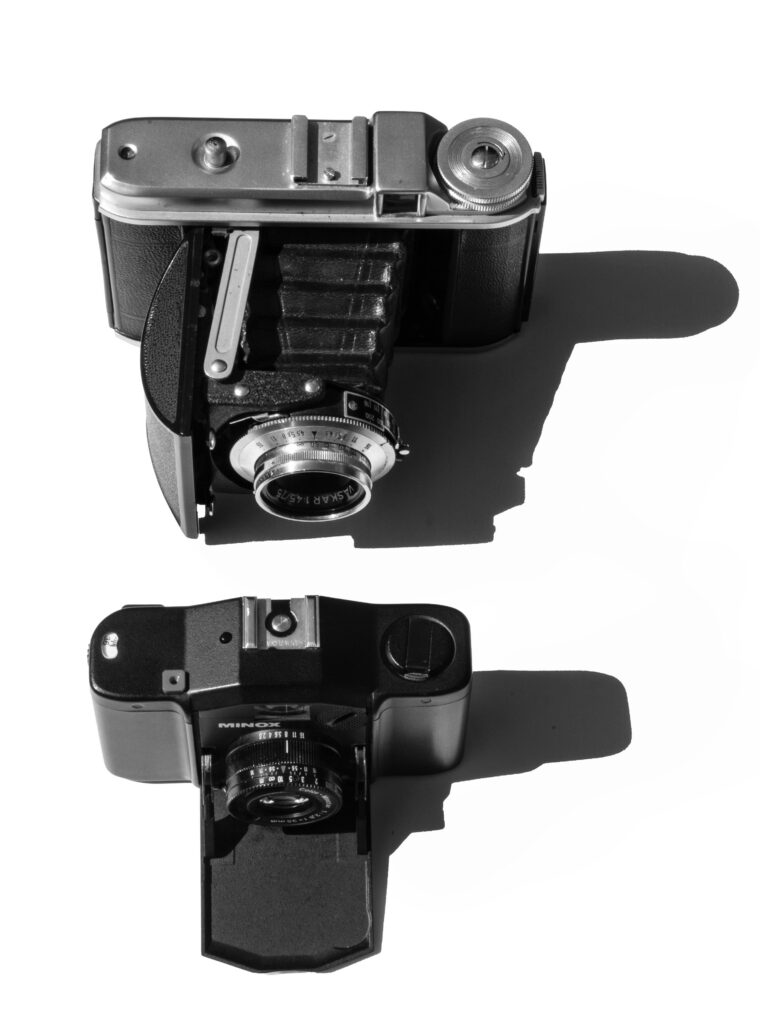
In my view, the EL’s closest competitors are the other models in the Minox 35 line. I have a Rollei 35, with which the Minox is often compared, but other than being small, they don’t have that much in common.
The Rollei 35
The Rollei 35 requires you to manually set the shutter speed and the aperture, using the meter as a guide, and you need to pull out and lock the lens before shooting. The Rollei’s shutter is mechanical, so the battery is required only for the meter. My Rollei has a 40mm f/3.5 lens and weighs about 370g – just under twice as much as the Minox.
The Minox 35 EL is not only more pocketable, but also quicker to use. You still estimate focus and choose the aperture, but the camera selects the shutter speed. Opening the folding front deploys the 35mm f/2.8 lens, while closing it produces that remarkably smooth package.
The Olympus XA
A better comparison, to my mind, is with the The Olympus XA, introduced in 1979. Both cameras put a full 35mm frame, aperture-priority exposure and a high-quality fixed lens into a pocketable body. The XA is slightly heavier and more substantial, and adds a coupled rangefinder, but the features they have in common and the clamshell cover make the XA a closer match.
Other Minox 35 Models
Of the Minox 35 models, the ML is arguably the most usable all-rounder. It retains aperture-priority control but adds LED shutter-speed indication, exposure memory, +1 EV backlight compensation and a program mode. More importantly it uses a 6V PX28 lithium or silver-oxide battery, which avoids the EL/GL/GT’s original 5.6V mercury-battery problem.
Another alternative is the Minox 35 GT-E with its MC Minoxar lens, closer 0.7m minimum focus and a 6V supply using two 3V lithium cells.
The only feature of these models I really care about is the more modern battery, but a fix for that can be also be achieved with V27PX Adapter, which I will purchase at some point. I think the EL will be a permanent fixture for me on trips which I previously would have been digital only.
Conclusion
The original EL has a simplicity and purity of purpose that I find really appealing. I’ve also found no other 35mm film camera that is so easy to carry in the pocket whilst providing a decent quality, fast lens. The shutter is admittedly excessively light, but I soon got used to that, and whilst the batteries present a drawback which is addressed by later models, it is at the cost of some of that original purity, which I am loath to lose. I could get an ML or GT-E, but I think I will stay with the original EL.
