The Newrick Surname
Newrick is a relatively rare English surname. This is primarily because, unlike the name Smith for example, which developed thousands of times, independently, it probably descends from a small number, or perhaps only a single, founder family in East Anglia.
The surname is generally regarded as an East Anglian variant of Newark. In Norfolk and Suffolk, the forms Newark and Newrick were historically used for members of the same families, apparently reflecting local pronunciation at a time when surname spelling was not fixed. The underlying name is locational and derives from Old English elements meaning “new work” or “new fortification”. Its linguistic roots are therefore Anglo-Saxon, although hereditary surnames developed considerably later.
Origins: The East Anglian Coastal Belt
The Newrick family’s story begins on the East Anglian coast in the late seventeenth century. The earliest traceable ancestor is James Newark, born in 1695, whose line descends through William Newark (1716–1791) and Robert Newark (1742–1810) before the surname variant Newrick appears in the next generation, with James Newrick born at Belton, Suffolk, in 1772.
Robert Newark’s son James married Elizabeth Butterfont, born at Toft, Norfolk, in 1774, and it is their children who carry the story north to Wearmouth; Elizabeth died at Sunderland in 1843, having made the journey with her family. The Butterfont name was preserved as a middle name by two of her sons, William Cooper Butterfont Newrick, born at Great Yarmouth in 1800, and John Henry Buttifant Newrick, born there in 1806, a deliberate marker of maternal descent across a generation where parish records were unreliable. The family’s roots in the Suffolk and Norfolk coastal strip thus span at least five generations before the move north.
The First Recorded Newrick
The first recorded Newrick is James, born in 1772 at Belton, Suffolk, a parish a few miles inland from Great Yarmouth. Another branch emerges at Great Yarmouth itself, this time bearing the distinctive middle name Buttifant, likely a local Norfolk surname, with William Cooper Butterfont Newrick born there in 1800 and John Henry Buttifant Newrick in 1806.
Still further inland, Thomas William Newrick, who would emigrate to Michigan in the 1850s, was born at Beccles in 1835, while Henry Valentine was born at Pakefield, near Lowestoft, in 1832. Bringing these threads together, the family’s roots lie in the Suffolk and Norfolk coastal strip: a zone of mixed arable farming, fishing, and small-scale craft trades.
This was also one of the regions most severely affected by the parliamentary enclosure movement. Between 1790 and 1815, successive Enclosure Acts extinguished common grazing rights across East Anglia, driving agricultural labourers off land they had worked for generations. E.P. Thompson, in The Making of the English Working Class (1963), traces the resulting drift of displaced rural labour toward the industrial north; and John Langton and R.J. Morris, in Atlas of Industrialising Britain (1986), map the flow of that migration along the east coast corridor, from the Norfolk and Suffolk lowlands toward the Durham and Northumberland coalfield. James Newrick’s move from Belton to Wearmouth before 1830 follows that route precisely.
The Durham Interlude: Wearside and the Industrial North
Wearmouth in the first decades of the nineteenth century was undergoing rapid expansion in coal, glass, and above all, shipbuilding. For a rural labourer from Suffolk, the wages on offer represented a transformation in circumstances. After James Newrick died at Wearmouth in 1830, a second generation was already established at Sunderland and North Shields. Charles C Newrick was born at North Shields in 1807, and Nathaniel Aaron in 1814. Later, James Archibald, born at Sunderland in 1826, would move on again to Darlington, where a further branch of the family put down roots and eventually dispersed to New Zealand and New South Wales.
This north-eastern phase set the pattern for further movement within industrial Britain. The Durham generation did not stay put. James Newrick, born in Sunderland in 1832, was a moulder, a foundry worker who cast metal components in sand or clay moulds, and his trade followed the railway frontier. The great railway building booms of the 1840s and 1850s created insatiable demand for iron moulders and engine fitters.
Crewe had been purpose-built by the Grand Junction Railway from 1843 as an engineering and locomotive works town, its population of barely two hundred growing to over eight thousand within two decades, almost entirely dependent on the railway. Oswestry, where James and his family were settled by 1871, was the headquarters of the Cambrian Railways from 1864, with locomotive workshops drawing skilled men from across the north and midlands. Raphael Samuel, in his essay “The workshop of the world” in History Workshop Journal (1977), documents this pattern of skilled iron workers following the railway frontier westward; James Newrick’s trajectory from Sunderland moulder to Oswestry moulder maps directly onto it.
From Oswestry to Woolwich, and the Arsenal
Charles Owen, James’s eldest son, took the next step. Already working as a moulder at sixteen in 1871, he had advanced to engine fitter by 1881, and by the mid-1880s, he had brought his family south to Plumstead, where he found employment at the Royal Gun Factory within the Royal Arsenal complex. To understand why Charles moved, it is important to note that the Arsenal had expanded dramatically from the 1850s onward; the Royal Gun Factory, established in its modern form in 1856, was by the 1880s recruiting specifically for engine fitters and skilled metalworkers, often targeting men with railway engineering experience.
The pull from the Welsh Marches to Woolwich therefore followed an established recruitment pipeline from the industrial midlands and north. By the 1890s, the Arsenal employed over ten thousand workers, making it the largest single industrial employer in Britain.
What is striking about the Plumstead household is how the Arsenal shaped the next generation. Charles Owen’s sons George, moved north to help establish the Royal Ordnance Factory at Blackburn. He was awarded the MBE for his work there. George’s brother, Richard Oswald, served in the Royal Artillery during the first World War and his sister Mary Ethel married a gunner, Albert Victor Wraight. Frank and Oscar Brown, first cousins and sons of Elizabeth Newrick, rose to Chief Inspector of Ordnance Machinery. The world of armaments and ordnance drew James Newrick’s descendants south from Sunderland and held them for three generations.
Emigration
While Charles Owen’s branch moved toward Woolwich, other members of James’s family emigrated in the final decades of the nineteenth century.
Four of James’s children settled in British Columbia: Elizabeth at Wellington, William also at Wellington, Mary Jane at Comox, and Ada, whose husband, Thomas Balderston, was a coal miner at Fernie in the Kootenay district in 1911, the year after his arrival from England. Elizabeth, William, and Mary Jane settled within a few miles of one another on Vancouver Island, in communities built around the Dunsmuir collieries; the tight cluster has the character of chain migration, one sibling following another to familiar faces and known work.
James, the fifth sibling to emigrate, went to Queensland rather than British Columbia, settling in Brisbane and marrying there around 1901. Queensland’s Assisted Immigration Act of 1869 had specifically targeted agricultural and skilled industrial workers from Britain, and its emigration agents were active in the north of England through the 1870s and 1880s.
The James Archibald branch at Darlington produced its own emigrant generation. Sarah Ann Newrick went to Dunedin , New Zealand in the 1870s, dying there in 1898; William Malcolm ended his days in Hawke’s Bay, also in New Zealand. Frederick Charles, a photographer, died in Granville, New South Wales, in 1928.
The Suffolk branches went to North America: Thomas William to Saginaw, Michigan, in the 1850s, and Henry Valentine eventually to Kansas. These movements belong to the broader story of mid-Victorian emigration to the United States, driven by industrial recruitment in the Great Lakes iron and steel belt rather than by colonial land settlement.
Summary
The Newrick migration across four generations fits a pattern well documented in literature on British internal and overseas migration (see Secondary Sources below). The first move, from East Anglian agriculture to Wearside industry, was driven by enclosure and industrial wages. The drift through the industrial north and midlands tracked the railway frontier. Moving to Woolwich was driven by Arsenal’s recruitment. Overseas dispersal, to Vancouver Island, Queensland, New Zealand, and New South Wales, followed organised colonial recruitment and chain migration, characteristic of late nineteenth-century British working-class emigration. It is notable that much of the migration was toward known work in established communities, along paths laid down by those who had gone before.
Sources for Newrick Origins and Migration
Parish registers and church records
- England and Wales, Christening Index, 1530–1980
- England, Select Births and Christenings, 1538–1975
- England, Select Marriages, 1538–1973
- England and Wales Marriages, 1538–1988
- England, Select Deaths and Burials, 1538–1991
- Norfolk, England, Church of England Baptism, Marriages and Burials, 1535–1812 (Burgh Castle; Caistor-next-Yarmouth; Great Yarmouth)
- Norfolk, England, Bishop’s Transcripts, 1579–1935
- Northumberland, England, Church of England Baptisms, Marriages and Burials, 1538–1938 (baptism of Charles Chicken Newrick, Christ Church, Tynemouth, 3 July 1808)
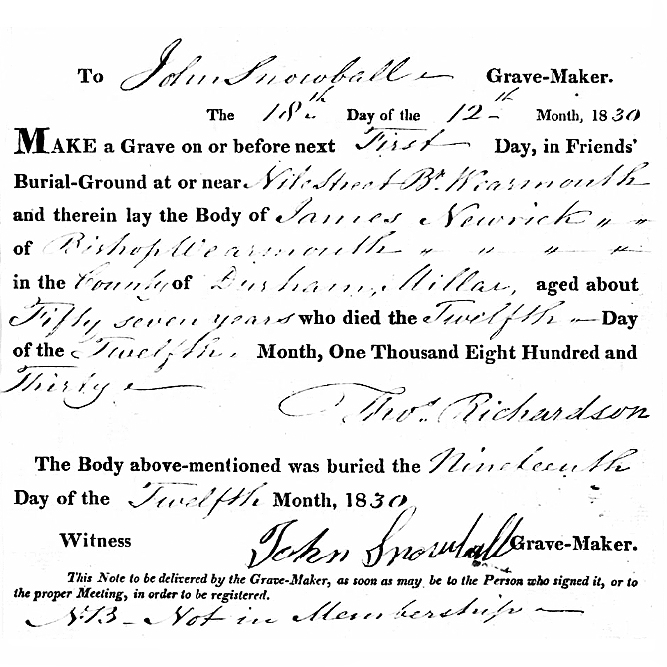
- Durham, England, Church of England Baptisms, Marriages and Burials, 1538–1919 (Bishopwearmouth; burial at Nile Street, 19 December 1830)
- Cheshire, England, Parish Registers, 1538–1909 (Crewe)
- England and Wales, Quaker Birth, Marriage, and Death Registers, 1578–1837 (TNA RG 6)
- England and Wales, Non-Conformist and Non-Parochial Registers, 1567–1970
Civil registration and probate
- England and Wales, Civil Registration Birth Index, 1837–1915
- England and Wales, Civil Registration Marriage Index, 1837–1915 (including Albert Newrick, Q4 1869, Sunderland, vol. 10a, p. 712)
- England and Wales, Civil Registration Death Index, 1837–1915
- England and Wales, National Probate Calendar (Index of Wills and Administrations), 1858–1995
Census returns
- 1841, Bishopwearmouth, Durham (Ballast Hills; Charles Chicken Newrick, agent)
- 1851, Bishopwearmouth and Sunderland, Durham (including the “Dewick” transcription)
- 1861, Lancashire and Crewe, Cheshire
- 1871, Oswestry, Shropshire (Tower Works Street)
- 1881, Oswestry, Shropshire (Middleton Road; not yet obtained, see snag 14)
- 1891, 1901, and 1911, Plumstead and Woolwich, Kent (Elm Street; 36 Purrett Road)
- 1901, Grantham, Lincolnshire
- 1841 to 1891, Darlington, Durham, for the James Archibald branch
- 1841 to 1871, Tynemouth and North Shields, Northumberland
- 1921 Census of England and Wales
- 1939 Register of England and Wales
Emigration, shipping, and overseas records
- UK, Outward Passenger Lists, 1890–1960 (TNA BT 27)
- Queensland, Australia, Assisted Immigration, 1848–1912, and associated agents’ records (James Newrick, SS Sirsa, 1884)
- Canada, Incoming Passenger Lists, 1865–1935 (LAC RG 76)
- Censuses of Canada, 1891, 1901, 1911, and 1921 (Nanaimo, Wellington, and Comox districts, Vancouver Island)
- British Columbia Vital Statistics: births, marriages, and deaths registrations
- Archives New Zealand passenger lists; New Zealand electoral rolls, 1853–1981; New Zealand Births, Deaths and Marriages historical records (Dunedin and Hawke’s Bay)
- New South Wales Registry of Births, Deaths and Marriages (Frederick Charles Newrick, Granville, 1928, registration 11860)
- Australia Electoral Rolls, 1903–1980 (Reid division, New South Wales)
- United States Federal Census, 1860 onward (Saginaw, Michigan; Kansas)
Apprenticeship, directories, newspapers, and maps
- Indenture of James May Butterfunt Newrick, 8 February 1834, Newcastle upon Tyne
- Durham County Advertiser, January 1834, insolvency notice for James May Butterfunt Newrick, grocer, Bishopwearmouth
- Ward’s Directory of Sunderland and District
- Kelly’s Directory of Kent, Woolwich and Plumstead sections
- Ordnance Survey town plans, Woolwich and Plumstead, 1:500 and 1:2500
- Trove, for Queensland and New South Wales newspapers; Papers Past, for the New Zealand press
- Royal Arsenal Woolwich records, The National Archives (verify the SUPP series in the catalogue before citing)
Compiled trees and indexes
- Ancestry Family Trees
- Geneanet Community Trees Index
Secondary works
- E. P. Thompson, The Making of the English Working Class (London, 1963)
- Arthur Redford, Labour Migration in England, 1800–1850, 2nd edn, ed. W. H. Chaloner (Manchester, 1964)
- Dudley Baines, Migration in a Mature Economy: Emigration and Internal Migration in England and Wales, 1861–1900 (Cambridge, 1985)
- John Langton and R. J. Morris (eds), Atlas of Industrializing Britain, 1780–1914 (London, 1986)
- Colin G. Pooley and Jean Turnbull, Migration and Mobility in Britain since the Eighteenth Century (London, 1998)
- John Douglas Belshaw, Colonization and Community: The Vancouver Island Coalfield and the Making of the British Columbian Working Class (Montreal, 2002)
- Marjory Harper and Stephen Constantine, Migration and Empire (Oxford, 2010)
