The Story of Two Newrick Brothers: Thomas William Newrick (1835–1895) & Henry Valentine Newrick (1832–1915)
The Suffolk Coast
On the eastern edge of England, where the county of Suffolk meets Norfolk at the mouth of the River Yare, there is a cluster of coastal towns and villages: Great Yarmouth, Gorleston, Belton, Pakefield, Lowestoft, which face the North Sea across marshes and sand dunes. It was here, in the 1830s, that two brothers were born into the Newrick family: boys who would grow up to cross an ocean, live through a civil war, and build lives on the American frontier.
Henry Valentine Newrick was born on 14 February 1832, Valentine’s Day, in Pakefield, a fishing village just south of Lowestoft. His brother Thomas William Newrick followed on 31 October 1835, born a few miles inland in the market town of Beccles, in the Waveney valley. Their father was John Henry Buttifant Newrick, born in 1806 in Great Yarmouth, just across the river from Pakefield. Their mother was Susanna Weavers, who was born around 1810.
The Newrick name had roots in this corner of East Anglia. John H.B. Newrick’s father, James, had been born in 1772 in Belton, a village close to Pakefield. In fact, the Newrick family tree extends back to James Newark (1695-1171) of Burgh Castle, Suffolk, the writer’s 8th great-grandfather.
At some point, James Newrick (b. 1772) migrated north to County Durham, where he died in 1830 at Wearmouth, near Sunderland, on the River Wear. This northward move planted the Newrick name in the industrial Northeast of England and established a line of ironworkers and engineers who would later move to Woolwich. Other branches of the family would seed their own emigrant lines to New Zealand and Australia, but John H.B. Newrick’s branch stayed in the Suffolk–Norfolk borderlands until they left for good.
There is one more Suffolk connection to note. In the tiny parish of Sotterley, barely four miles from Beccles, a girl named Louisa Clutten was baptised on 4 January 1839, the daughter of William Clutten and Hannah. She would become Thomas’s wife, thirty years and an ocean later. The proximity of the Newricks of Beccles and the Cluttens of Sotterley, who were close enough to share a market day, makes it all but certain that the families knew one another before either crossed the Atlantic.
Departure
By the late 1840s, the Newrick family had left Suffolk for Croydon, on the southern outskirts of London. The move was part of a broader pattern: Croydon was growing rapidly, its population swelling after the railway arrived in 1839, and it drew workers from across southern England. Thomas was baptised on 8 April 1849 at the parish church of St John the Baptist, Croydon — a strikingly late baptism at the age of thirteen, which may have been due either to the family’s move to a new parish or to a requirement for confirmation.
Two years later, the 1851 census recorded Thomas, now fifteen, as a servant in a Croydon household headed by one Harrietta Nanes, aged sixty-five. He was the only male among six residents, apparently serving as a general domestic in a gentlewoman’s establishment. His birthplace was given as Beccles, Suffolk, and his surname was rendered as “Newick”—a phonetic variant. Of Henry, there is no trace in the 1851 English census. He may already have been in America, or may have been enumerated elsewhere and not yet found.
The family emigrated around 1852. Henry’s 1910 census return lists his year of immigration as 1852 and records 61 years of American residence in 1900. His obituary, published in a Parsons, Kansas, newspaper, stated that he “was born in England and moved to America with his parents when but a small boy” — a description coloured by the passage of decades, since he was, in fact, about twenty. Thomas would have been sixteen or seventeen: old enough to have completed his service in Croydon and to join the family’s crossing. Their sister Caroline, about fifteen, presumably accompanied them. Their parents, John and Susan Newrick, are recorded as “both buried in England,” suggesting they either returned to England at some point or never emigrated—a discrepancy that remains unresolved.
Michigan in the 1850s
The Newrick brothers settled in Michigan, specifically in the central part of the Lower Peninsula, in the country drained by the Saginaw River and its tributaries. This was still largely frontier territory in the 1850s.
Isabella County, where Thomas would be recorded in 1863, had been formally organised only in 1859; its first permanent white settlers had arrived as recently as 1854. Its county seat, Mount Pleasant, was established at the geographic centre of the county in 1860, when the total population was approximately 1,441; roughly half American settlers and half Native Americans of the Saginaw Chippewa nation. The neighbouring county of Saginaw, to the east, was more developed, its economy driven by the lumber trade that would make the Saginaw Valley one of the great timber-producing regions of nineteenth-century America.
Henry married first. In 1858, in Saginaw, he wed Caroline Wilcox, born in 1837 in New York to Oziel Wilcox, a peddler from Connecticut, and Lucy Leete, also of Connecticut. It was a marriage that joined an English immigrant to a woman of old New England stock. Their first child, William H Newrick, was born around 1859; a daughter, Florence, followed around 1862.
Thomas’s movements in this period are less clear. He was recorded in the Third Ward of Mount Pleasant, Isabella County, in July 1863, when the Civil War draft enumerators came calling. He was listed as “married,” aged twenty-seven, born in England. Whether he had married by this date or whether the record is in error remains an open question. No wife or children have been identified for Thomas before his 1868 marriage to Louisa Clutten.
The Civil War
The American Civil War reached the Michigan frontier through the Enrollment Act of March 1863. This was the first national conscription law in United States history, and it required the enrolment of every male citizen and declarant alien between twenty and forty-five. Those aged twenty to thirty-five, married or unmarried, were placed in Class 1 and liable to be called first if a congressional district’s volunteer quota was not met.
On 1 July 1863, Thomas was enrolled in the draft. He appeared in the Consolidated Lists under the name “Thomas Newick”; the dropped-R spelling that American clerks naturally produced. He was classified as Class 1, resident in the Third Ward of Mount Pleasant, within Michigan’s Sixth Congressional District. This sprawling district encompassed Isabella, Saginaw, Bay, Gratiot, Genesee, and numerous other counties stretching into the Upper Peninsula.
The draft was deeply unpopular. Men felt, one contemporary account noted, that being drafted “robbed them of their patriotism and branded them as unwilling defenders of the nation.” In practice, the 1863 draft produced remarkably few soldiers. Of 292,441 names drawn nationally, roughly 190,000 were exempted for disability or hardship, over 52,000 paid the $300 commutation fee (equivalent to roughly $5,000 in an unskilled worker’s wages), and 26,000 furnished substitutes. Only 9,881 men, barely three per cent, actually entered the army through the draft process. In Michigan, “very few were drafted,” as most quotas were filled by volunteers, often incentivised by substantial bounties.
Thomas, it appears, was among the majority who did not serve. No record of military service under any spelling variant of his name has been found. Whether he paid commutation, furnished a substitute, or was exempted, we do not know.
Henry’s path was different. On 26 February 1864 — seven months after Thomas’s enrollment — Henry walked into the recruiting office at Corunna, in Shiawassee County, and enlisted as a Private in Company D of the 3rd Michigan Cavalry. He gave his age as twenty-eight, understating it by about 4 years; he was actually 31, married, and the father of 2 young children.
The timing suggests that Henry may have enlisted as Thomas’s substitute. The Enrollment Act explicitly permitted substitution, and brothers doing so for one another was not unknown. However, there is no evidence to support this.
The 3rd Michigan Cavalry had been organised at Grand Rapids in late 1861 and served primarily in the Western Theatre — Tennessee, Mississippi, Alabama, and the Gulf states. By the time Henry joined Company D, the regiment had already seen hard fighting. Henry served through the final year of the war and was mustered out on 17 June 1865 at Baton Rouge, Louisiana, having held the rank of Private throughout. He came through the war alive and, so far as the records show, physically intact.
Thomas: The Saginaw Entrepreneur
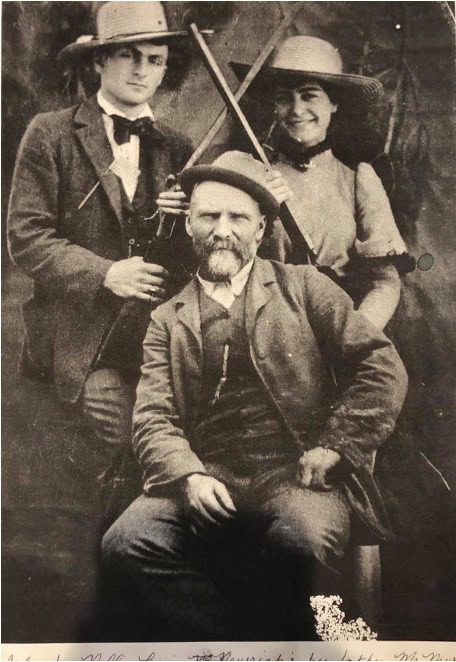
After the war, the brothers’ paths diverged. Thomas remained in Michigan. At some point in the mid-to-late 1860s, he moved, or prepared to move, from Isabella County toward the Saginaw area. On 28 January 1868, he married Louisa Clutten in Detroit, Wayne County. The marriage record named him as “Thomas William Newricke,” aged thirty (slightly understated), and his bride as “Louisa Clutte.”
Louisa had been baptised on 4 January 1839 in Sotterley, Suffolk, just four miles from Thomas’s birthplace of Beccles. Both were children of the same stretch of English countryside.
Thomas and Louisa settled in Saginaw County, where the 1870s and 1880s were the peak years of the great Michigan lumber boom. The Tittabawassee River, which flowed through the county into the Saginaw River and on to Lake Huron, was the principal highway for floating logs to the sawmills. By 1872, thirty-six mills, some of the largest in the country, operated along the Saginaw River. Thomas positioned himself at the intersection of this economy and the emerging farming country as forests were cleared.
His obituary, published in the Saginaw Evening News on 26 January 1895, recorded three distinct enterprises: he “once conducted a ferry across the Tittabawassee River,” “owned a grocery on S. Porter in Saginaw,” and had business interests “also in Hemlock.” Operating a river ferry in the lumber era was significant work, requiring a county licence and serving the constant traffic of loggers, farmers, and goods. The grocery on South Porter Street placed him in the commercial heart of old Saginaw City, on the west bank of the river.
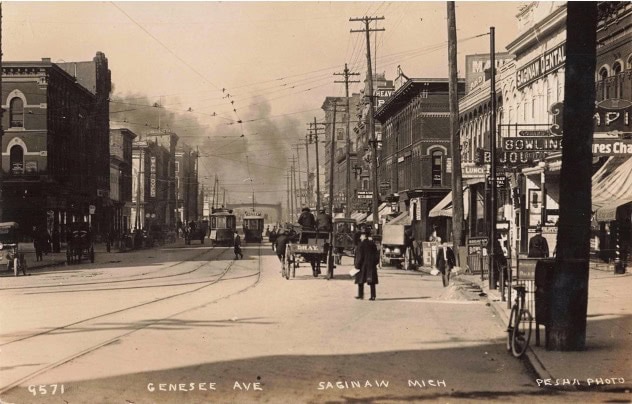
The 1880 Federal Census captured Thomas at the height of his business activity. On 5 June 1880, he was enumerated in Saginaw City as a retail grocer, aged about forty-two, living with Louisa, whose birthplace was confirmed as England and whose parents were English-born. Four days later, the agricultural census recorded his farm in Saginaw County — shopkeeper and farmer simultaneously, a common enough combination in rural Michigan. His neighbours on the agricultural schedule bore German surnames — Schilds, Knaile, Bytte, Meier, Engel- reflecting the mixed Anglo-German character of the Saginaw Valley’s settler population.
Thomas and Louisa had a child, Nellie Louise Newrick, in March 1874. Nellie was born in Saginaw City and baptised there, probably at St John’s Episcopal Church, the parish where Thomas would later be buried.
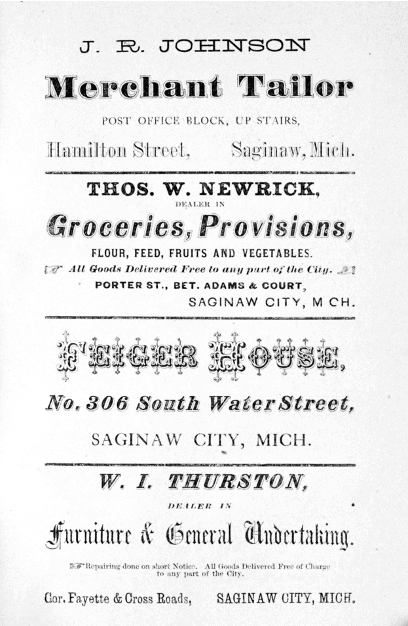
By 1887, Thomas had added another role: he was appointed Postmaster of Hemlock City, a small lumbering community in Richland Township, Saginaw County, about fifteen miles west of Saginaw. Hemlock was first settled in 1865, and its post office was established in 1869; by the 1880s, it was a modest but established village along the plank road connecting Saginaw with the farming country of Gratiot County. The postmaster’s compensation of $159.30 reflected a small rural office, probably run from Thomas’s own premises alongside his grocery. In this era, a postmaster appointment was a federal patronage position that signified civic standing.
By 1890, a directory placed Thomas at 1008 Adams Street, west side, Saginaw — probably his grocery, having moved from or supplemented the South Porter Street location. The “west side” placed him on the old Saginaw City bank of the river, consistent with his established roots. He was a man of substance: farmer, grocer, ferry operator, and postmaster.
Henry: Cavalryman, Farmer, Livery Man
Henry’s war ended at Baton Rouge in June 1865. Within five years, he had left Michigan entirely. In 1870, the census found him in Fort Scott, Bourbon County, Kansas — deep in the southeast corner of the state, close to the Missouri border. He was farming, with real estate valued at $1,000. His household comprised his wife Caroline (née Wilcox), son William and daughters Florence and Sarah. The family was joined later by a fourth child, Laura, born around 1872.
Fort Scott was a natural destination for a Union veteran. The town had been a military post since 1842 and played a significant role in the “Bleeding Kansas” conflicts of the 1850s. After the war, it became a railhead and agricultural centre, drawing settlers from across the Midwest. Kansas actively recruited veterans with offers of cheap land and the westward-expanding railroad.
By 1880, Henry had moved from farming into a business that suited a cavalry veteran: he was keeping a livery stable on Carroll’s Plaza in Fort Scott.
His sister, also named Caroline (born 1837), may have been in the household at various times, potentially contributing to the census confusion that listed his wife’s surname as “Newrick” rather than “Wilcox”.
Tragedy struck in March 1885 when Caroline Wilcox Newrick died, aged forty-eight, and was buried in Fort Scott. Henry, now fifty-three, was left a widower with adolescent and young adult children. His daughter Sarah, then about seventeen, appears to have assumed the role of housekeeper and companion — a position she would hold for the rest of Henry’s life.
On 4 August 1890, Henry filed for a Civil War pension in Kansas, for service with Company D, 3rd Michigan Cavalry. The timing coincided with the Dependent Pension Act of that year, which expanded eligibility to any Union veteran unable to perform manual labour, regardless of whether the disability was service-related.
In 1896, Henry moved from Fort Scott to Parsons, in neighbouring Labette County, where he would spend his final years. He lived for a time on the Plaza, then near the old county fairgrounds south of the city. By 1900, he was a widowed farmer, renting on Johnson Avenue with Sarah as his sole companion. By 1910, he owned his home outright at 2421 Main Street, making him a man of modest but secure means, living on his own income.
Henry was a member of the Grand Army of the Republic, the veterans’ organisation that served as a fraternal society, political lobby, and mutual aid network for Union veterans. A 1906 GAR muster roll records him as a member of the Parsons post, aged seventy, born in England, resident at Rural Free Delivery #4.
His funeral service in August 1915 was conducted at home by the Reverend P. H. Chappelear of the Washington Avenue Methodist Church. However, the veterans escorted his body to the cemetery and conducted the service at the graveside. This was a fitting farewell for a man who had ridden with the 3rd Michigan Cavalry half a century earlier.
Henry Valentine Newrick died on 8 August 1915 at his home in Parsons, after a lingering illness, at the age of eighty-three. He was buried in Oakwood Cemetery, Parsons. His obituary noted that he was survived by two daughters: Miss Sarah, who lived with him, and Mrs Morris (née Florence) of Joplin, Missouri, and one son, W. H. Newrick, an engineer on the Missouri-Kansas-Texas Railroad, known as the “Katy.” He was, the newspaper recorded, “well known to all of the older residents of this city.”
Thomas: Last Years
Thomas William Newrick died on 25 January 1895 in Saginaw, Michigan, at the age of sixty-one, twenty years before his elder brother. His funeral service was held at St John Episcopal Church, the American counterpart to the Church of England, where he had been baptised in Croydon nearly half a century earlier. He was buried at Oakwood Cemetery, Saginaw, a municipal cemetery established in 1868. His grave, the cemetery records note, has no marker.
His obituary appeared the following day in the Saginaw Evening News. It was a brief notice — recording the ferry, the grocery, and the Hemlock connection — but its appearance in the city’s daily newspaper reflected a man of standing in his community.
Louisa died on 14 November 1892, three years before Thomas, making him a widower at the time of his own death. Their daughter, Nellie Louise, remained in the Hemlock area. In 1893, she married Frank Brooks Cole, the son of another Civil War family. Frank’s father, Captain Frank J. Cole, had enlisted as a Private in Company G, 13th Illinois Infantry, at Dixon, Illinois, on 6 June 1861, mustered in by his own father, Captain George M. Cole. The elder Cole rose from Private through the ranks of the 13th Illinois and the 6th Missouri Cavalry to Captain: Frank’s mother, Susan L. Brooks Cole had been the public librarian at East Saginaw. The Cole and Newrick families had been neighbours in the Saginaw area since at least the early 1870s.
Frank Brooks Cole served in the Navy during the Spanish-American War, was a concert soloist at leading American hotels in early life, and went on to become the first president of the Pasadena Chamber of Commerce and Mayor of Pasadena in 1926. He died around 1943 at their home in Hermosa Beach.
Nellie outlived him by three decades. She moved north to Pismo Beach, San Luis Obispo County, to be near their daughter, Susan O’Connor, and died there on 12 October 1974 at the remarkable age of one hundred. Born nine years after the Civil War ended, she lived to see men walk on the moon and was the last link in Thomas and Louisa’s Suffolk-to-Michigan story. She and Frank had five children: Thomas (1894-1984), Maxine Ruth (1896-1985), Franklin Brooks Jr. (1901-1987), Susanna L. (1905-1987), and a daughter who became Mrs Lloyd C. Bauer.
Two Brothers, Two Oakwoods
The brothers’ final resting places were both in Oakwood. Thomas at Oakwood Cemetery in Saginaw, Michigan; Henry at Oakwood Cemetery in Parsons, Kansas. Both men left the same small corner of Suffolk, settled in the same part of Michigan, lived through the same war, and ended their days a thousand miles apart, in cemeteries that share a name.
Thomas was the settler-entrepreneur who put down roots, built businesses, and became a prominent member of his community: grocer, farmer, ferry operator, postmaster, and churchman.
Henry was the soldier-pioneer who moved west, kept a livery stable, and spent his last decades in the company of fellow veterans who had shared the same experience.
Both were ordinary men, but with extraordinary stories.
Sources
- Parish Register, Pakefield, Suffolk — Baptism of Henry Valentine Newrick, 19 March 1832. FHL Film 918521.
- Parish Register, St John the Baptist, Croydon, Surrey — Baptism of Thomas William Newrick, 8 April 1849. FHL Film 994333.
- 1851 Census of England and Wales — Thomas Newick, servant, Croydon. Piece 1601, Folio 122, Page 29.
- U.S. Civil War Draft Registrations, 1863 — Thomas Newick, Isabella County, Michigan. Series Nm-65, Entry 172.
- Record of Service of Michigan Volunteers in the Civil War, 1861–65 — Henry V Newrick, Pvt, Co. D, 3rd Michigan Cavalry.
- NPS Civil War Soldiers & Sailors Database — Henry V. Newrick, Pvt, Co. D, 3rd Michigan Cavalry. NARA Film M545 roll 30.
- Michigan Marriage Records — Thomas William Newricke to Louisa Clutte, 28 January 1868, Detroit. FHL Film 001377622.
- Suffolk County Baptism Register — Louisa Clutten, 4 January 1839, Sotterley. FHL Film 918543.
- 1870 U.S. Federal Census — Henry Valentine Newrick, Fort Scott, Bourbon County, Kansas.
- 1880 U.S. Federal Census, Population Schedule — Thomas William Newrick, Saginaw City, Michigan. ED 315.
- 1880 U.S. Federal Census, Agricultural Schedule — Newrick, Thomas William., Saginaw County. ED 313.
- 1880 U.S. Federal Census — Henry Newrick, Fort Scott, Kansas (livery stable, Carroll’s Plaza).
- The Postal Service, 1887 — Post-Offices and Postmasters, Michigan, p. 539: Hemlock City, T. W. Newrick.
- Directory listing, 1890 — Thomas William Newrick, 1008 Adams, w S, Saginaw.
- U.S. Civil War Pension Index — Henry V Newrick, D 3 Mich Cav, filed Kansas, 4 August 1890.
- Michigan Death Records; Saginaw Evening News, 26 January 1895 — Obituary of Thomas W. Newrick.
- Find A Grave — Thomas William Newrick, Oakwood Cemetery, Saginaw (biography present).
- Find A Grave — Henry Valentine Newrick, Oakwood Cemetery, Parsons, Kansas.
- Church Register, Saginaw — Baptism of Nellie Newrick, 30 March 1874. FHL Film 967179.
- Michigan Marriage Records — Nely L. Newrick to Frank B. Cole, 23 January 1900, Merrill. FHL Film 000967190.
- Death Record — Nely L Cole, 30 March 1874 – 12 October 1974, San Luis Obispo, California.
- U.S. Social Security Applications — Thomas Newrich (father), Louisa Clutten (spouse), Nely Louise Cole (child).
- 1900 U.S. Federal Census — Henry Newrick, Parsons, Kansas (widowed, farmer).
- 1900 U.S. Federal Census — Cole household, Hemlock Village, Saginaw County, Michigan.
- Grand Army of the Republic Muster Roll, Parsons, Kansas, June 1906 — Henry V Newrick.
- 1910 U.S. Federal Census — Henry B [sic] Newrick, 2421 Main Street, Parsons, Kansas.
- Obituary — “Death of Henry V. Newrick,” Fort Scott or Parsons newspaper, August 1915.
- Caroline Wilcox Newrick — born 1837, New York; married Henry V. Newrick, 1858, Saginaw; died March 1885, Fort Scott, Kansas. Research records.
- Imperial Publishing Co., The County of Saginaw, Michigan: Topography, History, Art Folio (Saginaw, 1896). Portrait plate, Richland Township: “12. T. W. Newrick, deceased.” University of Michigan Digital Collections; Library of Congress (LC item 2007626770).
- Imperial Publishing Co., The County of Saginaw, Michigan: Topography, History, Art Folio (Saginaw, 1896). Land ownership map, Richland Township, p. 25: “Newrick Est.”
- Record of Service of Michigan Volunteers in the Civil War, 1861–1865, Vol. 36 (Cavalry), p. 124: Henry V. Newrick, Co. D, 3rd Michigan Cavalry.
- Illinois: Roster of Officers and Enlisted Men — Frank J. Cole, Pvt, Co. G, 13th Illinois Infantry. Enlisted 6 Jun 1861, Dixon, Illinois. Transferred to the 6th Missouri Cavalry.
- NARA, Compiled Military Service Records — Frank J. Cole, Co. G, 13th Illinois Infantry. Film M539 roll 17. Physical description: age 22, 5’8¼”, brown hair, black eyes, light complexion. Residence: Fenton, Whiteside Co., Illinois. Occupation: clerk. Promoted Adjutant, 6 Mo. Cavalry, by order Gen. Halleck, 15 Feb 1862.
- U.S. Civil War Pension Index — Susan L. Cole, widow of Franklin J. Cole. Application 410599, Certificate 323539. Filed from Michigan, 14 Oct 1889.
- Ancestry.com — Susan L. (Susie) Brooks Cole (Feb 1843 – 18 Nov 1919). Born in Illinois; married Franklin J. Cole, 30 Oct 1862, Whiteside, Illinois; died in Los Angeles, California.
- Ancestry.com — Nellie Newrick (30 Mar 1874 – 12 Oct 1974). Born in Saginaw; married Frank Brooks Cole, 1893; died in Pismo Beach, San Luis Obispo, California.
- Obituary — Franklin B. Cole, aged 70, former Mayor of Pasadena. Newspaper clipping (undated, c. 1943). Hermosa Beach, California.
- 1880 U.S. Federal Census, Agricultural Schedule — Tittabawassee Township and Buena Vista Township, Saginaw County, Michigan. Page 9.
Researched by Nigel Williams, 2026. The writer is a first cousin five times removed of Thomas and Henry, through the Newrick line of his mother, Yvonne Patricia Newrick.
