My great-grandfather Edward Williams was born on 10 April 1870 in Usk, Monmouthshire. He was the youngest of seven children of Abraham Williams (1826-1905), a sawyer from Llanfihangel-juxta-Usk and Ellen Rebecca Williams (née Lucas, and also from Usk). Abraham’s father John (1791-1862) had been a cordwainer (bookmaker), and Abraham worked at that trade for the first few years of his working life before becoming a sawyer.
Usk is an old market town in Monmouthshire, set on the river of the same name about ten miles north-east of Newport. A Norman castle stands above it, overlooking an ancient bridge that still stands. The town had prospered in the first half of the nineteenth century, but by the time Edward was born in 1870, its prosperity had faded, and the population had declined due to the agricultural depression.
Edward had two sisters, Elizabeth (b.1850) and Frances b.1868), and four brothers: Henry (b.1853). George (b.1859), Blandford (b.1861) and Abraham (b. 1866).
Abraham and George became sawyers like their father. Through most of the nineteenth century, the sawyer’s trade was heavy manual labour. A log was rolled onto trestles above a saw pit and cut lengthwise by two men working a long framed saw. Abraham senior was probably a pit sawyer. From the 1850s onwards, steam and water driven mills began to take the work, first in the towns and the ports and later in the country districts. Edward’s brothers probably worked in a commercial mill.
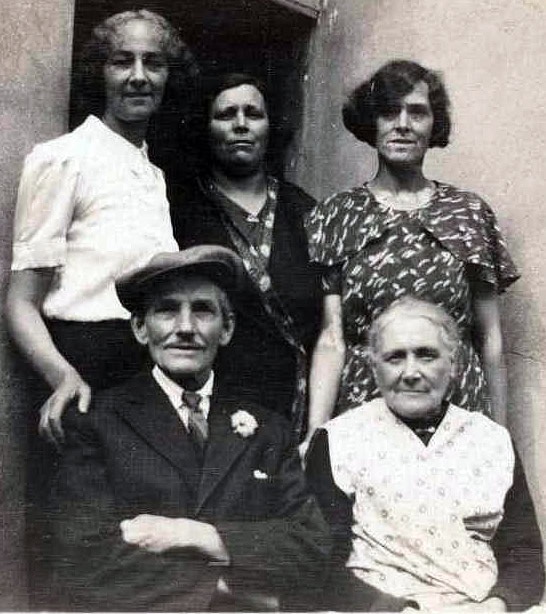
Blandford moved to Richmond, Surrey, where he became a bricklayer. Henry made a similar move to Camberwell in the same trade. Elizabeth is difficult to trace, but it appears she moved to London and became a cook, whilst her sister Frances married George James Priddy (1868-1940), a wood turner, and stayed in Wales. Edward grew up in Usk and trained as a tailor. However, sometime in the late 1880s, he left Usk and moved to London, where he joined the Police.
By this time, policing had become a sought-after occupation, with only about one applicant in five gaining acceptance. Senior Metropolitan Police officers preferred recruits from the countryside to Londoners, believing them healthier, more disciplined, and less likely to face conflicting loyalties when policing their own neighbourhoods. Consequently, only around one in ten Metropolitan Police constables was London-born. A young Welshman newly arrived from Usk would have fitted the profile of an ideal recruit.
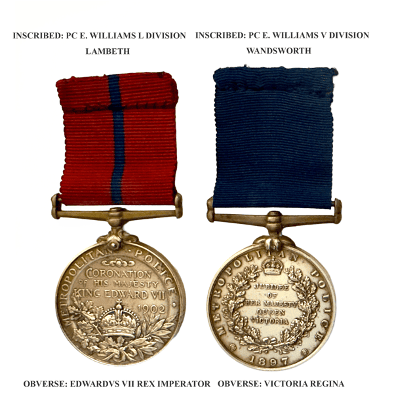
Edward was appointed as a constable on 28 January 1889. By 1891, he was living within the police station establishment at West Hill, Wandsworth (V Division), as a serving constable.
Wandsworth was an expanding and socially varied London district whose crime was predominantly ordinary urban crime: theft, burglary, drunkenness, assault, domestic disturbance, juvenile offending and public-order offences. For the constable on the beat, policing consisted of continuous patrol, preventing theft, controlling disorder and managing the daily frictions of a growing population.
Edward married Alice Bowler in 1896, and over the following decade, they had four children: Lawrence (1898), Louisa (1901), Francis (1905), and my Grandfather, Leonard Alfred (1906). By the time Leonard was born, the family was living in Newington, Surrey. In December 1898, Edward transferred to L Division(Lambeth), which became his final police posting.
Lambeth was a tougher beat, as its densely populated streets were subject to far more drunkenness, assaults and public-order offences, and its police court was among the busiest in London. Street robbery, prostitution, drunken disorder and pickpockets were all likely to have been more common in Lambeth than in Wandsworth.
After 20 years of service, Edward retired from the Metropolitan Police in April 1909 on medical grounds and was awarded a pension of £33 14s 4d per annum. At the time of his retirement, the family was living in Walworth.
By the 1921 census, Edward was still living in London with Alice and their children, within a working household as the children moved into clerical and commercial work. Leonard worked as a clerk at Scotland Yard, while Lawrence Edward held a similar post at the Ministry of Agriculture in Whitehall. Louisa, Ellen and Francis all worked as shop assistants. Later in life Francis would also become a policeman.
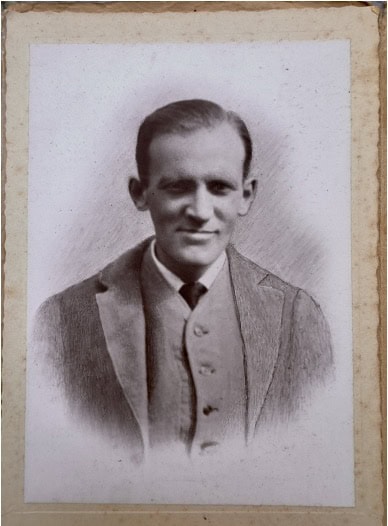
The one photograph we have of Edward appears to be a post-retirement portrait, probably taken in the last decade of his life (1916-1926). I have the original, and it was the first example I have seen of a portrait that uses pencil retouching over a photographic base. It was proably a Bromide enlargement reworked with pencil, a technique popular in the early 20th century. Photographers used enlargements on light-sensitive bromide print paper and manually enhanced them with graphite to add artistic depth, fix imperfections, or mimic the painterly look of the Pictorialist movement.
Edward died of pulmonary tuberculosis in 1926 at the family home in Archway Street, Barnes, aged 56. Whilst this condition was not uncommon at the time, it was a particular threat to men who spent years outdoors in all weathers. The policeman’s beat both shaped and perhaps hastened the end of his life.
Sources
- General Register Office: birth (Usk, 1870), marriage (St George Hanover Square, 1896), and death (Barnes, 1926) entries.
- Census returns, 1871 to 1921 (Wales and England).
- Church of England parish registers (marriage and baptisms), London and Surrey.
- Metropolitan Police service and pension records, The National Archives (MEPO).
Compiled by Nigel Williams, January 2026. Edward Williams was my great-grandfather.
