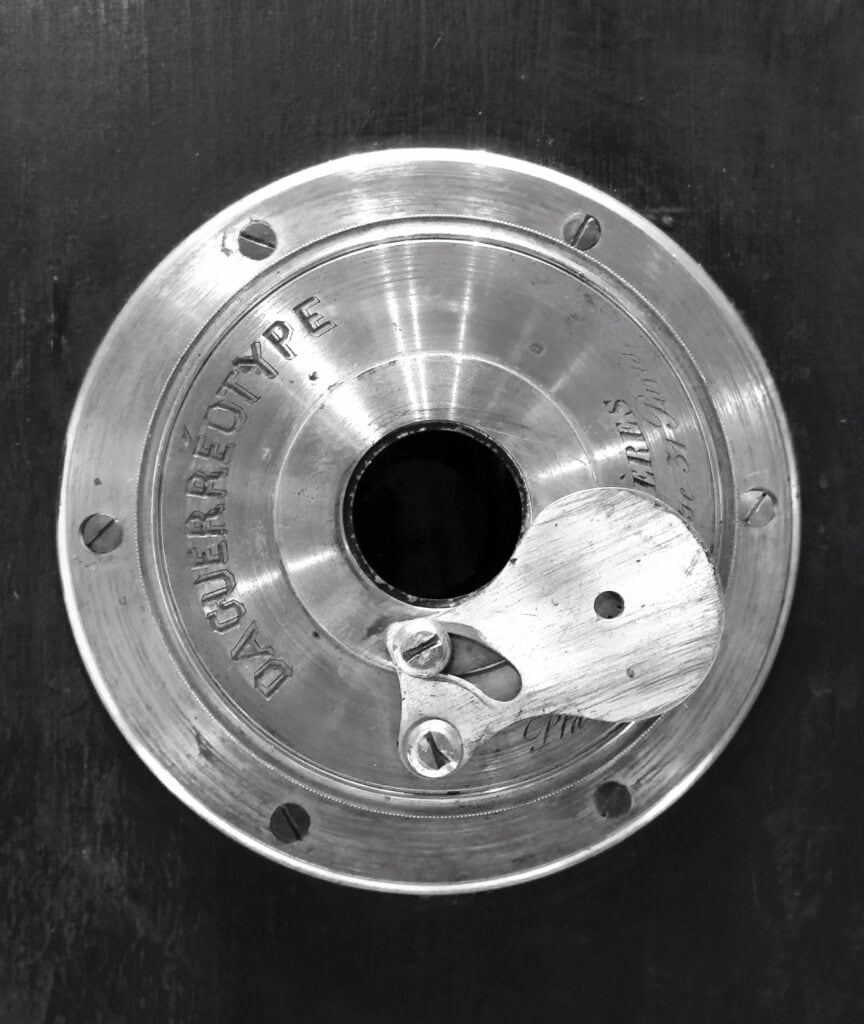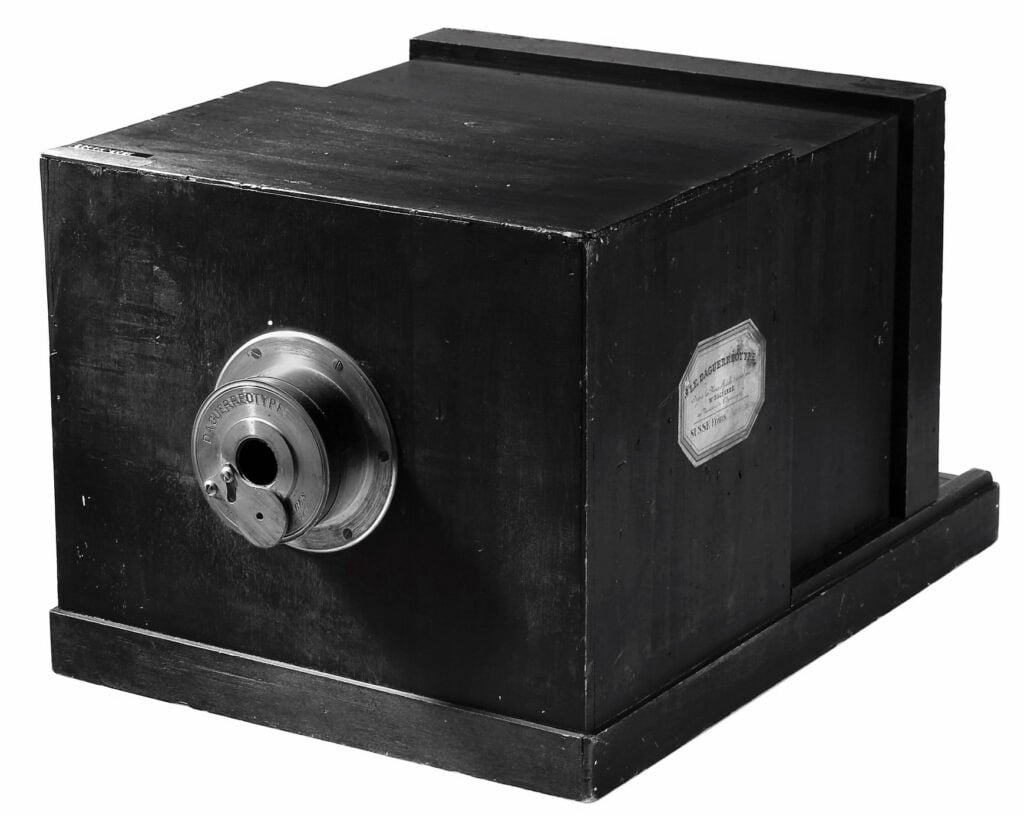
I came across what might be the first camera you could actually buy at the excellent Westlicht permanent exhibition in Vienna. The museum displays an impressive collection of 360 cameras and also hosts a 3D camera exhibition of 100 historically significant cameras.
The museum’s centrepiece and most valuable specimen, displayed as the world’s first commercially produced camera, is the “Susse Frères Daguerréotype”. This is the story of that camera and the race to sell the world’s first camera.
On 19 August 1839, physicist François Arago stood before the Académie des Sciences and the Académie des Beaux-Arts in Paris to reveal the details of a brand-new process and apparatus, first announced in January. The hall was packed, and those who could not get in waited outside on the Quai de Conti to learn what had been said.
The Contenders
Two months earlier, on 22 June, the man who put his name to the camera, Louis-Jacques-Mandé Daguerre, had signed contracts with two Paris firms to manufacture the camera. One was Alphonse Giroux et Cie of the Rue du Coq Saint-Honoré, an important Parisian manufacturer of luxury furniture and accessories. Giroux was Daguerre’s brother-in-law. The other was Maison Susse Frères, at 31 Place de la Bourse, a firm with a foundry business and a shop selling similar merchandise.
Both were granted the right to build the camera to Daguerre’s plans, though not on the same terms. Giroux’s cameras were endorsed by Daguerre and marketed on the basis that they were constructed under his supervision. Susse Frères cameras were produced according to Daguerre’s plans.
As a result, Giroux’s cameras carried an oval plaque bearing Daguerre’s own signature and a red wax seal dated with the year. Susse Frère’s octagonal label stated that the camera had been made to the plans lodged at the Ministry of the Interior.
The Timeline
Shortly after the Daguerreotype was announced, both firms went to press. Here is the Daguerreotype/Giroux/Susse Frères timeline, according to Photobibliothek.ch, a private library on the history of photography that houses the original adverts.
| Date | Event | Significance |
| 6 Jan | Gazette de France publishes H. Gaucheraud’s “Nouvelle découverte”, describing Daguerre’s invention. | The first public announcement of photography, one day before Arago’s presentation. |
| 7 Jan | François Arago announces Daguerre’s invention to the Académie des Sciences. | The first official scientific announcement. |
| Jan–June | Extensive press coverage follows in France and abroad, alongside rival priority claims from Talbot, Gerber and others. | Daguerre’s process becomes an international story months before the technical details are released. |
| 19 Aug | Arago and Daguerre publicly reveal the process in Paris. | The operating details become public and the French state effectively releases the process for public use. |
| 21 Aug | Gazette de France carries an advertisement from Alphonse Giroux & Cie. | Subscription/advance advertisement. Giroux says the apparatus is manufactured under Daguerre’s direction and will be accompanied by explanatory instructions. |
| 23 Aug | Gazette de France carries a Susse Frères advertisement: “On souscrit au Daguerréotype chez Susse frères…” | Susse Frères follows Giroux by only two days, again soliciting subscriptions/orders rather than announcing stock immediately available. |
| 25 Aug | Le Voleur reports extraordinary public interest at the Institut de France; crowds had arrived three hours before the presentation and three specimen daguerreotypes remained on display. | Demonstrates the intensity of the publicity surrounding the commercial launch. |
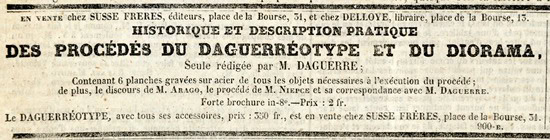
| 6 Sep | Susse Frères and bookseller Delloye advertise Daguerre’s manual under its full title, Historique et description pratique des procédés du Daguerréotype et du Diorama, price 2 francs. Susse also advertises the complete daguerreotype apparatus with accessories for 350 francs. | The wording changes to “En vente” — on sale. |
| 7 Sep | Giroux advertises Daguerre’s manual under its full title for 2 francs, with engraved plates, stating that Giroux is the only house making apparatus under Daguerre’s direction. | Giroux’s corresponding full commercial advertisement appears the day after Susse’s. |
Giroux appears to win the publicity race with its advertisement of 21 August, but Susse Frères is the first to offer availability. On 6 September, Susse Frères says both the manual and 350-franc apparatus are “en vente”. Giroux’s comparable full-title advertisement appears on 7 September.
The Other Race
There was another race in progress. While Daguerre and his supporters were preparing to reveal the new process to the world, across the Channel English gentleman-scientist William Henry Fox Talbot had been pursuing photographic experiments of his own. News of Daguerre’s discovery, announced on January 7th, though without details of the process, travelled quickly.
Within weeks the news had reached Fox Talbot in England, who immediately recognised that Daguerre’s claims overlapped with the photographic experiments he had been conducting privately for several years. Fox Talbot responded quickly. On January 25th he exhibited examples of his own ‘photogenic drawings’ at the Royal Institution in London. Four days later, he wrote to the French physicist Jean-Baptiste Biot asserting his prior work, and on January 31st presented his paper, Some Account of the Art of Photogenic Drawing, to the Royal Society.
The First Sale
Back in Paris in Autumn 1839, who rang up the first sale of a Daguerreotype? The available evidence isn’t conclusive, but I would bet that Susse Frères licensed but unendorsed position would create greater urgency, and the unsupervised nature of the manufacturing would probably make it a little faster, enabling the firm to get ahead by a few days. This is no more than a hypothesis, but not an unreasonable one.
The two cameras were similar, though the Giroux cost a little more. Both were wooden sliding-box whole plate designs mounted with a hand-ground achromatic lens made by Charles Chevalier. The Giroux cameras were made of hardwood with a natural varnished finish, while the Susse Frères camera was made of a softer wood and painted black.
The new Daguerreotype photographic process produced a small, short-lived occupational ecosystem that combined the skills of chemist, metalworker, optician, photographer, and portraitist. Several stages of the process, and thus more than one of these new daguerreotype jobs, were distinctly hazardous. You can read about this in the article The Short Lived, Hazardous Jobs of the Daguerrotype Era.
Technical specification
| Susse Frères Le Daguerréotype, 1839 | Susse Frères Le Daguerréotype, 1839 |
| Type | Sliding-box camera. |
| Plate format | 167 × 216 mm, full/whole plate, approximately 6.5 × 8.5 in. |
| Body | Softwood, black stained/finished; brass fittings. |
| Interior | Black velvet lining to camera and internal doors. |
| Focus | Rear sliding-box arrangement; ground-glass screen interchangeable with plate holder. |
| Lens | Charles Chevallier achromatic; approximately 38 cm focal length. |
| Working aperture | Approximately f/14. |
| Exposure control | Pivoting/swivelling brass plate at the front of the lens. |
| Light control at rear | Two inward-opening doors operable from outside so the plate could be inserted while the camera remained light-tight. |
Source: Westlicht camera auction
Today, about a dozen Giroux cameras are known to exist, most of which are in museums. There is one in the History of Science Museum, Oxford, and a copy in the National Science and Media Museum. There are also examples in museums in Munich, Barcelona, Tokyo and New York.
The Westlicht example is the only authenticated example of the Susse Frères. This appeared from an attic in Germany in 2007, so for most of photography’s history it was assumed there were no surviving Susse Frères, and that perhaps the advertisements referred to a production that had either never happened, or to a handful of examples that had been lost.
Whether it was actually the first camera sold remains impossible to prove. Giroux advertised first, but Susse Frères appears to have offered its camera for sale first. In the first days of September 1839, someone with a few hundred francs to spend walked into one of those two shops and purchased the world’s first camera offered for sale.
We don’t know which shop it was. But the sole surviving Susse Frères makes the more popular claim that the Giroux was the world’s first commercially produced camera rather less certain; and the race to sell the world’s first camera considerably more interesting.
.