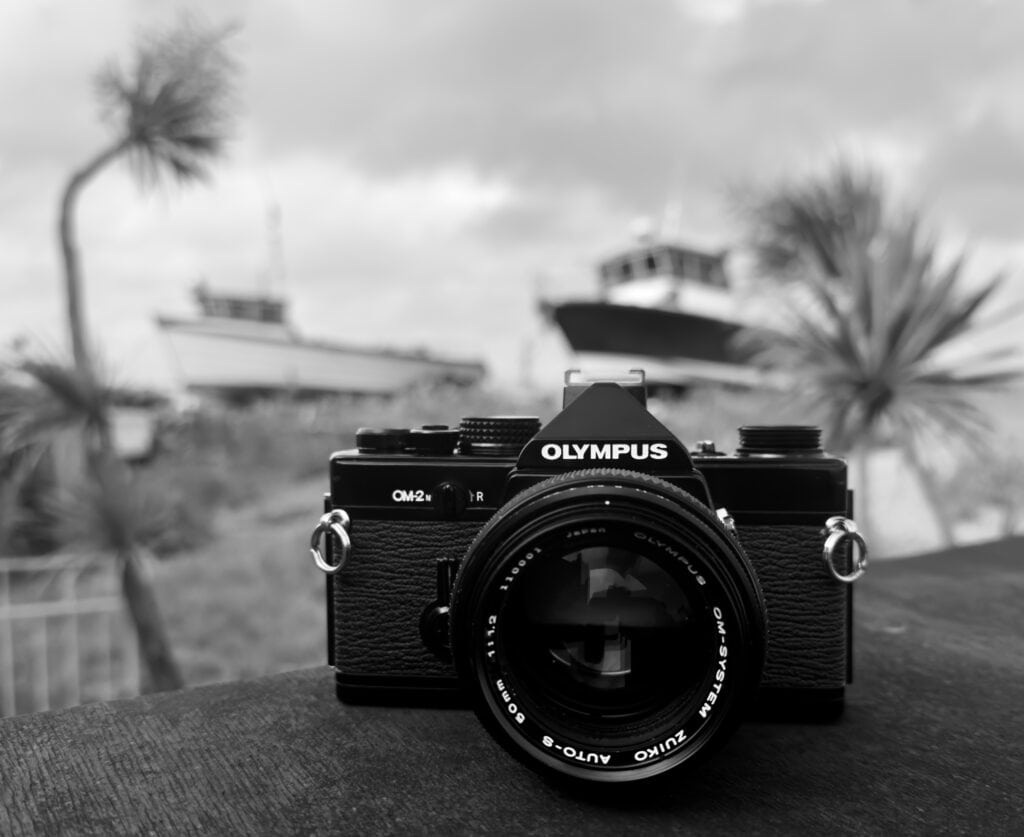
When I picked up an Olympus OM-1n SLR the first thing that struck me was how compact it was. Looking through the viewfinder it seemed to defy physics as it appeared to be bigger on the inside than the outside, due to the viewfinder’s massive size.
Fast forward to today and I own three Olympus OM bodies and an assortment of lenses. The cameras are the OM-1n, OM-2n and OM-2SP (Spot). As a confirmed Nikon SLR shooter it seemed an odd move to adopt another system. Fellow Nikon shooters certainly thought so…
But the OM-1 is just so compact – as are the lenses. It is also a remarkably good looking camera, the original compact SLR and a great film camera. This, and an attractive purchase price, was the justification for my OM-1n acquisition. An OM-2n, a camera responsible for a major milestone on how cameras measure light, beckoned a year later at a camera fair. The later, clever but slightly awkward OM-2SP appeared at the same event a year later and gives me most of the more sophisticated OM-4, which I do not own. This is the story of those three cameras, with a postscipt on the rest of the Olympus compact SLR series. There is a companion article on Zuiko lenses.
I love diminutive film cameras, especially when their lenses are equally compact. This, for me, is a large part of the appeal of Leica – and the leading reason for its genesis. But rangefinders are an entirely different breed to SLRs and by moving into Olympus I was duplicating what I already had in the Nikon system.
Yoshihisa Maitani and the Olympus Compact SLR
Olympus came late to the 35mm SLR. When the original OM-1 appeared in 1972, the established makers had been building reflex cameras for more than a decade, and Olympus was not seriously regarded as a contender among them. What it had instead was a chief designer, Yoshihisa Maitani, the man behind the half-frame Pen and later the pocketable, capless and caseless, XA.
Yoshihisa Maitani approached camera design from an unusual angle. Although trained as an automotive engineer and obsessed with photography from an early age, he was less interested in preserving established practice than in questioning it.
At Olympus he first made his name with the half-frame Pen, a camera conceived around the idea that high optical quality should not be reserved for expensive equipment. This he expressed as the lens is the soul of the camera.
Maitani was a visionary, but it took him a year to convince his superiors that a smaller SLR was a viable proposition, not least because it was technically challenging. In his own words:
However, every manufacturer had tried to develop smaller SLRs, and I was asking the production staff to do something that others had been unable to do. It was a challenge for the designers as well as for those in production. They wanted us to add 1 millimeter here and 3 millimeters there. There was a battery compartment in the bottom of the camera, and we wanted to insert packing to make it at least splash-proof, if not waterproof, but there was not enough space. When I yielded and gave them 1 millimeter, they immediately produced a design. They were so happy! People were competing for millimeters of space.
Maitani’s design brief was uncompromising: his insistance that the new camera had to be substantially smaller and lighter than contemporary rivals, was accompanied by an uncompromising view of its durability. He insisted on a shutter life of 100,000 cycles at a time when a tenth of that figure was acceptable.
The resulting OM-1 shows the leadership of a designer who viewed compactness as an engineering discipline rather than a styling exercise. Controls were repositioned to make better use of available space, unnecessary weight was stripped from components, and attention was paid to details often overlooked, such as mirror shock and operating noise. Naturally, as the soul of the camera, these ideas extended into the Zuiko lens range, which followed the same principle of reducing size without compromising performance. Maitani’s contribution was to demonstrate that careful engineering could achieve what many considered impossible.
Olympus claimed roughly a 35 per cent reduction in both volume and weight against the average SLR of the day, whilst still handling like a robust camera. The OM bodies were also notably quiet.
The Olympus OM-1n – The Compact Revolution

Development
The camera that started the compact SLR revolution was launched in 1972 as the M-1, in Maitani’s honour. Leica objected to the name, since its rangefinders had long carried the M designation, and Olympus renamed it the OM-1 in 1973. From there it evolved in stages: the OM-1MD of 1974 added a motor-drive coupling on the baseplate, enabling five frames per second; and the OM-1n of 1979 gathered a long list of refinements.
Operation
When anyone picks up an OM-1n the first thing that strikes them beyond its diminutive form is the size of the viewfinder. This, of course is what made the camera famous in the first place. Its 97% coverage was good, but not unique. It was the 0.92× magnification was extraordinary, and the real engineering achievement was combining both.
This is because they result from two competing design goals. Making the image appear large to the photographer (high magnification) and showing as much of the image as possible (high coverage) collide in camera design. Olympus quoted a 0.92× magnification with a 50mm lens and about 97 per cent coverage, and the view is something like 30 per cent larger than most SLRs of the period.
The second is the placement of the shutter-speed ring around the lens mount rather than on the top plate. It’s a logical design choice to put the aperture and shutter speed on concentric rings on the lens, though some photographers found the change irritating at the time.
Outstanding Manual Focus
One of the great strengths of the OM-1, and all the Olympus compact SLRs, is the ability to achieve crtical focus. Whilst the viewfinder image is unusually large and immersive, the standard Olympus focusing screens are equally important.

I have found the combination of a coarse microprism collar, a highly visible split-image rangefinder and a bright matte field provides exceptionally strong focus discrimination. Rather than just maximising brightness, Olympus prioritised the photographer’s ability to see the exact point of focus. As a result, many photographers find that OM SLRs exhibit a pronounced “focus snap”, with a very clear transition between in-focus and out-of-focus subjects. In short, the OM-1 and its successors are perhaps the easiest manual focus cameras to achieve good results with. I have tried many different focusing screens on Nikon SLRs, including the F3HP with a K screen, FM3a and FE2, and the Olympus still comes out slightly ahead.
Internals
Internally, the OM-1n is fully mechanical, with a cloth focal-plane shutter running from 1 second to 1/1000 plus B. The meter is full-aperture TTL using two CdS cells either side of the eyepiece, with a simple match-needle display, and it is the only thing on the camera that needs a battery. The mirror is an oversized, air-damped design, which is why these cameras are so quiet and low on vibration, and the OM-1n is the only OM body with a mirror lock-up. The interchangeable focusing screens drop in through the lens mount.
There is one drawback for modern owners: the OM-1 meter was designed around a 1.35V mercury cell that is now unavailable. The workarounds are a Wein zinc-air cell, an MR-9 voltage-reducing adapter, or by metering externally and accepting a small offset. I use the Weincell.
Reception and legacy
TThe OM-1 was immediately recognised as a breakthrough in industrial design. It didn’t add new features but it proved a professional SLR could be made small, quiet and beautifully integrated. Maitani and Olympus had created a masterpiece that changed the course of camera production in the 20th century. From then on, the race to build smaller, more-capable SLRs was on.
As a result, the compact bodies that followed from Pentax, Nikon and others all owe a debt to the OM-1. Today it is widely regarded as the defining OM camera and one of the great mechanical SLRs.
The Olympus OM-2n – Off the Film
Development
The OM-2 prototype appeared at the 1974 Photokina in Cologne, and it shipped in late 1975. From the outside it is similar to the OM-1: with same dimensions of 136 × 83 × 50mm, only slightly heavier at around 520g. The OM-2n of 1979, my version, refined the formula with improved TTL flash support for the new T-series flashes and longer automatic exposures.
Operation
The OM-2 added an electronic shutter and aperture-priority automatic exposure. Flicking the selector to manual invokes a match-needle scale.
The OM-2 was the first production camera with off-the-film (OTF) TTL direct metering. Before the exposure it reads light bouncing off a patterned first shutter curtain; during the exposure it reads light reflected from the film surface itself adjusting as it goes and without needing a memory circuit. That is why the camera can meter automatically out to around 60–120 seconds. Olympus marketed the system as TTL Direct, or Auto Dynamic Metering. However, unlike the OM-1, the OM-2 does not offer mirror lock-up.
I have had problems with my OM-2n, with two lots of films partially spoiled by incomplete shutter movement. The second repair sorted it, and it’s been reliable since.
Reception and legacy
The Olympus OM-2 was received very positively when it launched in late 1975, although the enthusiasm came more from photographers and the specialist press than from the wider consumer market. The trick the OM-2 had up its sleeve was that the same OTF principle that ran the ambient meter also controlled TTL flash. That neatly solved the fiddly business of flash exposure and virtually every other manufacturer adopted the idea. OTF ambient metering had fewer imitators, the Pentax LX of 1980 being the most notable, but TTL OTF flash became the industry standard for the rest of the film era.
The Olympus OM-2SP (Spot)
Development and naming
The OM-2SP is short for OM-2 Spot/Program. Confusingly, it is not a variant of the OM-2, but is based on the OM-4. It arrived in 1984, the year after the OM-4, despite the lower model number, and production ran to 1988.
Operation
The OM-2SP keeps the OTF aperture-priority and manual modes of the OM-2 and adds a programmed auto mode, where the camera chooses both aperture and shutter speed, and a spot meter which reads a small central patch from the focusing screen. This was a single spot meter, not the multi-spot system of the OM-4. The program mode was advanced for its day and worked with older lenses not built for shutter-priority automation.

The OM2-SP Meter
To engage spot metering on the OM-2SP the photographer turns the selector to Manual/Spot which changes where the reading comes from. In program and aperture-priority mode the camera reads off the patterned shutter curtain and the film surface, whereas in Manual/Spot it reads a small central patch from the focusing screen. This is not the exact centure, but the outer portion of the microprism.
The display is vertical strip down the left of the viewfinder, with a shutter speed scale marked alongside. In the automatic modes a bar rises to the speed the camera has chosen. Warnings use same strip. OVER blinks for overexposure, and in program mode it blinks to indicate that the lens must be stopped down. A plus and minus symbol at the foot of the display blinks whenever exposure compensation is engaged.
The camera warns audibly as well. An electronic beeper backs up the finder display, sounding for overexposure and underexposure.
Auto is extremely straightfoward to use, but I found Manual/Spot metering counterintuitive at first. The metering bar on the left is still used, but it changes to a null indicator. Here, the tip of the bar now shows how far the current settings sit from the metered value currently set, moving in third-stop steps against a fixed point marked between two small triangular indicators. The photographer turns the aperture ring, the shutter speed ring, or both, until the tip of the bar meets that fixed point. This is perfectly straightforward, but what confused me intitally was that the bar extends right to the bottom of the viewfinder, where if you have exposure compensation engaged, as I did, there is a flashing +- symbol.
Other OM-2SP Considerations
Where the OM-1 and OM-2 have a smooth wind and a quiet mirror, the OM-2SP uses a double mirror whose secondary mirror produces a slightly louder, less refined sound. It’s still a tough, dependable body, but not quite as refined as it’s predecessors. It also has a long-standing reputation for heavy battery drain. This is because their is no ‘off’ position, as such. The meter deactivates after a short period, but leaves the circuitry slightly active, which is a problem early OM-4 models also suffered from. There is a alleged fix of setting the camera to B (Bulb) or 60 (mechanical 1/60th sec), but that’s an internet myth – the 1/60th setting is a fail-safe, not a power control.
Speaking of which, whilst the OM-2 stops when the battery gives out, the Spot does offers that 1/60th of a second mechanical backup.
Reception and legacy
At launch, the OM-2SP’s biggest problem was timing. By 1984 program AE was already commonplace, and multi-segment evaluative metering, first seen on the Nikon FA of 1983, had made a single spot meter look dated. The camera had also arrived just as autofocus was beginning to reshape the market. Minolta’s Maxxum/7000 would appear in 1985 and rapidly change buyer expectations.
Olympus Camera Comparison
| OM-1n | OM-2n | OM-2SP | |
| Introduced | 1979 (OM-1 line from 1972) | 1979 (OM-2 line from 1975) | 1984 |
| Shutter | Mechanical, 1–1/1000 + B | Electronic, auto to ~120s; manual 1–1/1000 | Electronic to 1/1000; 1/60 + B mechanical |
| Exposure modes | Manual | Aperture-priority, Manual | Program, Aperture-priority, Manual |
| Metering | Centre-weighted TTL CdS meter | OTF centre-weighted (first OTF camera) | OTF + single spot |
| Mirror lock-up | Yes (OM only) | No | No |
| Works without battery | Yes (meter excepted) | No | Only 1/60 + B |
| Body weight (approx.) | ~500g | ~520g | ~540g |
Legacy
Between them these three Olympus compact SLRs carry a decent share of the OM system’s importance. The OM-1 set the stage for the compact SLR and proved a small camera could be extremely competant. The OM-2 gave the world OTF metering and TTL OTF flash, the single most widely copied idea to come out of the system and the basis of film-era flash automation.
The OM-2SP’s is a bit of an oddball, but it is undoubtedly a very good camera, giving you the best of the OM-4, Olympus’s peak professional OM body, in an easier to use package. It lacks the OM-4’s famous multi-spot metering system, which was one of the most advanced metering systems of any manual-focus SLR, but I would argue that features such the 8 spot readings stored in memory and averaging of multiple spot readings are infrequently used.
The OM-3, OM-4 and titanium variants, which I have not shot with, are covered in the postscript below the section on Zuiko lenses.wn 85mm, but it is one of the sharpest lenses in the OM range and its compact for its focal length.
Olympus Compact SLR Camera Specifications
Olympus OM-1n
- Type: mechanical 35mm SLR, cloth focal-plane shutter
- Shutter: 1–1/1000 sec + B
- Metering: full-aperture TTL, two CdS cells, match-needle
- Exposure: manual only
- Finder: fixed pentaprism, ~0.92× at infinity (50mm), ~97% coverage, interchangeable screens via mount; mirror lock-up
- Film speed: ASA 25–1600
- Power: one 1.35V mercury cell (meter only; now requires an adapter or zinc-air substitute)
- Dimensions / weight: 136 × 83 × 50mm; ~500g body (sources differ: 490–510g)
Olympus OM-2n
- Type: electronic 35mm SLR, electronic focal-plane shutter
- Shutter: auto to ~120s; manual 1–1/1000 + B
- Metering: OTF TTL direct (centre-weighted); SBC cells for live exposure, CdS for readout; first production OTF camera
- Exposure: aperture-priority auto and manual
- Flash: TTL OTF auto flash with T-series units
- Finder: fixed pentaprism, ~0.92× at infinity (50mm), ~97% coverage, interchangeable screens; no mirror lock-up
- Film speed: ASA 12–1600
- Power: two 1.5V silver-oxide cells (SR/S-76)
- Dimensions / weight: 136 × 83 × 50mm; ~520g body
Olympus OM-2SP (US: OM-2S / OM-2S Program)
- Type: electronic 35mm SLR; introduced 1984, produced to 1988
- Shutter: electronic to 1/1000; 1/60 and B mechanical
- Metering: OTF centre-weighted (program / aperture-priority) plus single spot (manual); light range approx. -5 to +18 EV
- Exposure: programmed auto, aperture-priority auto, manual
- Flash: TTL auto with T-series flash, 1/60 sync or slower; permanent hot shoe
- Finder: pentaprism, ~0.86× at infinity (50mm), ~97% coverage, interchangeable screens
- Film speed: ASA 12–3200
- Power: two SR44 silver-oxide or LR44 alkaline cells
- Dimensions / weight: 136 × 84 × 50mm; ~540g body
Postscript: The OM-3, OM-4, and the Titanium Variants
I have not shot with these cameras (yet), but am including a note on them for completeness. The OM-3 and OM-4 both arrived in 1983 and shared the same advance, a multi-spot meter that could take up to eight readings from around the frame and average them, with highlight and shadow buttons to place a tone deliberately. An LCD replaced the match needle, and top shutter speed rose to 1/2000. The difference between them is that OM-4 is electronic, whilst the OM-3 is fully mechanical.
The OM-3 did not sell well sold, as the cheaper OM-1n was still in production, and Olympus discontinued it in 1986, which is why the OM-3 is a more expensive body to buy today. Both were later reissued with titanium top and bottom plates. The OM-4Ti of 1986 cured the battery drain that had afflicted early OM-4 bodies and added Super FP synchronisation, giving flash out to 1/2000 with the F280 unit. The OM-3Ti followed about eight years later, in very small numbers, and it is the last true OM camera; it is also the most expensive of them all to buy today (£1,100-£3,000 as I write this in 2026). The OM-4Ti stayed in production until about 2002 and is far more affordable (£230-£1,500).
If I were to acquire another Olympus compact SLR it would probably be the OM-Ti, for its faster shutter and better battery life.
| OM-3 | OM-3Ti | OM-4 | OM-4Ti | |
|---|---|---|---|---|
| Introduced | 1983 | 1994 (sources differ: 1994–1995) | 1983 | 1986 |
| Shutter | Mechanical, 1–1/2000 + B | Mechanical, 1–1/2000 + B | Electronic to 1/2000; 1/60 + B mechanical | Electronic to 1/2000; 1/60 + B mechanical |
| Exposure modes | Manual | Manual | Aperture-priority, Manual | Aperture-priority, Manual |
| Metering | Centre-weighted + multi-spot (to 8 readings), highlight/shadow control | As OM-3, plus TTL flash and Super FP | OTF centre-weighted + multi-spot, highlight/shadow control | As OM-4, plus Super FP flash to 1/2000 |
| Mirror lock-up | No | No | No | No |
| Works without battery | Yes (meter excepted) | Yes (meter excepted) | Only 1/60 + B | Only 1/60 + B |
| Body weight (approx.) | ~540g | ~510g | ~540g | ~510g |
Selected Sources
- MIR’s classic-camera pages on the OM-1(n), OM-2(n) and OM-2SP
- Olympus global home page for their technology museum
- Camerawiki Olympus Zuiko Lenses
- The Olympus OM System Information File (OM-SIF), at olympus.dementix.org. This is a serious enthusiast technical reference but does not have HTTPs.
- Camera-wiki’s combined page on the Olympus OM-1/2/3/4
- Mike Eckman’s review of the OM-4
- The Olympus OM-2S Program instruction manual
