Development, launch, reception, adoption, production history and legacy
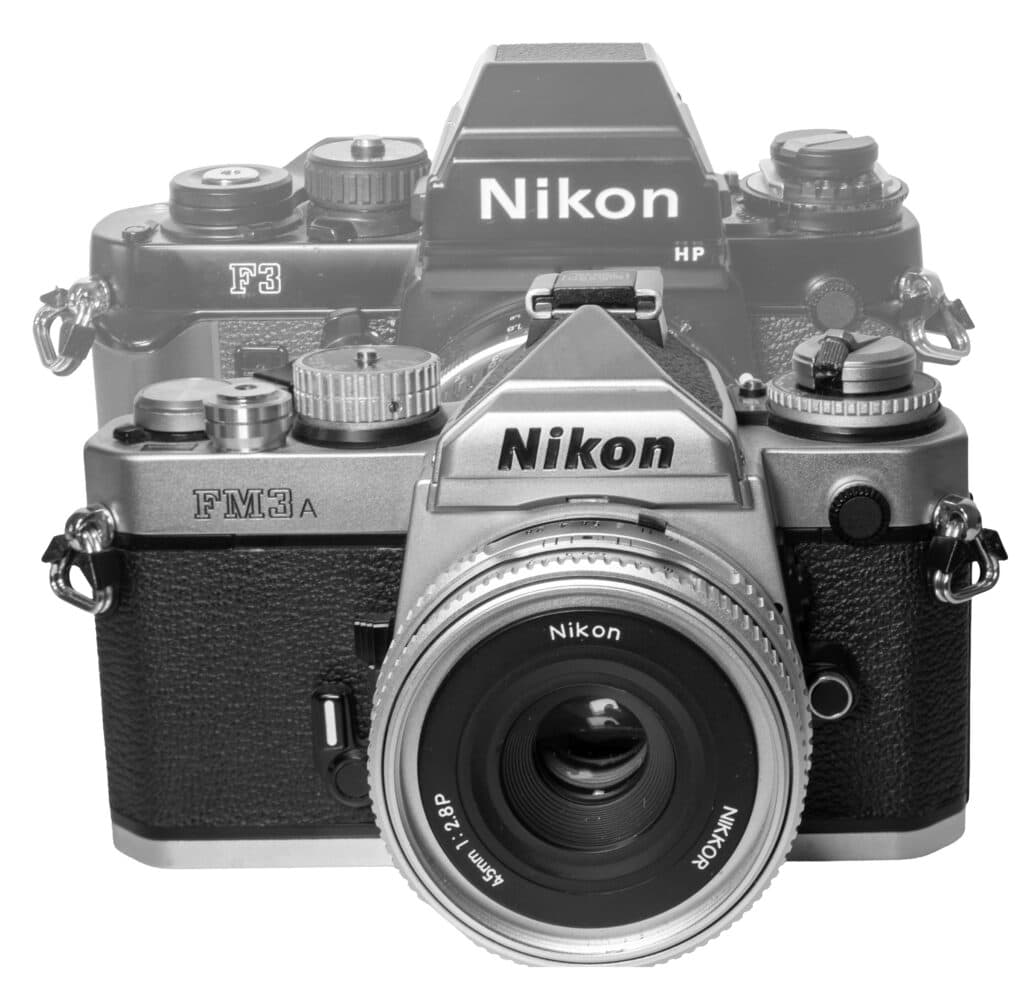
As much as I admire the Nikon FM3A, I shoot with the Nikon F3 much more frequently. I’ve had my hand on the FM3A, but changed my mind and taken the F3 more than once. I think this is due to three factors. The first is the most obvious; the FM3A is both more costly and less robust than the F3, so any knocks will hurt more. The second is that the F3’s shutter and wind-on mechanisms both feel more solid and satisfying to me, and the third is that the HP viewfinder is really convenient with glasses. As a result, the F3 has travelled abroad with me quite frequently whilst the FM3A has been restricted to the UK. Both cameras are premium, manual-focus, aperture-priority Nikon SLRs, which is why they invite comparison. Curiously, they are almost opposites in one respect – the F3 was Nikon’s step into an electronic future, while the FM3A was a retrospective on a manual film camera past. What follows is a detailed comparison of the two, interspersed with shots I’ve taken with each camera.
Summary Comparison Nikon F3 vs FM3A
The F3 was Nikon’s professional system flagship. It was designed as a modular replacement for the F2 that would persuade sceptical pro photographers to accept an electronic shutter and automatic exposure. The camera’s strengths are its robust build, 100% viewfinder coverage, interchangeable finders and screens, many accessories, compatibility with pre-AI lenses through stop-down metering, mirror lock-up and unusually smooth professional ergonomics. Its main compromises are dependence on batteries for all normally selected shutter speeds, a slow 1/80-second flash synchronisation speed, a proprietary flash-shoe arrangement and a small LCD display.
The FM3A was designed as a compact, premium manual-focus camera for experienced enthusiasts and traditionalists at the point when Nikon was moving to digital photography. Its design combines the FM2’s battery-independent mechanical operation with the FE2’s aperture-priority automation. The FM3A’s most notable achievement is its astonishing hybrid shutter: every manual speed from one second to 1/4000 second, plus Bulb, works mechanically without batteries, while aperture-priority mode provides stepless electronic timing from eight seconds to 1/4000 second. It is an engineering marvel.
Where taking a knock, finder coverage, interchangeable prisms (DE-3 high-eyepoint, DW-3 waist-level etc.) and mirror lock-up are needed the F3 has the edge. For compact travel photography the FM3A is more convenient – and better looking in my view. The FM3A also offers the faster shutter and flash synchronisation, a conventional hot shoe, DX coding and lower weight. Low weight is generally important to me, but when weight is at an absolute premium and I need to take a few lenses with me I will probably take the Olympus OM-1n, OM-2n or OM-2SP or the Leica M6 TTL.
As a purchase in 2026, the F3 is generally the better value as the FM3A commands a scarcity and last-of-the-line premium: FM3A asking prices I saw in the UK in August 2026 when I wrote this averaged about £739, compared with roughly £410 for the F3.
Development history and launch
Nikon F3: persuading professionals to accept electronics
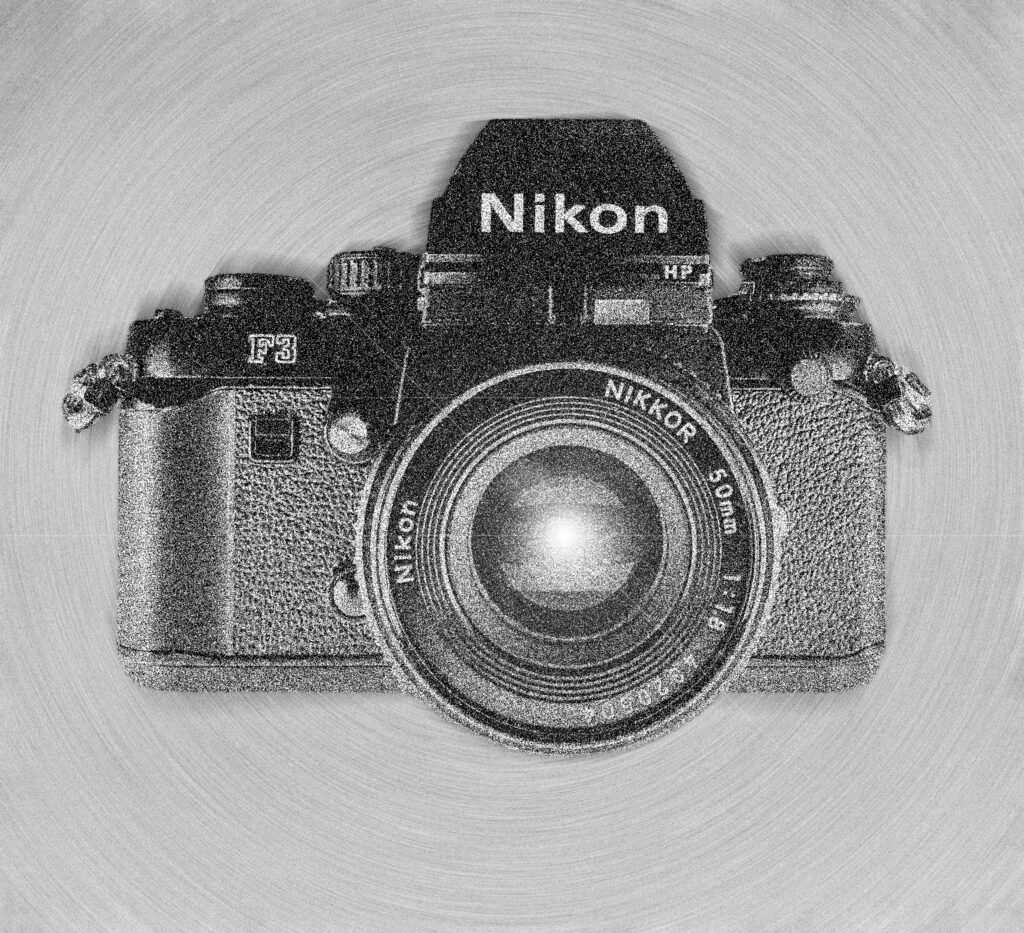
Planning for the F3 began soon after F2 production stabilised. Purely mechanical shutters had earned professional trust, but electronics offered greater exposure accuracy, more automation, energy-saving functions and the possibility of better reliability through fewer and more efficiently adjusted components. Nikon therefore chose not merely to add aperture-priority exposure to an F2, but to develop a new professional camera around an electronically controlled shutter.
The F3 development programme began in 1973. The early concept, sometimes described in Nikon’s history as an “F3 Photomic AE”, retained the F/F2 pattern of placing the TTL meter and exposure electronics in an interchangeable Photomic finder. It was close to production but was abandoned when Nikon’s Engineering and Development Group succeeded in developing in-body metering using a semi-transparent “pinhole” reflex mirror and secondary mirror. Moving the meter into the body meant that waist-level, action and high-magnification finders could all retain TTL metering without individual meter assemblies or recalibration. The plan was therefore renewed and development restarted in 1976. The world moved at entirely different pace back then.
Formal design began in March 1977. Nikon stated three inherited F2-level objectives: high quality and reliability; ease of operation and versatility; and automatic operation. Electronic control and low power consumption were additional requirements. A modular horizontal-travel titanium-foil shutter was subjected to extensive accuracy and durability analysis, while value-engineering methods were applied to reduce component count and weight. The prototype was completed in November 1978.
The project also changed direction as new technologies became feasible. Nikon replaced an the analogue display initially envisaged with digital circuitry and a low-consumption LCD, adopted quartz shutter timing and developed an electromagnetic release. The MD-4 motor drive was treated as an integral part of the system rather than a peripheral accessory; Nikon targeted six frames per second, compared with four frames per second for the F2 drive, using a coreless motor and a lower-friction gear train.

Legendary designer Giorgetto Giugiaro, of Volkswagen Golf, Lotus Esprit, and Maserati Ghibli fame, was brought in for the exterior design. His contribution included the camera and MD-4 as a unified form, the shallow integral handgrip and the vertical red accent. The design language he introduced remained influential on Nikon cameras for many years.
NASA came calling in autumn 1978, while the F3 prototype was being finalised, asking for cameras capable of automatic exposure and unusually large film loads. Nikon produced a 250-exposure “Big” camera and a 72-exposure “Small” camera and delivered them in May 1980. The smaller version flew aboard Columbia in April 1981 without a backup camera and completed its mission successfully; later shuttle F3 configurations were further modified for long eye relief and gloved operation and used specialist lubricants.
The production F3 was launched in March 1980.
Nikon FM3A: combining the FM2 and FE2 in the digital era
The FM3A programme began in December 1998. Unlike conventional Nikon projects, engineers from Mito Nikon joined the Ohi plant design group at the outset because the camera was expected to require extensive hand assembly, adjustment and production-line expertise. The team began with seven people and later expanded to twelve.
The product concept emerged around April 1999 after some months of discussion. Nikon’s starting point was the continuing popularity of the New FM2 among experienced amateurs, photography students and photographers who valued operation without batteries. Customers were nevertheless asking for the convenience of aperture-priority exposure and TTL automatic flash. The design goal was therefore not simply “a final mechanical Nikon”, but a camera that would preserve full mechanical shutter control while adding the FE’s automatic exposure functions.
That requirement produced the hybrid shutter. Nikon had to package both the FM2-style mechanical linkage and FE2-style electronic control into essentially the same body volume as the New FM2. The resulting mechanism was unusually difficult to manufacture. Nikon initially doubted that a mechanically governed 1/4000-second speed could be achieved within the size and precision constraints. The company also had to locate a supplier capable of producing the tiny high-precision analogue ammeter used by the match-needle display.

Line preparation, pilot fabrication/initial manufacturing activity began in 2000 and full series output in April 2001. The intended April 2001 release was delayed until July because orders exceeded the supply available from the rather labour-intensive line.
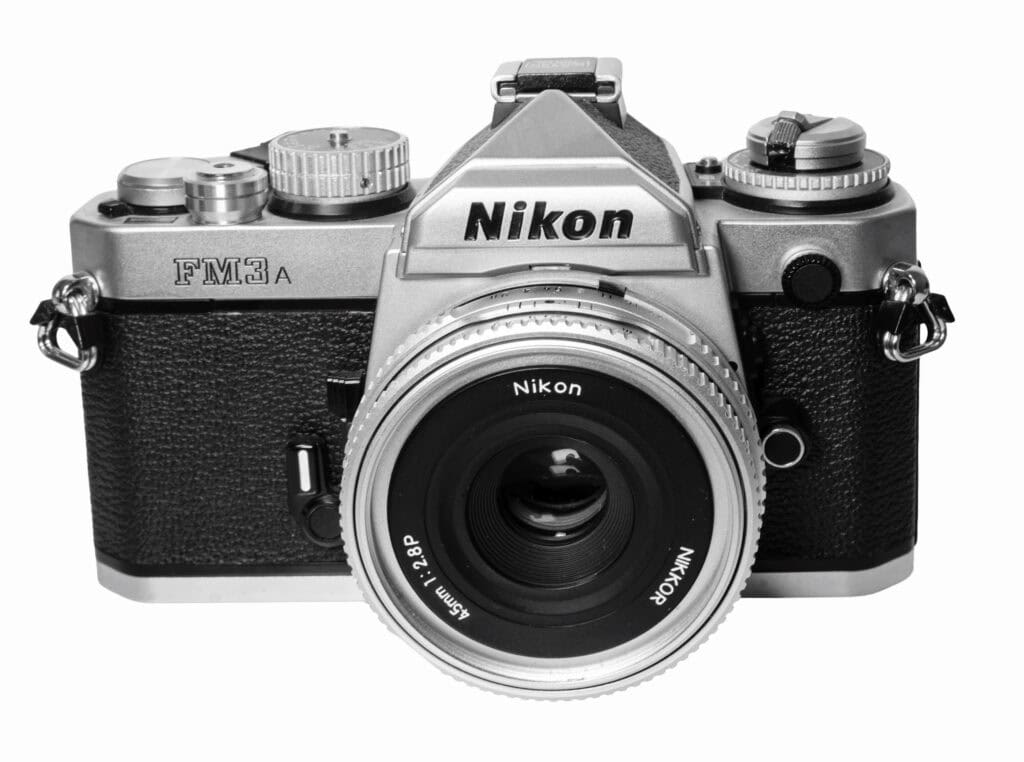
The matching silver AI Nikkor 45mm f/2.8P pancake lens launched with the camera in July 2001. It weighed about 120g and incorporated a CPU for communication with later Nikon bodies. A black-finish lens followed in November 2001 at ¥48,000 before tax. The lens is extremely compact, and sharp, but I use the 50mm f1.8 pancake much more frequently.
F3 and FM3A Milestones 1973-2006
1973 Initial F3 development begins; Early meter-in-finder “F3 Photomic AE” concept
1976 F3 programme restarted around body-integrated pinhole-mirror metering
1977 Formal F3 design begins; Quartz timing, LCD and Giugiaro design incorporated
1978 F3 prototype completed; NASA approaches Nikon
1980 Standard Nikon F3 launched; NASA cameras delivered
1981 Nikon F3 Small flies aboard Space Shuttle Columbia
1982 F3HP and F3/T introduced
1983 F3AF and F3P introduced
1988 Nikon F4 succeeds F3 as current flagship, F3 remains in production
1993 F3 Limited introduced
1996 F3 High Speed appears
1998 FM3A development begins
1999 FM3A product concept fixed
2000 F3 discontinuation announced
2001 FM3A full production and launch in July
2002 FM3A receives Camera Grand Prix Special Prize
2006 FM3A production and final shipments end
Reception and adoption
Reception of the F3
The F3’s reception was divided – much as Nikon had anticipated. Supporters welcomed a robust, ergonomic, aperture-priority professional Nikon that retained lens compatibility. Others objected to an electronic shutter in a professional F-series body.
Nikon won the more conservative professionals over and total sales exceeded 751,000 by September 1992. The F3’s handling was particularly favoured. The Giugiaro grip and rounded body were considered more comfortable than the squarer F and F2, while the ball-bearing-supported film transport made the manual advance exceptionally smooth.
Critics, however, focused on the relatively small LCD display, the proprietary flash shoe and the marmite-like divisiveness of the red stripe. Its 1/80-second X-sync also became somewhat restrictive for daylight fill flash as 1/200- and 1/250-second shutters became common.
Reception of the FM3A

The FM3A received unusually enthusiastic attention for a manual-focus film camera launched beside Nikon’s D1X and D1H digital professional bodies. Advance orders exceeded production capacity and specialist magazines published extensive features.
Popular Photography considered battery-free operation one of the camera’s principal attractions and described the FM3A as one of the best manual-focus SLRs then in production. Camera Arts praised its straightforward controls, versatile flash functions and mechanical fallback, while Shutterbug highlighted intuitive control placement, metal construction and smooth operation.
The camera received at least three formal honours: the 2001 Good Design Award, selection as a 2001 Japanese Historical Camera, and the Camera Grand Prix 2002 Special Prize. The Camera Grand Prix award praised its popularity, topical significance and advanced engineering, particularly the survival of a genuine manual-focus SLR in an autofocus and digital market.
The FM3A sacrificed autofocus, matrix or spot metering, automatic film transport, interchangeable finders and mirror lock-up. Spot metering did actually reach prototype stage, but Nikon abandoned it because the design could not be mass-produced with adequate consistency. Mirror lock-up was omitted because engineering resources and packaging space were focused on the complex hybrid shutter.
Adoption
The F3 was designed for press, commercial, scientific and institutional use and was part of a broad professional system. The standard body and F3HP were used by professionals and serious amateurs, while the F3P, F3 Limited and F3H addressed press or specialist high-speed requirements.
NASA is the most famous and influential institutional adoption. The 72 and 250-exposure F3 derivatives were followed by versions adapted for shuttle cabin use. NASA features included larger controls for gloves, extended eye relief, modified lubrication, thermal protection and high-capacity film backs. NASA selection has done wonders for many products (think Omega Speedmaster, for example) and the F3’s adoption was both a technical validation and an important part of the F3’s professional reputation.
The F3 also played a role in early digital professional photography, as Eastman Kodak chose the F3/F3HP architecture as the camera basis for the Kodak DCS 100 system introduced in 1991.
Nikon aimed the FM3A at experienced amateurs. It was not aimed at professionals, as it arrived after Nikon’s D1 and at the same time as the D1X and D1H, when professionals were moving to autofocus digital cameras.
Technical and usage comparison
Core specifications
| Characteristic | Nikon F3 | Nikon FM3A |
| Market position | Professional modular flagship | Premium compact manual-focus enthusiast/semi-professional body |
| Launch | March 1980 | July 2001 |
| Exposure modes | Aperture-priority AE and manual | Aperture-priority AE and manual |
| Shutter architecture | Horizontally travelling titanium-foil focal-plane shutter; electronically quartz timed at normal speeds | Vertically travelling aluminium-alloy metal focal-plane shutter; dual electronic and mechanical control |
| Automatic range | Stepless 8 seconds to 1/2000 second | Stepless 8 seconds to 1/4000 second |
| Manual range | 8 seconds to 1/2000 second, plus B, T and X; selected normal speeds require power | One second to 1/4000 second plus B, all mechanically timed |
| Battery-free operation | Separate mechanical release at about 1/60 second; T mechanically available | Every marked manual speed and B |
| Meter | TTL, approximately 80/20 centre-weighted | TTL, approximately 60/40 centre-weighted |
| Metering range | EV 1–18 at ISO 100 with 50mm f/1.4 | EV 1–20 at ISO 100 with 50mm f/1.4 |
| Film speed | ISO 12–6400, manual | ISO 25–5000 by DX; ISO 12–6400 manually |
| Exposure compensation | ±2 EV | ±2 EV |
| AE lock | Yes | Yes |
| Viewfinder coverage | Approximately 100% | Approximately 93% |
| Magnification | About 0.8× with DE-2; about 0.75× with DE-3 HP | 0.80× / 0.83× – sources vary* |
| Finder system | Interchangeable: standard eye-level, high-eyepoint, action, high-magnification and waist-level options | Fixed pentaprism |
| Screens | Twenty officially listed in Nikon’s launch-era account, including standard K | K3 standard; B3 and E3 optional |
| Flash | TTL off-the-film; proprietary F3 shoe system; PC connection; 1/80-second X-sync | TTL off-the-film; standard ISO hot shoe and PC connection; 1/250-second X-sync; −1 EV flash-compensation button |
| Mirror lock-up | Yes | No |
| Depth-of-field preview | Yes | Yes |
| Motor drive | MD-4, up to six frames per second; powered rewind | MD-12, approximately 3.2 frames per second; manual rewind |
| Dimensions | Approximately 148.5 × 96.5 × 65.5mm | Approximately 142.5 × 90 × 58mm |
| Weight | Approximately 715g body with DE-2 | Approximately 570g excluding batteries |
| Finish | Black standard; titanium and specialist variants | Silver/chrome or black |
| Primary evidence | Nikon F3 history and manual-derived specifications. | Nikon FM3A history and US specification sheet. |
*Nikon corporate history states 0.83×, while the Nikon USA specification sheet gives 0.80×.
Shutter and battery dependence
The F3’s shutter provided quartz-controlled electronic timing, which improves consistency, and aperture-priority mode, which can select intermediate values steplessly. As the shutter speeds are electronic, an exhausted battery limits the camera to a separate mechanical release of 1/60 second or mechanical T operation. Given how small, inexpensive and easily available the F3’s batteries are I have never seen this as a limitation, but it troubled many photographers in its heyday, and is still the subject of debate in forums today.
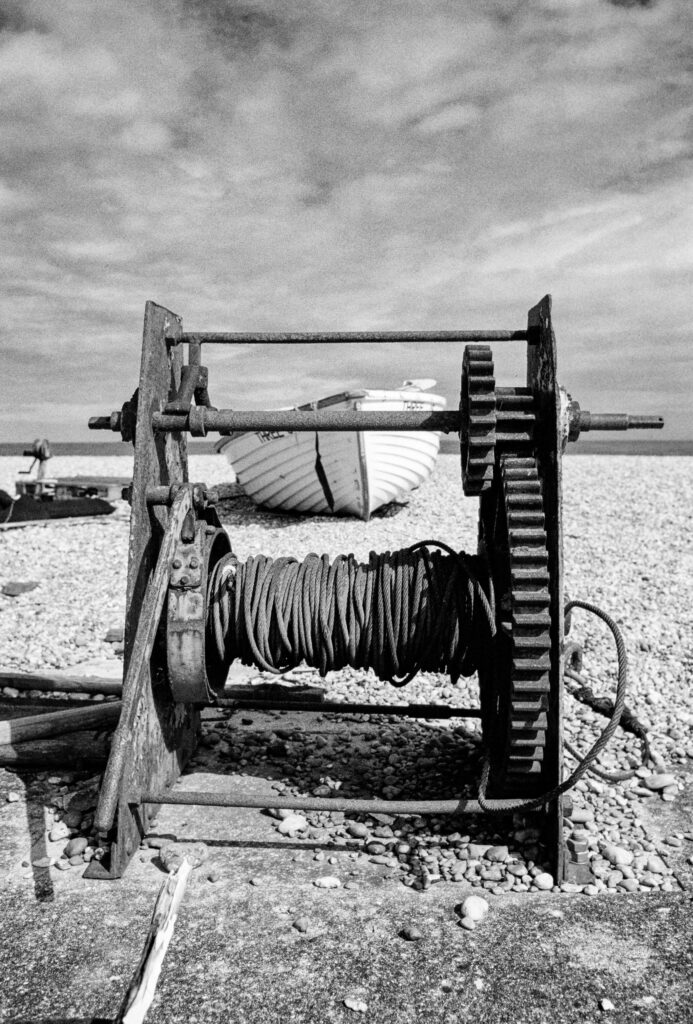
The FM3A’s shutter is mechanically far more ambitious. Selecting a manual speed engages the mechanical governor and linkage, while selecting ‘A’ activates the electronic timing mechanism. It replaces a single emergency mechanical speed with a full manual sequence from one second to 1/4000 second. The batteries are still required for the meter, aperture-priority automation, AE lock etc.
Metering and exposure control
The F3 concentrates approximately 80% of meter sensitivity in the central 12mm circle and spreads the remaining 20% across the rest of the frame. Light passes through tens of thousands of microscopic non-reflective areas in the main mirror, is redirected by a secondary mirror and reaches a silicon photodiode (SPD) in the bottom of the mirror box.
The FM3A employs a less strongly weighted 60/40 centre-weighted pattern, using paired SPDs located behind the pentaprism. Its rather lovely analogue match-needle display shows the meter’s recommended shutter speed and a separate indication of the selected speed. In aperture-priority mode, the needle shows the stepless speed the camera intends to use.
Neither camera provides matrix metering or a built-in spot meter. The F3’s stronger centre weighting reflected its pro design; Nikon’s brief was to replace the F2 for photographers who had spent years using handheld light meters and this pattern let a photojournalist meter selectively through the lens quickly and easily. The FM3A employed the same, more forgiving, weighting the FM2 and FE2 used, so those photographers trading up or adding a body found the meter behaved as they expected.
Viewfinder system
The F3’s DE-2 standard finder gives approximately 100% coverage and relatively high magnification. The DE-3 High-Eyepoint finder, introduced as standard on the F3HP in March 1982, provides excellent eye relief for glasses wearers at the expense of some magnification. Action, waist-level and high-magnification finders are all available. Because the meter is in the body, exchanging finders or screens does not require a different metering prism.

The FM3A’s fixed finder is smaller in system scope but exceptionally good for a compact SLR. Nikon redesigned the K3 screen to improve brightness and reduce split-prism blackout with slower lenses. The B3 plain matte screen was designed for macro and long lenses, and the E3 grid for architectural and landscape alignment. Its 93% coverage means more appears on film than is shown in the finder, which is convenient for uncritical consumer processing but less exact for slide, copy or tightly framed professional work.
Replacing the ‘Finder’
The term ‘finder’ can cause confusion when applied to the F3 and FM3A. This is because the term is used to refer both to replacing a focusing screen (FM3A and F3) and replacing a prism/finder screen assembly (F3 only).
The focusing screen sits on a shelf above the mirror, directly beneath the prism. It is a piece of ground glass, and it is where the image from the lens actually lands. Everything you see when you raise the camera to your eye is a projection onto that surface. The screen determines what focusing aid you get, such as a split-image wedge, a microprism collar, a plain matte field, or a grid. It also determines how bright the view is, and how the out-of-focus areas render.
The prism is the block of glass sitting on top of the screen. The image on the screen arrives laterally reversed and upside down, and the prism puts that right before it reaches your eye. On the F3 you can remove it and fit a waist-level hood in its place, and there is no prism in the light path at all; you look straight down onto the screen through a magnifier, with the image reversed left to right, just like you would with a Rolleiflex.
The finder, according to Nikon, means the whole viewing assembly of prism and eyepiece together, as a unit. This is why Nikon’s part numbers for the F3 carry finder designations rather than prism ones.
On the F3 both prism and screen come off. Nikon offered more than twenty screens for the camera and five finders or viewing heads. I’ll call them heads to avoid potential confusion. These were the standard DE-2, the high-eyepoint DE-3, the DW-3 waist-level, the DA-2 action finder, and the DW-4 magnifying finder. Lift the head off, and you are looking at the bare screen.
On the FM3A the prism is fixed and bonded to the top plate. The screens, however, come out through the lens throat. Nikon supplied three, being the K3 with split-image and microprism, the B3 plain matte, and the E3 with grid lines. Anyone who has fitted the grid screen for architectural work has, in a perfectly reasonable sense, changed the finder, as they have changed what they see. They just have not changed the thing that Nikon calls the finder.
The FM3A also accepts eyepiece accessories that thread onto the fixed prism, including dioptre correction lenses, the DG-2 magnifier, and the DR-3 right-angle attachment.
Finder Design Decisions
The F3 meters from a silicon photodiode in the base of the body, reading light passed down through the semi-silvered main mirror. The metering system therefore sits below the screen. Whatever head you fit, the meter reads identically.
The FM3A puts its metering cells in the prism, alongside the needle display. That is a cheaper and simpler arrangement, but it also makes an interchangeable prism close to unworkable, because every alternative head would need its own cells and display.
Lens compatibility
Both bodies use Nikon’s F mount, and for almost every lens Nikon has made since 1977, the two cameras behave identically. AI and AI-S Nikkors, the Series E lenses, the AI-P range with its CPU contacts, and the autofocus lenses of the AF and AF-D generations all mount and work fully on both bodies, with full-aperture metering and manual focusing. AF-S lenses are the same, offering manual focus provided the particular lens carries an aperture ring.
The F3 has a hinged meter-coupling lever that folds up out of the way, which allows unmodified pre-AI lenses to be mounted and metered stopped down, subject to checking the clearance on each individual lens. The FM3A has no equivalent release. Its coupling lever is fixed, and a pre-AI lens will foul it. The F3 will also accept fisheye lenses that require mirror lock-up.
Build, ergonomics and handling
Both cameras use rigid metal-based structures rather than moulded shells. Nikon’s FM3A has a copper-silumin aluminium-alloy chassis and metal outer body. The F3 likewise uses a strong die-cast alloy chassis and professional metal construction, but its modular finder, larger body and accessory couplings make it heavier.
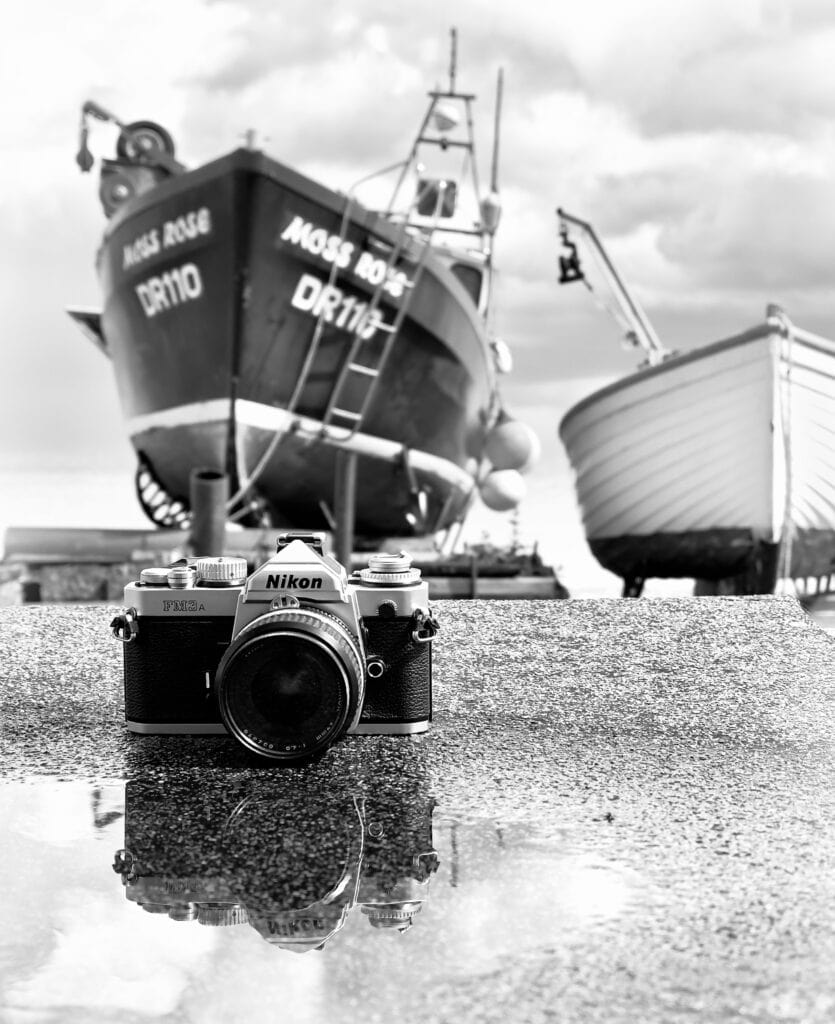
The F3 is exceptionally smooth to handle, with the film advance being particularly noticeable. It is slightly let down by the proprietary flash location and the small, not terribly bright LCD – though the latter has proved far more durable than Nikon advised users in the manual. The guidance given there was that although the camera used the highest quality LCD available, it would lose contrast and become hard to read after six or seven years, at which point they should take it to a dealer or Nikon service centre for replacement. Nikon was guessing at LCD longevity, of course, and happily my 1980 F3 and 1982 F3HP LCDs are both still working fine.
The FM3A has FM/FE type ergonomics: prominent shutter and film-speed dials, a conventional hot shoe, compact dimensions and a direct match-needle display. It is lighter and perhaps slightly less conspicuous.
Flash and motorisation
For flash, the FM3A offers 1/250-second synchronisation and its ISO-standard hot shoe accepts ordinary flashes while retaining Nikon TTL contacts. The −1 EV TTL-flash compensation button provides a quick fill-flash reduction.
Flash users might find the F3’s 1/80-second sync somewhat limiting. Dedicated TTL flash units use the contacts around the F3’s odd rewind-side accessory fitting, and hot-shoe flashes require an adapter or cable. On the plus side, the F3 offers a plethora of cords, high-capacity backs, finders, data equipment and motor-drive accessories. I have no experience of any of these.
The MD-4 transforms the F3 into a fast press or sports camera, advancing at up to 5.5 frames per second, or six with the mirror locked up, and rewinding a thirty-six exposure roll in a rapid four and a half seconds. It will also power the camera body should the F3’s own batteries run out. The unit weighs about 490 grams before the eight AA batteries, taking the full load to something like 1.7 kilograms with a standard lens.
The FM3A’s MD-12 is a little lighter at about 410 grams, and it manages 3.2 frames per second, but doesn’t provide a powered rewind. Instead, you use a slider that engages the camera’s film release so you can hand rewind.
Mirror Lock-up
For tripod, macro and long-lens work, the F3 also has mirror lock-up, which the FM3A lacks.
The F3 has a dedicated control. You just push in the depth-of-field preview button and rotate it, and the mirror rises and stays up until you release it. With the mirror up, the F3 cannot meter as its photodiode reads light passed down through the mirror, so raising the mirror cuts the light path to the meter entirely. The camera doesn’t actually tell you this because the LCD carries on displaying a shutter speed, but that speed is wrong. The right sequence is to meter first, hold the reading or transfer it to manual, and then lock the mirror.
Some fisheye lenses require mirror lock-up before they will mount on the F3 because they intrude far enough back into the mirror box that they would strike the mirror. With those fitted you compose through an accessory finder, because there is nothing to see through the camera.
The FM3A lacks this mirror lock-up, but has a decent workaround as its self-timer raises and locks the mirror at the start of its run, so the mirror is up and settled before the shutter opens.
Reliability and serviceability
The F3’s NASA qualification, more than 751,000 sales by 1992 and a production life extending to the year 2000 provide decent evidence of durability.
Age is not kind to anything much, but it is somewhat more spiteful to electronics than mechanical components. The F3’s LCD, electromagnetic release, metering electronics and dedicated flash contacts will eventually deteriorate and fail when it participates in the electronics apocalypse. The mechanical 1/60-second fallback is an emergency measure, but it isn’t much use in that final, terminal case. That sounds really quite morbid, but so far, so good, and I have an F, F2, FM and FM3A to fall back on.
The FM3A does not rely on a battery for shutter operation, but its hybrid assembly is far from mechanically simple. According to Nikon, its marvellous hybrid capability relies on a high part count, dual stop-shoe system, complicated gear routing, tight backlash control and individual hand adjustment. On the plus side, the FM3A repair documentation states that its basic construction follows the FM2 and FE2 and directs technicians to their manuals, tools and procedures where applicable, which might help somewhat with mechanical servicing. A bit.
Nikon F3 vs FM3A – which camera is best suited for what task?
| Requirement | More suitable | Reason |
| Press, sport or action with motor drive | F3 | MD-4 at up to six frames per second, powered rewind, professional controls and extensive accessories |
| Use with glasses (spectacles) | F3HP | High-eyepoint DE-3 finder |
| Exact slide, copy or architectural framing | F3 | Approximately 100% viewfinder coverage; interchangeable grid and specialist screens |
| Low-angle, waist-level or action-finder work | F3 | Interchangeable finder system |
| Pre-AI Nikkor collection | F3 | Folding meter-coupling lever and stop-down metering |
| Daylight fill flash | FM3A | 1/250-second sync and standard ISO hot shoe |
| Prolonged remote or cold-weather work (neutral with a supply of spare batteries!) | FM3A | Full manual shutter-speed range without batteries |
| Travel and street photography | FM3A | Smaller, lighter, unobtrusive body |
| Film camera learning | FM3A | Match-needle manual exposure is intuitive – I love it |
| Heavy lenses and prolonged professional handling | F3 or F3HP | Slightly better grip, larger body and modular finder options |
The question of which camera is ‘best’ depends on what the use case is. The above is my take on that and opinions will no doubt differ. Clearly, either body can produce identical image quality when fitted with the same lens, film and accurately controlled exposure.
Production, variants and serial numbers
F3 production history
Nikon announced the F3’s discontinuation in 2000. Nikon’s official figure of units shipped is 751,000 units by September 1992. A specialist serial database maintained by Nico van Dijk records F3 serial numbers beginning around 120xxxx in March 1980 and reaching 200xxxx by June 2000, with 201xxxx associated with parts.
F3 variants
| Version | Introduced (approx.) | Distinctions |
| F3 | March 1980 | Standard body with DE-2 finder; black finish |
| F3HP | March 1982 | Standard body supplied with DE-3 High-Eyepoint finder |
| F3/T champagne | December 1982 | Titanium external covers; champagne finish |
| F3/T black | September 1984 | Titanium external covers in black |
| F3AF | April 1983 | DX-1 autofocus finder; dedicated AF-Nikkor 80mm f/2.8 and 200mm f/3.5 IF-ED |
| F3P | April 1983 | Press-oriented sealed and reinforced controls, DE-5 finder with conventional shoe, specialist back and control changes |
| F3 Limited | October 1993 | Japanese-market collector version closely based on F3P; “Limited” marking |
| F3H / F3 High Speed | 1996 | Fixed semi-transparent mirror and high-speed motor configuration for very rapid sequences |
| NASA “Big” and “Small” | Delivered May 1980; subsequent mission variants | 250- or 72-exposure capacity, modified controls, optics, lubrication and thermal arrangements |
Nikon FM3A production history
The FM3A was commercially available from July 2001 until production and final shipment ended in January 2006. Nikon says its early production could not satisfy demand, but digital camera adoption shortened its life to four and a half years of sales. Building a manual film camera at that point, with that amazing hybrid shutter does Nikon a lot of credit, in my estimation.
Nikon did not publish a production total or an official serial number allocation for the FM3A. User and collector sites list serial numbers from approximately 200000 or 200001 into the 310xxx–312xxx region, which gives a 112,000-number span, though this is not proof that 112,000 cameras were manufactured.
The two versions of the FM3A were silver/chrome and black.
| FM3A production form | Introduction | Notes |
| Silver/chrome body | July 2001 | ¥96,000 before tax in Japan; product number 1666 in Nikon USA literature |
| Black body | July 2001 | ¥99,000 before tax in Japan; product number 1667 |
| Silver 45mm f/2.8P pairing | July 2001 | Matching pancake lens introduced simultaneously |
| Black 45mm f/2.8P | November 2001 | Black-finish lens added at ¥48,000 before tax |
Legacy
The F3’s legacy

The F3 established electronic shutter control and aperture-priority automation as acceptable in Nikon’s top professional line. The controversy over batteries was overtaken by the practical advantages of accurate timing and by the camera’s reliability in extended professional service. Nikon’s following flagship, the F4, expanded the formula with autofocus, more advanced metering, higher shutter speeds and integrated motorisation, but retained compatibility with a remarkably broad range of older F-mount lenses.
Its body-integrated metering was particularly influential. By moving the sensor out of the finder, Nikon preserved the interchangeable-viewfinder concept without sacrificing TTL measurement.
The F3AF was an important transitional product. It was Nikon’s first autofocus SLR system and demonstrated that focus detection could be integrated into a professional F-series platform.
The Kodak DCS 100 connection gives the F3 an additional legacy in that it participated in the transition that eventually displaced cameras such as the FM3A.
The FM3A’s legacy
The FM3A was the culmination of two existing Nikon product lines, fusing the mechanical FM/FM2 design with that of the electronically timed FE/FE2.
The FM3A demonstrated that a full-speed mechanical shutter and stepless electronic aperture-priority system could coexist, but it also marked the point at which such labour-intensive manufacturing was no longer feasible. Nikon’s history stresses that several subcontractor craftspeople and specialist engineers were approaching retirement and that the camera depended on local Mito-area expertise inherited from the FM2 and F3.
Buying: F3 vs FM3A
As I write this in 2026, the F3 is still an affordable film camera, though titanium bodies, clean F3P or Limited versions command higher prices.
The FM3A is consistently more expensive, with black bodies and complete 45mm f/2.8P sets being the most costly. I bought my silver/chrome FM3A from Greys of Westminster in about 2018 for a price I can’t recall, but I know it made me wince a little. Silver bodies with ordinary wear are the least costly but cost more than FM2, FE2 or standard F3 bodies.
Aesthetics
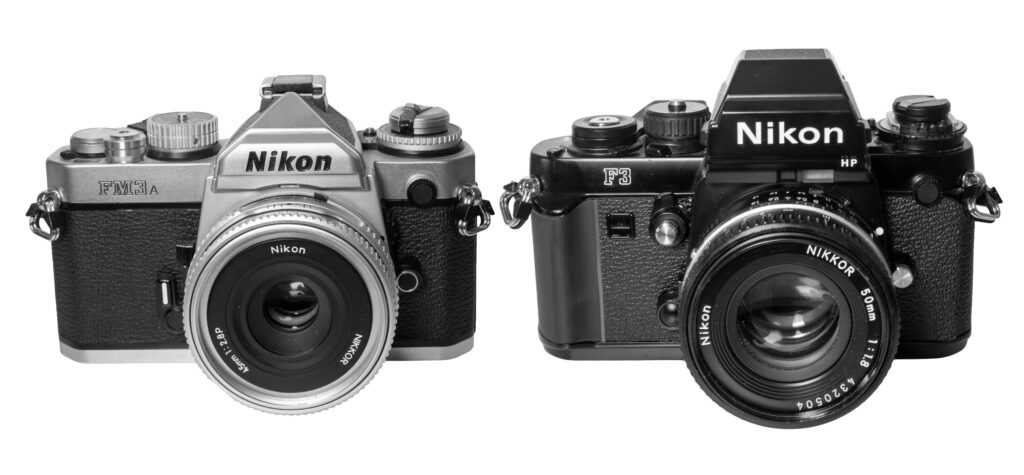
When I put the F3 and FM3A next to each other the F3 looks large and somewhat ungainly in comparison to the diminutive FM3A, which, like the FM2 (and the original F) are great looking film cameras. The F3’s square head, in particular, looks unlovely in comparison. In my view, it is still far better looking than Nikon’s autofocus models, however. As much as I love using the F6, it is not a thing of beauty. This kind of contrast must have been very apparent at the launch of the FM3A when it sat next to Nikon’s first digital models.
However, once I pick up either camera and use the controls, the feeling is reversed. The F3 feels just right, while the FM3A feels fine.
Nikon F3 vs FM3A Conclusion
These are both wonderful cameras.
The F3 led Nikon’s professional line from the mechanical F2 into a quartz timed, electronic future. NASA adoption and use as the basis for Kodak’s DCS 100 cement its importance in the timeline of photography. For the photographer it is practical, exceptionally hard wearing and feels great to operate.
The FM3A was Nikon’s last hurrah for the manual film camera, and offers a great deal of useful functionality in a very attractive package. Its 1/4000-second top speed, hybrid shutter, 1/250-second sync, conventional hot shoe, DX coding, bright match-needle finder and 570g body are a tough act to beat. The fact that it tends to spend more time on the shelf than in my bag is really down to the fact that the F3 feels so solid to pick up and operate, and I know it will take the inevitable knocks so much better.
Sources and Further Reading
Nikon
- Nikon — Debut of the Nikon F3
- Nikon — The Story of the Nikon F3
- Nikon — Nikon FM3A: Camera Chronicle
- Nikon — Imaging Products: historical camera archive
- Nikon — NIKKOR lens compatibility and product information
Manuals and museums
- Butkus Camera Manual Library — Nikon camera manuals
- George Eastman Museum — Technology Collection
- NASA History — Space Shuttle programme resources
- Smithsonian National Air and Space Museum — Collections
- Kodak — Company and imaging history
Reviews
- Amateur Photographer — Celebrating 40 years of the Nikon F3
- Amateur Photographer — Nikon FM3A review at 20
- ePHOTOzine — Camera reviews and archive
- Camera Grand Prix — Award archive
- Good Design Award — Award archive
Wikis and serial-numbers
- Nikon F3 serial-number database – Nico van Dijk
- CollectiBlend — Nikon F3 price guide
- CollectiBlend — Nikon FM3A price guide
- Camera-wiki — Nikon F3
- Camera-wiki — Nikon FM3A
Articles on this Site
- The Nikon F – Nikon’s first SLR
- The Nikon F6 – Nikon’s last film camera
- The Nikon F3 – Back to film
- The Nikon FE
- The Nikon FE2
- From Chemistry to Computation (History of Photography)
- Cameras Year by Year (20th Century Camera timeline)
