The children of Charles Owen Newrick (1855-1911) and Mary May Hiles (1855-1935)
Introduction
Growing up, I knew the Newrick family leaned towards the scientific and mathematical. My mother, Yvonne Patricia Newrick (1941-2024), was proficient at maths and enjoyed it. My Uncle and Grandfather, both named George, were engineers by trade.
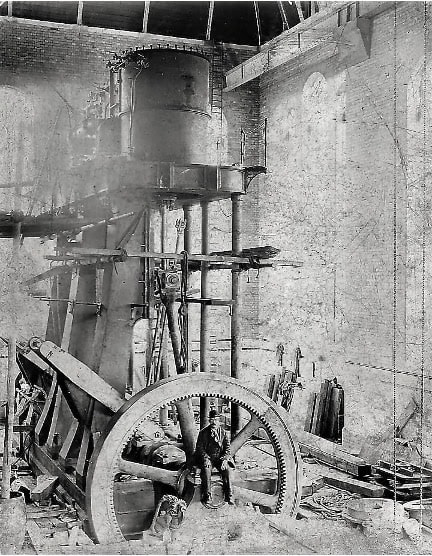
As I learned more about the family history, I found this pattern repeated. Many Newrick men were engineers. Several Newrick women also married into the profession, marrying engine fitters, toolmakers, turners and machinists.
As I went deeper into the records, a particular engineering specialisation emerged; the world of ordnance and artillery. Charles Owen’s cousins, Frank and Oscar Brown, sons of his aunt Elizabeth Newrick, both rose to the rank of Chief Inspector of Ordnance Machinery in the Army Ordnance Department, Oscar holding the DSO. George, Charles Owen’s own son, was awarded the MBE for his engineering work, initially at Woolwich and later at the Royal Ordnance Factory at Blackburn. In turn, his son, my Grandfather, also worked at the Woolwich Arsenal.
Another recurring theme in the Newricks also emerged: life at sea. The Newrick line had produced seafarers before Charles Owen’s children were born, and the Merchant and Royal Navies would figure heavily in the life of this branch of the family.
The intersection of engineering and the sea was marine and maritime engineering, encompassing work in the engine room, at sea, and in constructing the huge engines that powered ships crossing the oceans.
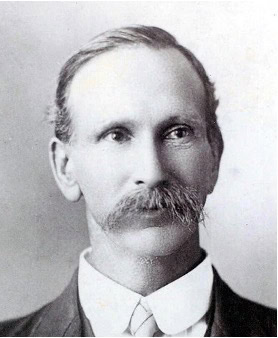
The pull of the sea ran through the wider family too. Of my 3rd great-grandfather James’ children (by his two wives), five emigrated in the decades around the turn of the century.
His son James (1861-1945), settled in Queensland and married there around 1901. Four others, Elizabeth, Mary Jane, William, and Ada, made for British Columbia, three of them ending within a few miles of one another on Vancouver Island, at Wellington, Comox, and Nanaimo. That cluster on the island, with its coal mines and harbour traffic. Charles Owen, by contrast, went south to Woolwich.
From Sunderland to Plumstead
Charles Owen Newrick was born in Sunderland in 1855, the eldest surviving son of James Newrick, an iron moulder who moved his family across the north and midlands of England for work. By 1871, they were settled in Oswestry, Shropshire, at Tower Works Street, where Charles Owen, then sixteen, worked alongside his father as a moulder; a foundry worker who cast metal in sand or clay moulds to produce components for industrial machinery.
He married Mary, née Hiles, a Shrewsbury woman, in 1877; the Hiles family had worked the mills on the Rea Brook since the late eighteenth century, acquiring Abbey Mill and several others along its lower reaches.
Their first two children, James William and Emily May, were born there in the late 1870s. By 1881, he had advanced from moulder to engine fitter, a step reflecting both his growing skills and the demands of the railway and engineering works that then dominated Oswestry.
It was at this point, during their years on Middleton Road while raising their young family, that they relocated south, Charles and Mary welcomed Edith, their fourth child, in Plumstead around 1884, signalling the family’s establishment in Kent by the early 1880s. James Newrick, Charles Owen’s father, would later die in Grantham in 1900.
After arriving in Kent, Charles worked at the Royal Gun Factory, part of the Royal Arsenal complex. The family first lived on Elm Street, later moving to 36 Purrett Road, Plumstead. By the 1891 census, the Elm Street household had nine children, five of whom were born in Plumstead. (Mary was born in Shrewsbury in 1858.)
Purrett Road, Plumstead
The family at 36 Purrett Road in Plumstead was large. Between 1878 and 1898, Mary and Charles had fourteen children, thirteen of whom survived infancy, and two of whom perished in WWI. In 1890, Mary was briefly admitted to Cane Hill Asylum but returned home in January 1891.
The adult children of Charles and Mary were: James William (eldest son), Emily May (eldest daughter), Charles Hiles, Frederick Arthur, Irwin Owen, George, Harold, Edith, Richard Oswald, Agnes Elizabeth (youngest surviving daughter), and Florence (who died at five). By 1911, Charles (the father) was fifty-five and still at the Royal Gun Factory. Frederick and George were then working at the Western Electric Factory in North Woolwich, and the Purrett Road household had thinned as older children left.
This article is the story of the Newricks of Purret Road, Plumstead.
James William Newrick 1878-1952
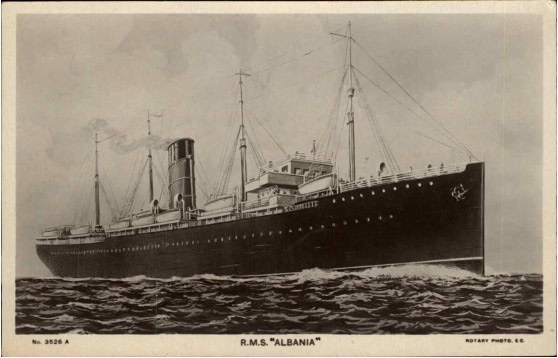
The eldest son, James William, born in January 1878, went to sea as a Marine Fireman and later Marine Engine Driver. He served many years in the merchant navy, earning a medal for wartime service. In 1925, he served aboard the SS Albania on a voyage to New York.
His personal life was complicated: he lived with Emily Elizabeth Clark, a Plumstead woman whose husband was in the Royal Navy, and had two sons with her before her husband died in the catastrophic November 1914 explosion of HMS Bulwark off Sheerness.
Emily Elizabeth Clark was herself a child of the Arsenal world: her father, John William Clark, had worked as a labourer in the Laboratory, the ammunition production arm of the complex, until his death in tragic circumstances in 1889, when Emily was eight. She grew up in Plumstead, married, was abandoned by her husband when he joined the Royal Navy, and was living with her children when James William entered her life.
James married Emily the month after her first husband’s death in late 1914. He outlived her—she died in Lambeth in 1952, and James himself died the following year at the age of seventy-five.
Emily May Newrick 1879-1969
Emily May, the second child and eldest daughter of Charles and Mary, was born in July 1879. In 1901, she had left Plumstead and worked as a nurse in a household in Leyton. In 1921, she was working as a private nurse for Colonel W. W. Chitty, an Indian Army officer who commanded the 119th Infantry of the Indian Expeditionary Force (The Mooltan Regiment) in the First World War. The Chittys lived at a fashionable address; Lansdown Crescent, Notting Hill.
In the 1920s, Emily travelled widely, appearing on P&O and Blue Funnel Line passenger lists to India, South Africa, and Japan, always listed as a nurse. A second-class passage to Bombay in 1923 cost about thirty-two pounds, a significant sum for a nurse, which suggests these were working voyages. Her trip to Yokohama, a hub for British expatriates, may have meant caring for a naval or colonial family. Emily never married. In the 1950s, after decades in London, she moved to Sussex and died in Chichester in January 1969, aged eighty-nine, outliving most of her siblings.
Edith Newrick 1884-1921
Edith, born in 1884, married David Vince in 1921. David, born on 16 October 1885 at East Wickham Road, Welling, was the son of Job Vince, a general labourer, and Esther Emma, née Harris. That same year, 1921, the couple were living at 10 Graham Road, Bexleyheath, with their young son, George Frederick. Prior to the First World War, David had worked as a nurseryman and was listed as a labourer in 1921. By 1939, he had become a Naval Ordnance Examiner—a role connecting him, occupationally, to the world of armaments and inspection that had defined Edith’s father’s career at the Royal Gun Factory. By 1939, Edith was a patient at the Kent County Mental Hospital in Maidstone. Her mother, Mary, had herself been briefly admitted to Cane Hill in 1890.
Charles Hiles Newrick 1887-1952
Charles Hiles Newrick, born in 1887 to Charles and Mary, enlisted in the Royal Navy at Portsmouth in April 1905, aged seventeen. His long career spanned both world wars; he served aboard Impregnable, St George, Victory I, Bellerophon, Agamemnon, Venerable, and others. He advanced from Ordinary Seaman to Leading Seaman and passed his Petty Officer exam in March 1909.
He served in the First World War and, in January 1920, transferred to the Royal Australian Navy. In 1930, he married Ann Elizabeth Lyall, an Australian, in Victoria and settled at HMAS Cerberus, the RAN’s main training base. He served through the Second World War and was discharged as a Petty Officer in 1947. Ann died in September that year. Charles died in Heidelberg, Victoria, in 1952 at sixty-five, and was buried at Springvale.
Frederick Arthur Newrick 1889-1915
Frederick Arthur, born in January 1889, also went to sea, but as an engineer rather than a deck or engine-room rating. By July 1915, he held the specialist role of First Refrigerating Engineer aboard the SS Durham, a London-registered vessel making a voyage from Southampton to Sydney. By August 1919, he was rated as Second Engineer. In June 1924, he was serving as Acting Engineer aboard the SS Hororata of the New Zealand Shipping Company, which arrived in New York from Newcastle. By 1934, his Continuous Certificate of Discharge again listed him as Second Engineer, on the SS British Hussar. Frederick married Florence Hardy in 1913, and they had two children, Queenie and Frederick. He died in 1984 in Hastings, Sussex, at the age of ninety-five.
Irwin Owen Newrick 1892-1915
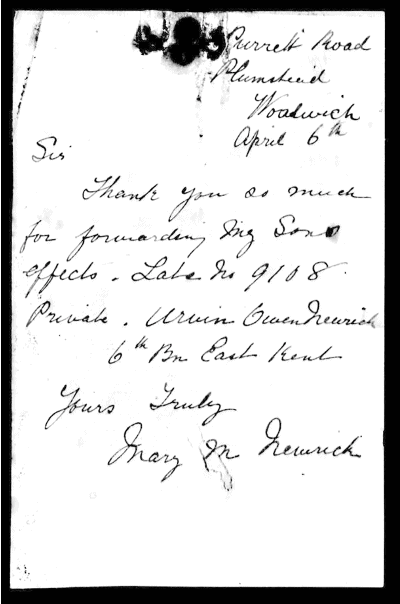
Irwin Owen Newrick, born in 1892, enlisted as a Special Reservist at Woolwich in February 1908, giving his trade as Electrical Engineer. He served with the 6th Battalion, The Buffs (East Kent Regiment), as Private L/9108. Before the First World War, he saw postings to India and Singapore; after the war broke out, he returned to England in 1914 and was posted to France with the British Expeditionary Force. He died on 9 November 1915. He has no known grave and is commemorated on the Loos Memorial, Panels 15-19. In April 1916, his mother, Mary, wrote to the War Office to acknowledge receipt of his effects, signing herself Mary M. Newrick of 36 Purrett Road.
Harold Newrick 1895-1915
Harold, born in 1895, served as Gunner 40955 in the Royal Garrison Artillery, 108th Heavy Battery. During the First World War, he was wounded in France and died of his wounds on 24 May 1915, six months before his brother. On 9 July 1915, Mary wrote to the War Office asking which hospital Harold was in, as she had heard nothing since a report dated 7 June. She did not yet know he was dead. He is buried at Bailleul Communal Cemetery Extension, Nord, grave I. F. 88.
George Newrick 1894-1968
George, my great-grandfather, was born in April 1894 and worked as an engineer. He started with Vickers and later worked at Woolwich Arsenal. In the late 1930s, he moved north to help establish the new Royal Ordnance Factory at Blackburn, a wartime armaments facility of strategic importance. He was awarded the MBE in the 1958 New Year Honours for his work there. He married Rose Ann Mayes in April 1915, the same spring Harold died of his wounds. They had four children: George, Joyce, Margaret Rose, and Brenda. George died in Blackburn on 25 January 1968, aged seventy-three. My mother Yvonne Newrick recalled that he enjoyed repairing watches and clocks, which seems a fitting hobby for a man who, as his son, my Grandfather, told me, ‘could work to the very tightest of tolerances’.
Richard Oswald Newrick 1897-1961
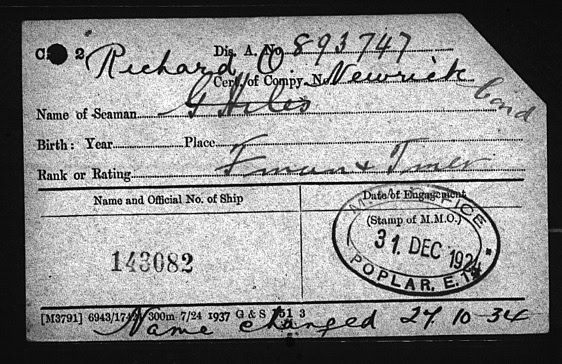
Richard Oswald enlisted in the Royal Field Artillery and served in France starting in 1915, the year both his brothers Irwin and Harold were killed. In 1917, he was listed as a deserter. Somehow, he reached a port, joined the merchant marine under the name George Hiles (using his mother’s maiden name), and went to sea. In 1934, he resumed his birth name and continued his maritime career through the 1930s. He later returned to Plumstead, dying there on 24 May 1961 at the age of sixty-four. The date of his death matched Harold’s, forty-six years earlier.
Agnes Elizabeth Newrick 1900-1973
Agnes Elizabeth, the youngest surviving daughter, married Herbert Joseph Matthews at Greenwich Register Office on 1 January 1910 and settled in Wanstead, Essex. Herbert served in the First World War as a Sapper with the London Electrical Engineers, a specialist Royal Engineers unit, and was stood down from colours in March 1917. He returned safely, and the couple were still at Wanstead in 1939, Herbert working as a Stockbroker’s Clerk and serving as an ARP warden. They had two daughters, Agnes and Kathleen.
The Parents, Charles Owen and Mary
Charles Owen Newrick died in 1911, before the world war that would take two of his sons. Mary lived until 1935, long enough to have buried Irwin and Harold, to have seen Richard vanish into the sea under a borrowed name, and to have watched Frederick, Charles Hiles, and James William pursue their careers across the world’s oceans. Her letter, thanking the authorities for the return of Irwin Owen’s effects, was strikingly poignant. Mary died at seventy-seven. She was the last living member of a household that had scattered from Purrett Road to Hasting, Bailleul, Melbourne and Yokohama.
Researched and written by Nigel Williams. Charles Owen Newrick (1855–1911) was the writer’s great-great-grandfather.
