Introduction
Many families have a story that describes former prosperity or an aristocratic connection that isn’t exactly true but isn’t completely false, either. The ancestor who owned half the village, for example, turns out to have been the proprietor of a modest farm.
My grandmother ‘Grandma Williams’ (Gwendoline Frances 1903-1991) told my sister and me just such a story sometime in the early 1970s, when we were small children.
In it, our ancestor, The Squire of Nettlebed, had a wife named Annie Andrews and gambled and drank the family fortune away. He died penniless and was buried in a pauper’s grave. Grandma insisted that we would have been a wealthy family if he had been more abstemious and was strongly opposed to gambling.
I was curious about this, and after my father died in 1979, his brother, Uncle Peter, a large, loud man who never married, helped me search the graveyard in Nettlebed. We found nothing to confirm the story.
This is unsurprising, given there was never a squire in the family, and the man who died a pauper was not from Nettlebed. However, there were some facts behind my Grandmother’s story.
The Andrews
Frederick Andrews (my 3rd great-grandfather) appears to be the man who inspired the story. He had a wife called Ann, and he died as a pauper, having spent time in at least two Poorhouses. This is his story.
Frederick Andrews and his twin sister Ann were born in 1827 in Bucklebury, Berkshire, to George (b. 1796), a shoemaker, and Jane (b. 1806, née Lindsey).
His future wife was also named Ann (née Dinch). She came from the village of Ogbourne St. George, Wiltshire. They married in October 1847. Five generations of Dinch lived in the tiny Wiltshire village: Ann, her father, Edward, and three previous generations named John. John the Elder was born in 1706.
Ogbourne St. George is best known for its role in deceiving the Germans during World War II: the manor house’s address was used in a letter from a fictitious ‘Pam’ to an equally fictitious but also deceased ‘Major Martin’. The rationale was that ‘no German could resist the Englishness of such an address’.
Frederick and Ann Andrews had five children in 13 years: George (1848), Clara (1853), Emma, my 2nd great-grandmother (1855), William (1858), and Henry (1861).
In 1861, Frederick was working as a ‘Grocer and Poulter’, Ann as a charwoman, and his eldest son George was a 13-year-old errand boy. George would go on to work at the Huntley and Palmer Biscuit Factory in Reading for over 20 years.
Destitution
In 1871, Frederick was working as a ‘Servant Groom’. His son William was working as a Labourer at a Mill, and Henry was still at school.
Ann died in 1880. Where Frederick was on census night in 1881 is unknown, as he does not appear in the returns. What is certain is that within fifteen months he was in London, sick, and on the parish – as an inmate in the infirmary of Islington Workhouse. The record states: ‘Andrews, Frederick, aged 55, admitted 8 July 1882, discharged 20 July 1882. Twelve days.’ There is no ‘See old reg.’ against his name, which may mean it was his first time in the institution. Many entries above him have no leaving date but are marked ‘dead’.
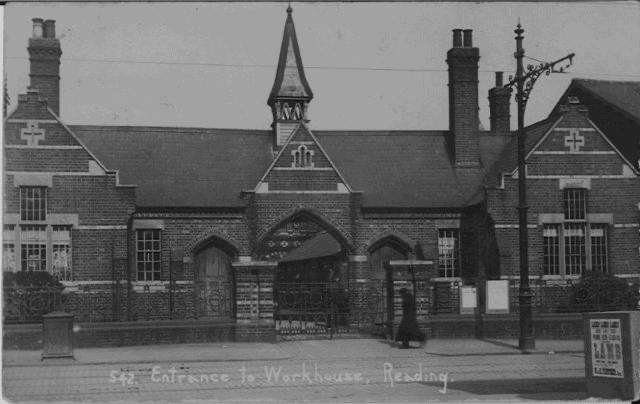
The census of 1891 finds Frederick in The Reading Union Workhouse. This opened in 1867 on Oxford Road in Reading, to consolidate several local parish poorhouses. It comprised receiving blocks, an infirmary and a fever block.
For its time, it was considered clean and well run, though the rule was that the conditions of the pauper relieved at public expense were that they should be ‘less eligible’ than those of the lowest-paid independent labourer. Eligible is used here in its older sense, meaning desirable or worth choosing.
Frederick was in Reading Union ten years later at the next census, in 1901. He died on the 10th June 1904, aged 76, once again, or still in the Workhouse, of cardiac disease and exhaustion. Whether he remained within its walls throughout all those years, or passed in and out of them, destitute, we do not know.
The Nettlebed Connection
Frederick Foster (1855-1942) married my 2nd-great-grandmother, Emma Andrews, in 1880. He was born in Nettlebed, as was his mother Emma Dyer (1819-1896). This is the connection to Nettlebed.
The Real Squire of Nettlebed
Ironically, there was a squire of Nettlebed who endured financial woes during Frederick Andrews’ life. 1894, the manor was bought from the ancestral owners, the Stonors, by H. H. Gardiner, a wealthy London businessman. He was forced to sell in less than a decade after suffering financial losses . Robert Fleming, the Scottish financier and grandfather of Ian Fleming, then bought the estate in 1903.
Bromley and Hackney Workhouses
As I did more research, I found that he was not the only ancestor to have resided in the workhouse.
James Smith (1807-1885), my 4th great-grandfather, an agricultural labourer, was in the Bromley Union Workhouse in 1881 and died there four years later.
Mary Turkington (1845-Bef.1911), my 3rd-great-aunt, was a soldier’s daughter born in South Africa. Her husband William Turkington (1843-1901) was one of the many men in the family tree who served in the Royal Artillery serving in China during the Second China War from Jan 1860 to April 1861.
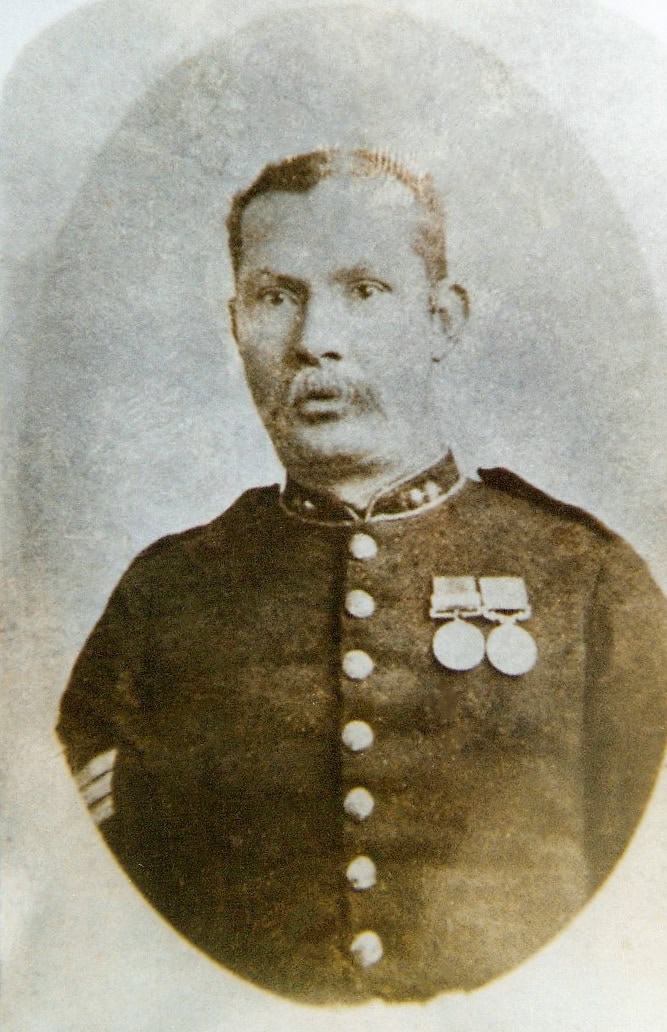
At the 1881 census, Mary and William were living in Streatham. Sometime between then and 1885, William and Mary appear to have separated, and she spent time in Hackney Workhouse in June 1885. In 1891 she was supporting herself by working as a dressmaker and living as a lodger without him. She had a further spell in Hackney Workhouse in March 1902.
From Workhouse to Hospital
Finally, I found that the vaccination records of my cousins in the Williams branch of the family from Usk, Wales, were in the Pontypool Union. This was beginning was the beginning of a transition of the institution from Poor Law workhouse to Panteg County Hospital and finally to a free NHS hospital in 1948.
Sources
- England, Select Births and Christenings, 1538–1975 (baptism, Bucklebury, Berkshire, 23 December 1827)
- England & Wales, Christening Index, 1530–1980
- 1841 England Census (Thatcham, Berkshire)
- London, England, Church of England Marriages and Banns, 1754–1938 (marriage to Ann Dench, St Sepulchre, London, 3 October 1847)
- England, Select Marriages, 1538–1973
- 1851 England Census (St Bartholomew the Great, Middlesex; lodger)
- 1861 England Census (St John, Greenham, Berkshire; grocer and poulterer)
- 1871 England Census (Greenham, St John the Evangelist, Berkshire; servant groom)
- London, England, Poor Law Hospital Admissions and Discharges, 1842–1918 (Islington workhouse infirmary, admitted 8 July 1882, discharged 20 July 1882)
- London, England, Workhouse Admission and Discharge Records, 1764–1921
- 1891 England Census (Reading Union Workhouse, Oxford Road, Reading; general labourer)
- 1901 England Census (Reading Union Workhouse, Reading)
- Death certificate, General Register Office (died Reading Union Workhouse, 10 June 1904, aged 76, cardiac disease and exhaustion)
- England & Wales, Civil Registration Death Index, 1837–1915
- England, Select Deaths and Burials, 1538–1991
- Web: UK, Burial and Cremation Index, 1576–2014 (burial, Reading, 14 June 1904)
- England & Wales, Civil Registration Death Index, 1837–1915 (Ann Andrews, 1880)
- Victoria County History, Oxfordshire, volume eighteen, Nettlebed (British History Online)
- Peter Higginbotham, The Workhouse: The Story of an Institution, workhouses.org.uk (Reading Union workhouse)
- British Medical Journal, report on Reading Union workhouse infirmary, 1894 (Nursing Commission on Provincial Workhouses
