James Frederick Newrick 1839–1896
Early Life and Family
James Frederick Newrick was born in 1839 in Durham to Nathaniel Aaron Newrick, a miller, and Charlotte (née Dawson Maddy), who was 24. James was baptised at the church of St. Mary The Less, which was founded in the 12th century as a garrison chapel for soldiers stationed on the nearby city walls.
The family lived in Durham Lane (1841) and South Johnson Street (1851), in Sunderland. Though his father was a miller, there were seafarers in the family through his Uncle Charles Newrick (1807-1858), who married Isabella Blythe in 1829. Her father, William Blythe (1788-1855), and brother, Robert Robson Blythe (1822), were both Master Mariners. William was also a shipowner.
Apprenticeship
James first appears in naval records in September 1855, when he was bound as an apprentice at the age of sixteen. This is the same route as Robert Robson Blythe took at the same age in 1838.
On 22 September 1855, he entered into a five-year indenture, enrolled at Sunderland, to serve aboard the vessel Margaret, a ship of about 247 tons. A vessel of that tonnage in the 1850s was modest in size by ocean-going standards, probably a brig or small barque, and crewed by about a dozen men. Ships like this commonly traded across the North Sea and Baltic, carrying coal outward and returning with timber, grain, or naval stores.
Apprenticeship was the recognised starting point for a serious maritime career: a period in which a boy learned the work of seamanship; handling sails and rigging, standing watches, learning shipboard routines, and gradually being introduced to the navigational knowledge that separated an ordinary sailor from a future officer.
James’s indenture expired in September 1860, by which time he would have been about twenty-one years old and ready to move beyond apprentice status into the ranks of fully competent seamen.
Sunderland
Sunderland in the 1850s was one of Britain’s most active shipbuilding and exporting ports. The River Wear was lined with yards constructing wooden brigs and barques, many engaged in the coal and Baltic trades. To be apprenticed there meant immediate immersion in a tough maritime environment shaped by North Sea crossings, timber imports from Scandinavia, and the outward coal trade from County Durham.
The years following the completion of his apprenticeship were the formative middle stage of his career. Between 1860 and 1865, he would have served as an able seaman and, increasingly, as a man being prepared for responsibility on deck.
These were the years in which he accumulated the sea time and experience required under the Merchant Shipping Act framework to present himself for examination. Promotion in the merchant service was not automatic: advancement depended on proven competence, recorded service, and success in formal testing.
Transition to Officer
By January 1865, at about twenty-five or twenty-six years of age, James had achieved a major professional milestone. On 14 January 1865, the Board of Trade issued him a Certificate of Competency as Second Mate. This qualification marked his transition from the forecastle into the officer ranks.
The Second Mate was a navigational officer responsible for watchkeeping, assisting with chartwork, and taking on duties that required literacy, numeracy, and technical skills. His certificate was formally entered into the General Register and Record Office of Seamen two days later, confirming his standing within the official national system of certificated merchant officers.
Shortly after his promotion, James married Julia Lewis at St George in the East, located in the docklands fringe, close to the River Thames, London, on 11 April 1866.
First Mate
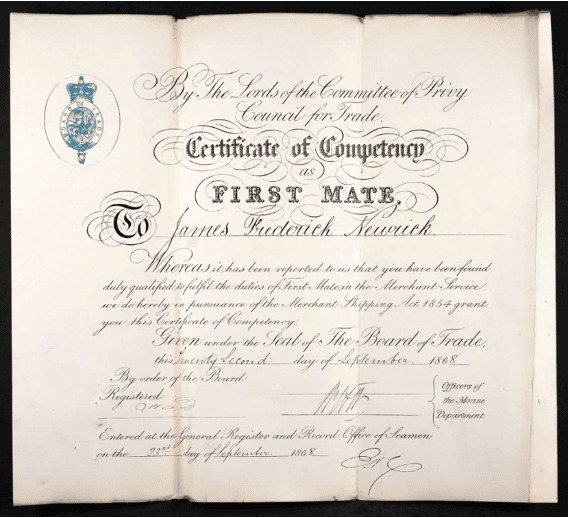
James continued his upward progress over the next three years. Having served as a Second Mate and gained further experience, he advanced again through examination and certification. On 22 September 1868, the Board of Trade granted him a Certificate of Competency as First Mate, which was entered in the register the following day. This was an even higher rank, placing him as the chief officer under the master.
A First Mate carried major responsibility for the ship’s daily management, discipline, cargo operations, and the safe running of the vessel, and was legally qualified to assume command if required.
By 1871, James and his wife Julia were living with Julia’s mother in Poplar, London.
Final Chapter – The Dreadnought Seaman’s Hospital
In the final months of his life, James Frederick Newrick reappears in the records of the Dreadnought Seamen’s Hospital at Greenwich, the institution for the care of merchant sailors arriving in the Port of London. Set against the backdrop of the Royal Naval College and the great river traffic of steamers and sailing vessels, it was a familiar institution to seafarers of every rank.
From1821-1870, the Dreadnought was a floating hospital, based in three successive converted warships, one of which, HMS Dreadnought, veteran of the battle of Trafalgar, gave the hospital its name. It then moved onto land and, until 1986, occupied the buildings that are now a student hub for the University of Greenwich.
By May 1896, he was fifty-seven years old. An admission on 9 May 1896 records him as “James Fred Newrick,” aged 57, born about 1839 in England. A second entry, dated 2 June 1896, refines his birthplace to Durham.
The Dreadnought treated seamen who were currently serving or who could demonstrate a legitimate connection to the merchant marine. His admission there therefore confirms that, more than forty years after being bound apprentice in 1855, he was still recognised within the maritime system.
At the time of his admission, James was serving as an Able Seaman on the Loch Lomond, a coastal role on a Glasgow-registered barge owned by Aitken Lilburn & Co. Seafarers often continued in the short-sea and coastal trades as they aged.
Death
The hospital records his illness as “Abd. Aneurysm” (Abdominal aortic aneurysm, a dilation and eventual rupture of the main abdominal artery). This condition was uncommon but recognised in late Victorian medical practice, particularly among older men engaged in physically demanding occupations. In 1896, there was no effective surgical treatment, and rupture was often fatal. James died at the Seaman’s Hospital on 20 June 1896.
More than forty years after beginning his apprenticeship aboard the Margaret in Sunderland, he remained part of the merchant marine system, his working life concluding under the care of the seamen’s hospital at Greenwich.
Sources
- 1841 England Census (Bishopwearmouth, Durham)
- 1851 England Census (Bishopwearmouth, Durham)
- 1871 England Census (All Saints, Poplar, London)
- England, Select Births and Christenings, 1538–1975 (baptism, St. Mary-the-Less, Durham, 23 June 1839)
- England & Wales, Civil Registration Birth Index, 1837–1915
- England & Wales, Civil Registration Marriage Index, 1837–1915
- London, England, Church of England Marriages and Banns, 1754–1938 (marriage to Julia Lewis, St George in the East, 11 April 1866)
- England & Wales, Civil Registration Death Index, 1837–1915
- UK, Apprentices Indentured in Merchant Navy, 1824–1910 (indenture, Sunderland, 22 September 1855, the Margaret)
- UK and Ireland, Masters and Mates Certificates, 1850–1927 (Certificate of Competency, Second Mate, 14 January 1865)
- UK and Ireland, Masters and Mates Certificates, 1850–1927 (Certificate of Competency, First Mate, 22 September 1868)
- England, Dreadnought Seamen’s Hospital Admissions and Discharges, 1826–1930 (admission, 9 May 1896)
- England, Dreadnought Seamen’s Hospital Admissions and Discharges, 1826–1930 (admission, 2 June 1896)
- UK and Ireland, Find a Grave Index, 1300s–Current
- Web: UK, Burial and Cremation Index, 1576–2014 (burial, Greenwich)
- Ancestry Family Tree
Researched by Nigel Williams.
James Frederick Newrick was the writer’s 1st cousin 5 times removed.
